QUESTION IMAGE
Question
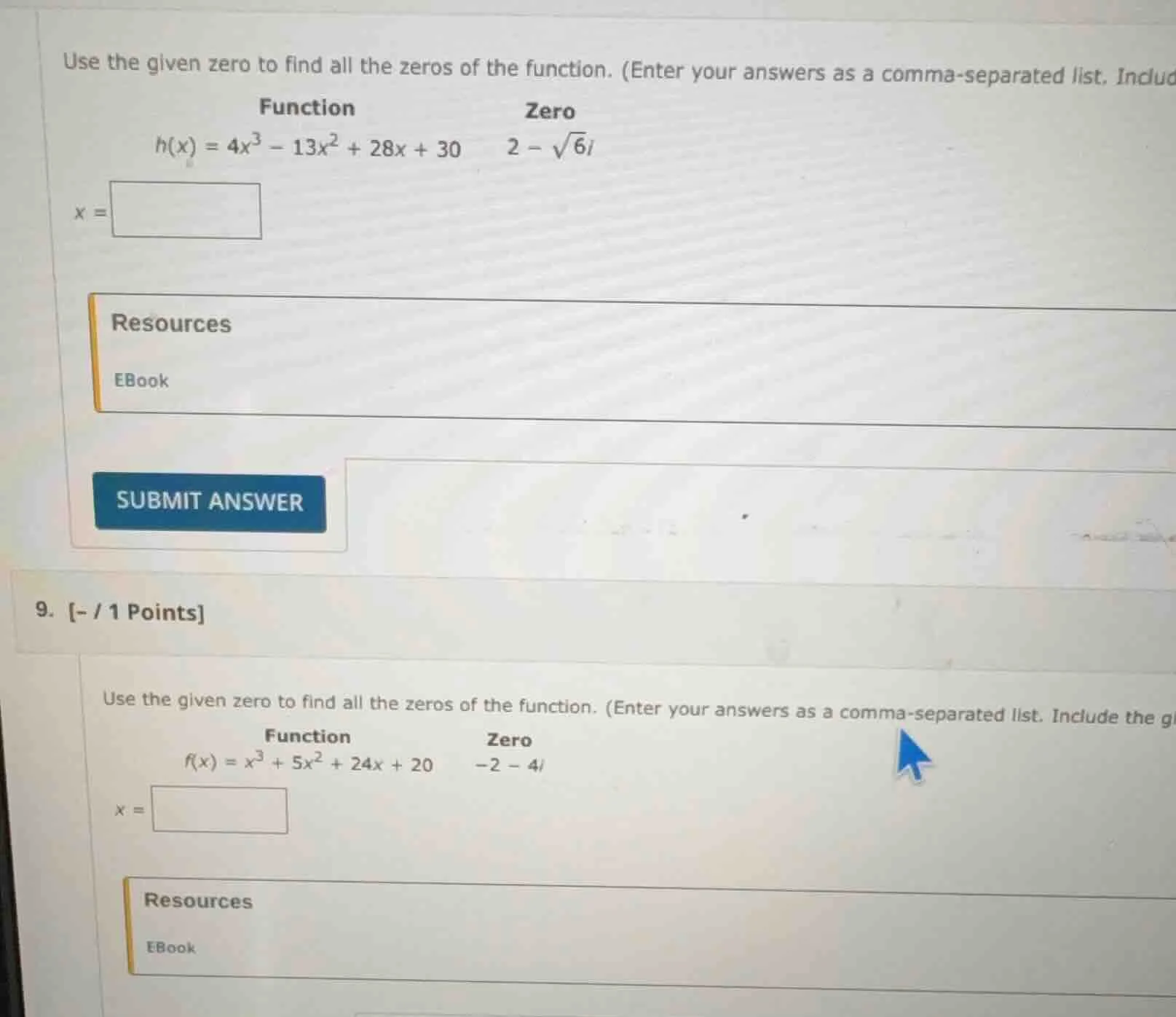
use the given zero to find all the zeros of the function. (enter your answers as a comma-separated list. indudfunction$h(x) = 4x^3 - 13x^2 + 28x + 30$zero$2 - \sqrt{6}iLXB0x = \square$resourcesebook
---
For \(h(x) = 4x^3 - 13x^2 + 28x + 30\)
Step1: Identify conjugate zero
By the Complex Conjugate Root Theorem, if \(2-\sqrt{6}i\) is a zero, then \(2+\sqrt{6}i\) is also a zero.
Step2: Form quadratic factor
Multiply the linear factors for the conjugate zeros:
\[
\]
Step3: Divide polynomial by quadratic
Divide \(4x^3 -13x^2 +28x +30\) by \(x^2-4x+10\):
Using polynomial long division or synthetic division, we get \(4x + 3\). Set this equal to 0:
\(4x+3=0 \implies x=-\frac{3}{4}\)
---
For \(f(x) = x^3 + 5x^2 + 24x + 20\)
Step1: Identify conjugate zero
By the Complex Conjugate Root Theorem, if \(-2-4i\) is a zero, then \(-2+4i\) is also a zero.
Step2: Form quadratic factor
Multiply the linear factors for the conjugate zeros:
\[
\]
Step3: Divide polynomial by quadratic
Divide \(x^3 +5x^2 +24x +20\) by \(x^2+4x+20\):
Using polynomial long division or synthetic division, we get \(x + 1\). Set this equal to 0:
\(x+1=0 \implies x=-1\)

Snap & solve any problem in the app
Get step-by-step solutions on Sovi AI
Photo-based solutions with guided steps
Explore more problems and detailed explanations
For \(h(x) = 4x^3 - 13x^2 + 28x + 30\): \(2-\sqrt{6}i, 2+\sqrt{6}i, -\frac{3}{4}\)
For \(f(x) = x^3 + 5x^2 + 24x + 20\): \(-2-4i, -2+4i, -1\)