QUESTION IMAGE
Question
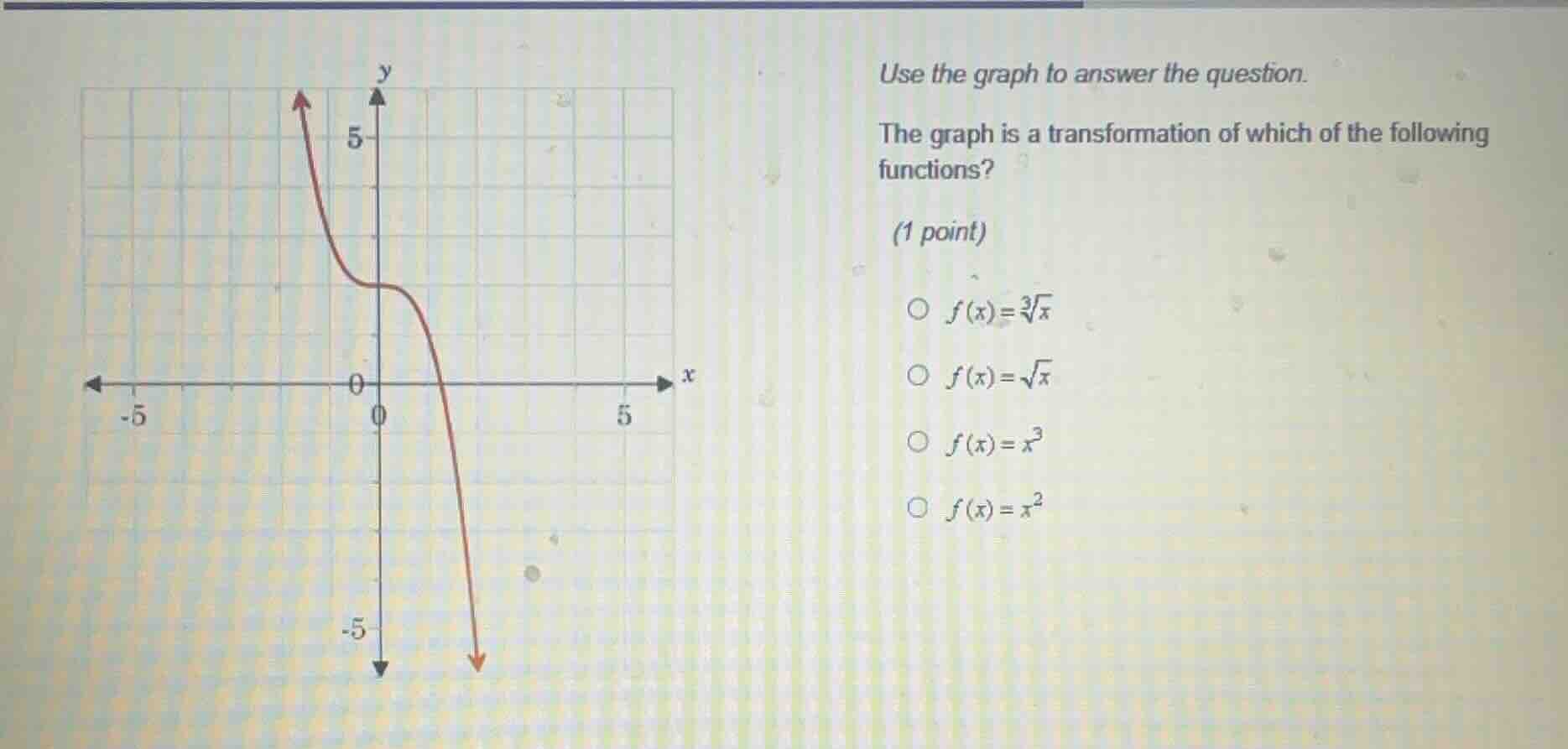
use the graph to answer the question. the graph is a transformation of which of the following functions? (1 point) \\(\bigcirc\\ f(x)=\sqrt3{x}\\) \\(\bigcirc\\ f(x)=\sqrt{x}\\) \\(\bigcirc\\ f(x)=x^3\\) \\(\bigcirc\\ f(x)=x^2\\)
Brief Explanations
- Analyze the domain of the graphed function: it exists for all real numbers (positive, negative, zero), matching $f(x)=\sqrt[3]{x}$ and $f(x)=x^3$, but not $f(x)=\sqrt{x}$ (only non-negative $x$) or $f(x)=x^2$ (symmetric over y-axis, no negative $y$ for positive $x$).
- Analyze the end behavior: as $x\to+\infty$, $y\to-\infty$; as $x\to-\infty$, $y\to+\infty$. This matches the reversed end behavior of $f(x)=x^3$ (which has $x\to+\infty, y\to+\infty$; $x\to-\infty, y\to-\infty$), indicating a reflection transformation. The cube root function $f(x)=\sqrt[3]{x}$ has end behavior $x\to+\infty, y\to+\infty$; $x\to-\infty, y\to-\infty$, which does not match the graph's downward trend on positive $x$.
- Confirm the shape: the graph has the characteristic S-curve of a cubic function, transformed (reflected and possibly shifted), which aligns with $f(x)=x^3$ as the parent function.

Snap & solve any problem in the app
Get step-by-step solutions on Sovi AI
Photo-based solutions with guided steps
Explore more problems and detailed explanations
$\boldsymbol{f(x)=x^3}$