QUESTION IMAGE
Question
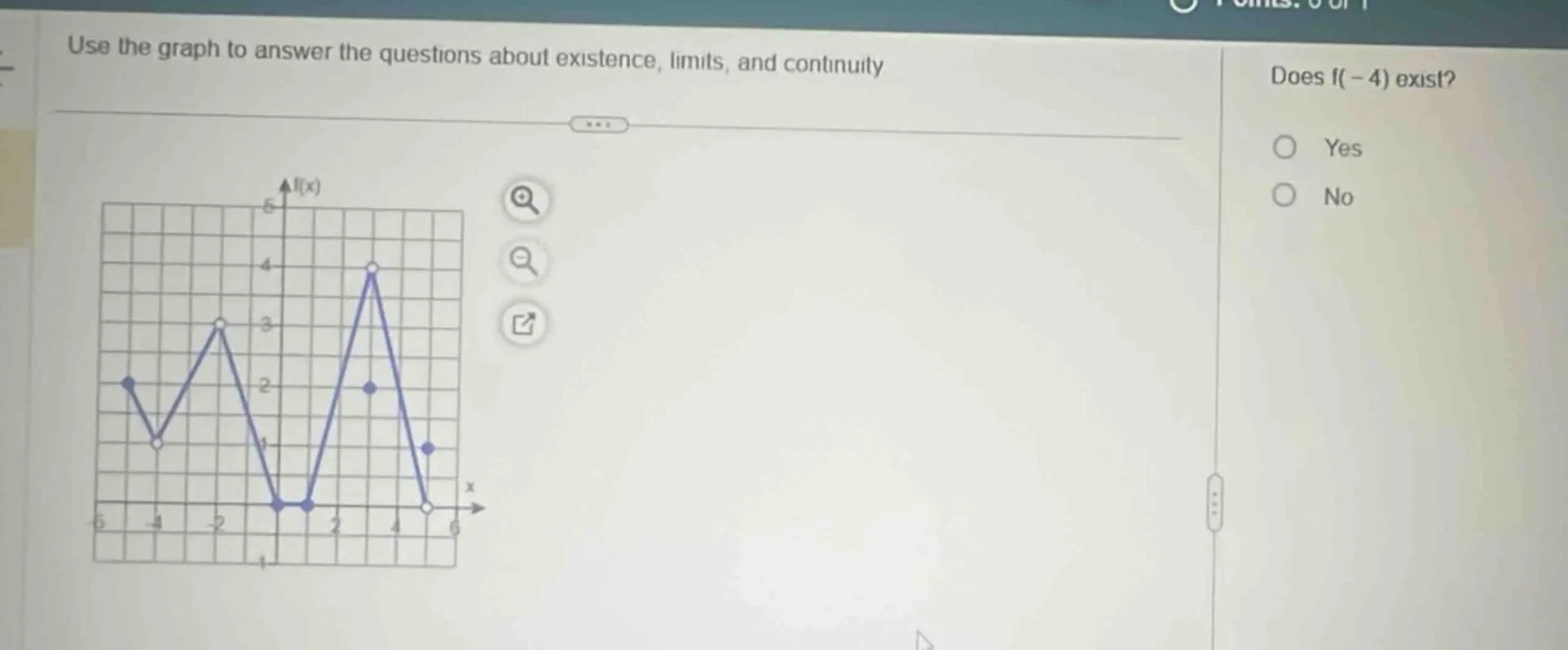
use the graph to answer the questions about existence, limits, and continuity
does f(-4) exist?
yes
no
To determine if \( f(-4) \) exists, we look at the graph at \( x = -4 \). A function value exists at a point if there is a defined point (a solid dot or a clear indication of a value) at that \( x \)-coordinate. At \( x = -4 \), there is an open circle, but wait—wait, no, wait. Wait, actually, looking at the graph, at \( x = -4 \), the point is an open circle? Wait, no, let's check again. Wait, the graph: at \( x = -4 \), the point is an open circle? Wait, no, maybe I misread. Wait, the graph has a point at \( x = -4 \)? Wait, no, the open circle is at \( x = -4 \)? Wait, no, let's look at the coordinates. The \( x \)-axis: -6, -4, -2, 0, 2, 4, 6. At \( x = -4 \), the graph has an open circle (hollow dot) at \( y = 1 \)? Wait, no, wait the blue dots: at \( x = -5 \) (maybe -6? Wait, the grid: each square is 1 unit. So at \( x = -4 \), the graph has an open circle (hollow) at \( y = 1 \)? Wait, no, maybe I made a mistake. Wait, the question is: Does \( f(-4) \) exist? A function value \( f(a) \) exists if there is a point (either a solid dot or a defined point) at \( x = a \). If there is an open circle, that means the function is not defined there (or has a discontinuity, but the existence is about whether the point is defined). Wait, but in the graph, at \( x = -4 \), is there a solid dot? Wait, looking at the graph again: the leftmost solid dot is at \( x = -5 \) (maybe -6? Wait, the first solid dot is at \( x = -5 \) (assuming the grid is from -6 to 6, each unit). Then at \( x = -4 \), there is an open circle (hollow) at \( y = 1 \)? Wait, no, maybe I'm misinterpreting. Wait, the problem is: the graph—let's see, the \( x \)-axis: -6, -4, -2, 0, 2, 4, 6. At \( x = -4 \), the graph has an open circle (hollow) at \( y = 1 \), and a solid dot at \( x = -5 \) (or \( x = -6 \)?) with \( y = 2 \). Wait, no, maybe the open circle is at \( x = -4 \), but is there a solid dot? Wait, no, the key is: a function value \( f(-4) \) exists if the point \( (-4, f(-4)) \) is on the graph (i.e., there is a solid dot or a defined point). If it's an open circle, that means the function is not defined there (the limit might exist, but the function value doesn't). Wait, but wait—maybe I made a mistake. Wait, the graph: let's check the coordinates again. The blue line: at \( x = -5 \) (or \( x = -6 \)?), there's a solid dot at \( y = 2 \). Then at \( x = -4 \), there's an open circle at \( y = 1 \). Then at \( x = -2 \), there's a solid dot at \( y = 3 \)? Wait, no, the open circle is at \( x = -2 \)? Wait, no, the graph is a bit confusing. Wait, the problem is: Does \( f(-4) \) exist? Let's recall: in a graph, a solid dot means the function is defined at that point (the \( y \)-value is the function value), an open dot means the function is not defined there (or has a different value). So if at \( x = -4 \), there is an open dot, then \( f(-4) \) does not exist? Wait, but wait, maybe I'm looking at the wrong point. Wait, the user's graph: the leftmost solid dot is at \( x = -5 \) (assuming \( x = -5 \) is the first solid dot) with \( y = 2 \). Then at \( x = -4 \), there's an open circle (hollow) at \( y = 1 \). Then at \( x = -2 \), there's an open circle at \( y = 3 \), and a solid dot at \( x = -1 \) (or 0?) with \( y = 0 \). Wait, maybe the open circle at \( x = -4 \) is a discontinuity, but the function value \( f(-4) \) would exist only if there's a solid dot. Wait, but maybe I'm wrong. Wait, the answer options are Yes or No. Let's think again: the existence of \( f(-4) \) is about whether the function has a value at \( x = -4 \). If the graph has…

Snap & solve any problem in the app
Get step-by-step solutions on Sovi AI
Photo-based solutions with guided steps
Explore more problems and detailed explanations
No (the option is "No")