QUESTION IMAGE
Question
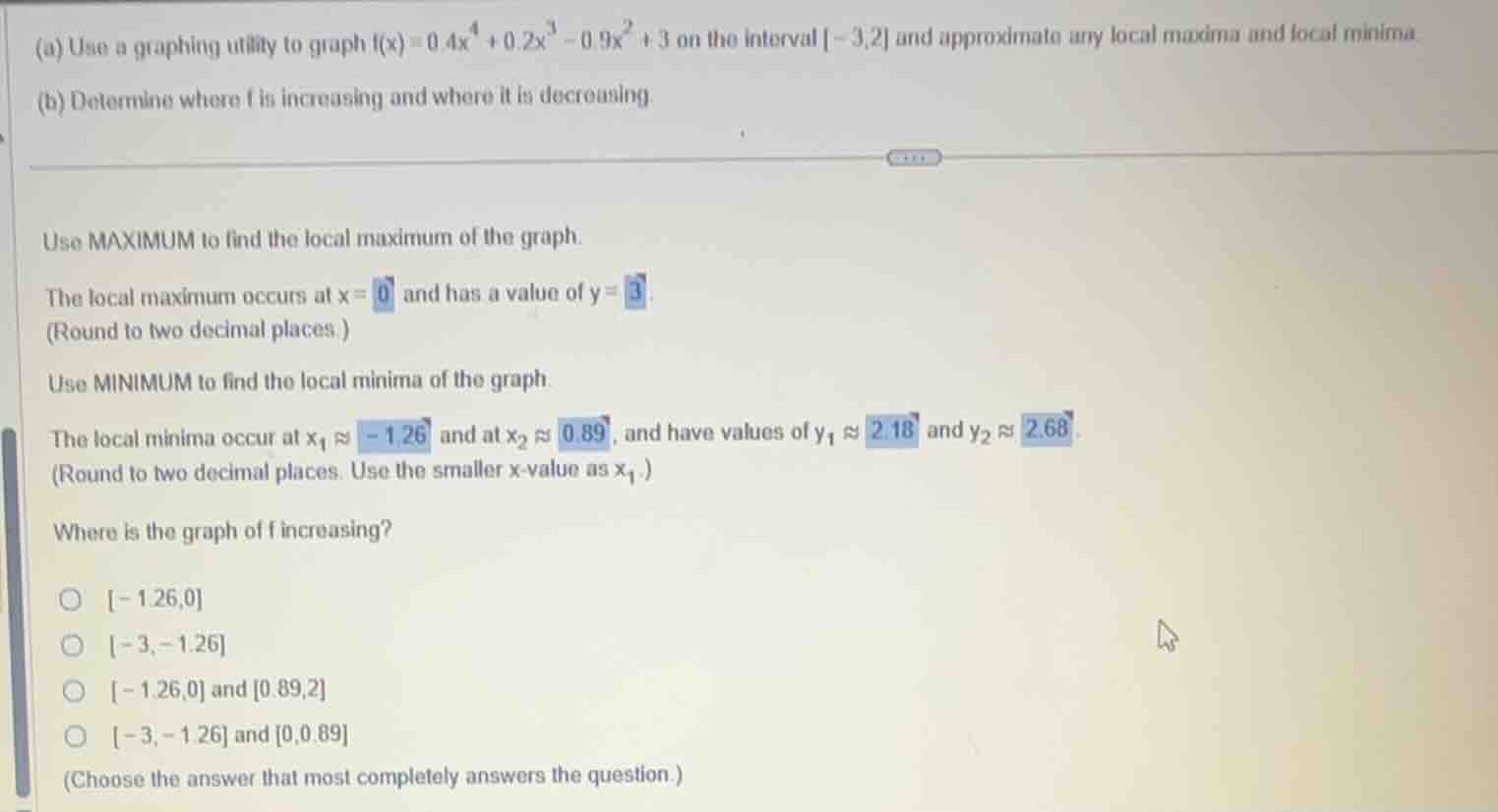
(a) use a graphing utility to graph ( f(x) = 0.4x^4 + 0.2x^3 - 0.9x^2 + 3 ) on the interval (-3, 2) and approximate any local maxima and local minima. (b) determine where ( f ) is increasing and where it is decreasing. use maximum to find the local maximum of the graph. the local maximum occurs at ( x = 0 ) and has a value of ( y = 3 ). (round to two decimal places.) use minimum to find the local minima of the graph. the local minima occur at ( x_1 approx -1.26 ) and at ( x_2 approx 0.89 ), and have values of ( y_1 approx 2.18 ) and ( y_2 approx 2.68 ). (round to two decimal places. use the smaller ( x )-value as ( x_1 ).) where is the graph of ( f ) increasing? ( \bigcirc -1.26, 0 ) ( \bigcirc -3, -1.26 ) ( \bigcirc -1.26, 0 ) and ( 0.89, 2 ) ( \bigcirc -3, -1.26 ) and ( 0, 0.89 ) (choose the answer that most completely answers the question.)
Step1: Recall increasing interval rules
A function increases when its output rises as input increases, which occurs between a local minimum and the next local maximum, or from the start of the domain to a first local maximum, or from a final local minimum to the end of the domain.
Step2: Use given extrema points
We have local minima at $x \approx -1.26$ and $x \approx 0.89$, local maximum at $x=0$, on interval $[-3,2]$.
- From $x=-3$ to $x=-1.26$: function decreases (toward the first local minimum).
- From $x=-1.26$ to $x=0$: function increases (toward the local maximum).
- From $x=0$ to $x=0.89$: function decreases (toward the second local minimum).
- From $x=0.89$ to $x=2$: function increases (toward the end of the interval).

Snap & solve any problem in the app
Get step-by-step solutions on Sovi AI
Photo-based solutions with guided steps
Explore more problems and detailed explanations
[-1.26,0] and [0.89,2]