QUESTION IMAGE
Question
use the image to answer the question.
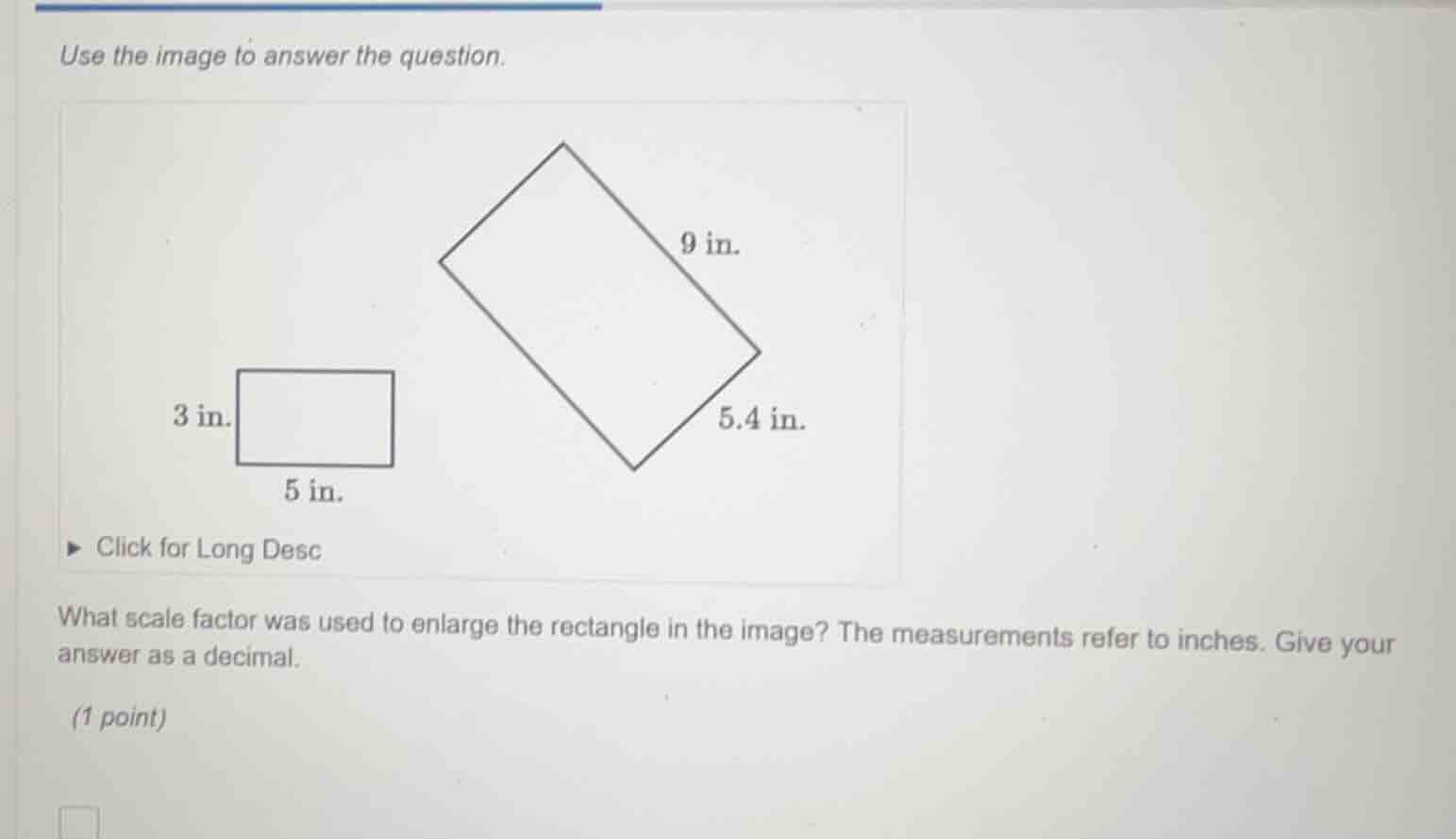
(image of two rectangles: smaller one with height 3 in. and width 5 in.; larger one with sides 9 in. and 5.4 in.)
click for long desc
what scale factor was used to enlarge the rectangle in the image? the measurements refer to inches. give your answer as a decimal.
(1 point)
Step1: Identify corresponding sides
The original rectangle has sides 3 in (height) and 5 in (length). The enlarged rectangle has sides 9 in (corresponding to 3 in) and 5.4 in (corresponding to 5 in). We can use either pair to find the scale factor. Let's use the height: original height = 3 in, enlarged height = 9 in.
Step2: Calculate scale factor
Scale factor = enlarged length / original length. Using height: $ \frac{9}{3} = 3$? Wait, no, wait, maybe I mixed up. Wait, the other side: original length 5 in, enlarged length 5.4? Wait, no, wait the image: the small rectangle is 3 in (height) and 5 in (length). The large rectangle: one side is 9 in (maybe corresponding to 3 in? No, wait 33=9, but 51.08=5.4? Wait no, maybe I got the corresponding sides wrong. Wait, maybe the small rectangle's height is 3, and the large rectangle's corresponding side is 9? No, 33=9, but 51.08=5.4? That can't be. Wait, maybe the small rectangle's length is 5, and the large rectangle's corresponding length is 5.4? No, that would be a reduction. Wait, no, the large rectangle is the enlarged one. Wait, maybe the small is original, large is enlarged. So original: 3 in (height) and 5 in (length). Enlarged: let's see, the large rectangle has sides 9 in and 5.4 in. Wait, 3 3 = 9, 5 1.08 = 5.4? No, that's inconsistent. Wait, maybe I mixed up the sides. Wait, maybe the small rectangle's height is 3, and the large rectangle's height is 9? Then scale factor is 9/3 = 3. But then the length should be 53=15, but it's 5.4. So that's wrong. Wait, maybe the small rectangle's length is 5, and the large rectangle's length is 5.4? No, that's a scale factor of 5.4/5=1.08, but then the height should be 31.08=3.24, but it's 9. So that's wrong. Wait, maybe the small rectangle's height is 3, and the large rectangle's length is 9? No, that's not corresponding. Wait, maybe the image is rotated, so the sides correspond as: small rectangle: 3 (height) and 5 (length); large rectangle: 9 (length) and 5.4 (height)? Wait, no, height and length are just labels. Let's take the two pairs: original side 3, enlarged side 9: scale factor 9/3=3. Original side 5, enlarged side 5.4: 5.4/5=1.08. That's a problem. Wait, maybe I misread the image. Wait, the small rectangle: 3 in (height) and 5 in (length). The large rectangle: one side is 9 in, the other is 5.4 in. Wait, maybe the small rectangle's height is 3, and the large rectangle's height is 5.4? No, 31.8=5.4, and 51.8=9. Ah! There we go. I had the sides reversed. So original height: 3 in, enlarged height: 5.4 in? No, wait 31.8=5.4, and 51.8=9. Yes! So original: 3 (height) and 5 (length). Enlarged: 5.4 (height) and 9 (length). So scale factor is 5.4/3 = 1.8, or 9/5 = 1.8. Yes, that works. So I had the sides reversed. So original height: 3 in, enlarged height: 5.4 in? No, 31.8=5.4, and 51.8=9. So the scale factor is 1.8. Let's check: 3 1.8 = 5.4, 5 1.8 = 9. Yes! So I had the sides of the large rectangle reversed. So the large rectangle's sides are 9 in (length, corresponding to original length 5 in) and 5.4 in (height, corresponding to original height 3 in). So scale factor is 9/5 = 1.8, or 5.4/3 = 1.8. So that's the scale factor.

Snap & solve any problem in the app
Get step-by-step solutions on Sovi AI
Photo-based solutions with guided steps
Explore more problems and detailed explanations
1.8