QUESTION IMAGE
Question
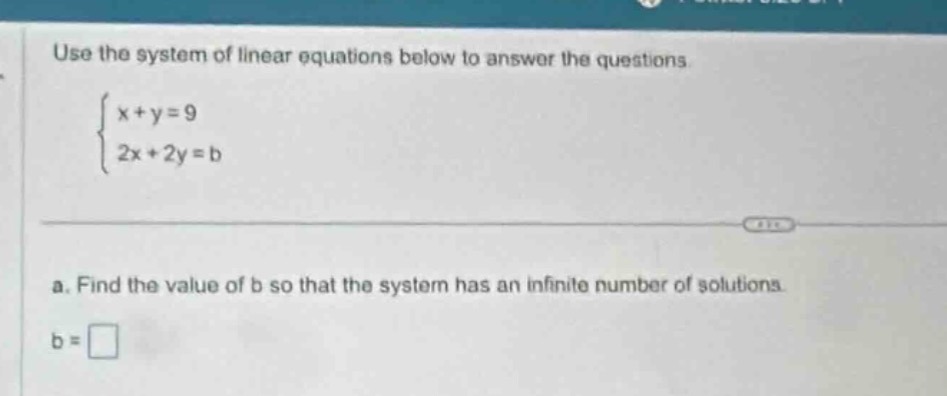
use the system of linear equations below to answer the questions
\
a. find the value of b so that the system has an infinite number of solutions.
b = \square
Step1: Recall the condition for infinite solutions
For a system of linear equations \(
\) to have infinite solutions, the two equations must be scalar multiples of each other, i.e., \(\frac{a_1}{a_2}=\frac{b_1}{b_2}=\frac{c_1}{c_2}\).
Step2: Analyze the given system
The given system is \(
\). Here, \(a_1 = 1\), \(b_1 = 1\), \(c_1 = 9\) and \(a_2 = 2\), \(b_2 = 2\), \(c_2 = b\).
First, check the ratio of coefficients of \(x\) and \(y\): \(\frac{a_1}{a_2}=\frac{1}{2}\) and \(\frac{b_1}{b_2}=\frac{1}{2}\). For infinite solutions, \(\frac{c_1}{c_2}\) must also be \(\frac{1}{2}\).
So, \(\frac{9}{b}=\frac{1}{2}\). Cross - multiplying gives \(b = 9\times2\).
Step3: Calculate the value of b
\(b = 18\). We can also observe that the second equation \(2x + 2y=b\) can be simplified by dividing throughout by 2, which gives \(x + y=\frac{b}{2}\). For the two equations \(x + y = 9\) and \(x + y=\frac{b}{2}\) to be the same (so that they have infinite solutions), \(\frac{b}{2}=9\), which implies \(b = 18\).

Snap & solve any problem in the app
Get step-by-step solutions on Sovi AI
Photo-based solutions with guided steps
Explore more problems and detailed explanations
\(b = 18\)