QUESTION IMAGE
Question
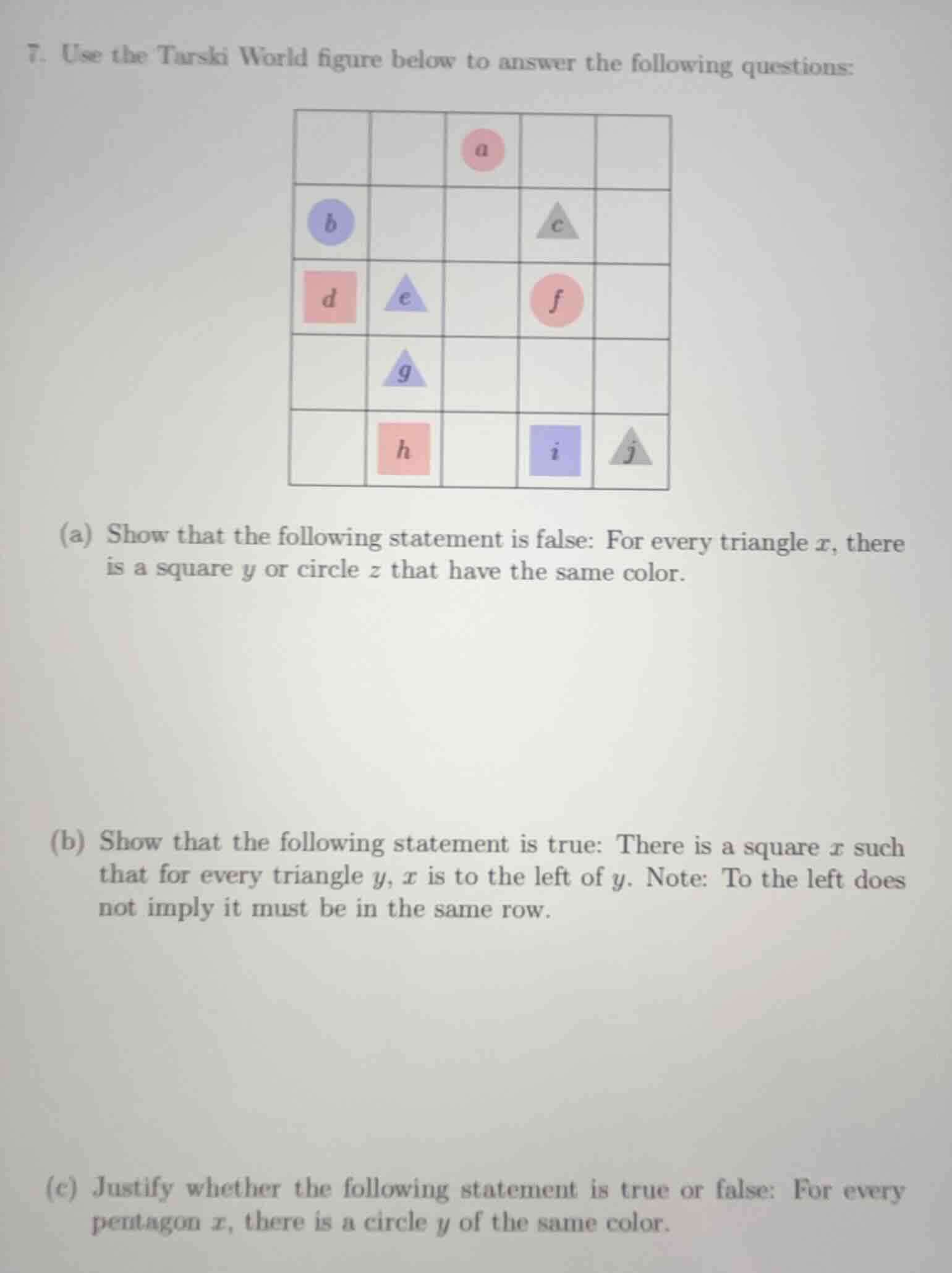
- use the tarski world figure below to answer the following questions:
(a) show that the following statement is false: for every triangle ( x ), there is a square ( y ) or circle ( z ) that have the same color.
(b) show that the following statement is true: there is a square ( x ) such that for every triangle ( y ), ( x ) is to the left of ( y ). note: to the left does not imply it must be in the same row.
(c) justify whether the following statement is true or false: for every pentagon ( x ), there is a circle ( y ) of the same color.
Part (a)
To show the universal statement is false, find a counterexample: a triangle with no matching square/circle. Triangle $c$ (gray) has no gray squares or circles in the Tarski World.
Part (b)
To prove the existential statement is true, find one square that is left of all triangles. Square $d$ is in column 1; all triangles ($c,e,g,j$) are in columns 2-5, so $d$ is left of every triangle.
Part (c)
Check if all pentagons have a matching circle. There are no pentagons in the Tarski World. A universal statement about an empty set is vacuously true.

Snap & solve any problem in the app
Get step-by-step solutions on Sovi AI
Photo-based solutions with guided steps
Explore more problems and detailed explanations
(a) The statement is false. Triangle $c$ (gray) has no square or circle of the same color, serving as a counterexample.
(b) The statement is true. Square $d$ is in column 1, and all triangles ($c,e,g,j$) are in columns 2-5, so $d$ is to the left of every triangle.
(c) The statement is true. There are no pentagons in the Tarski World, so the universal claim holds vacuously.