QUESTION IMAGE
Question
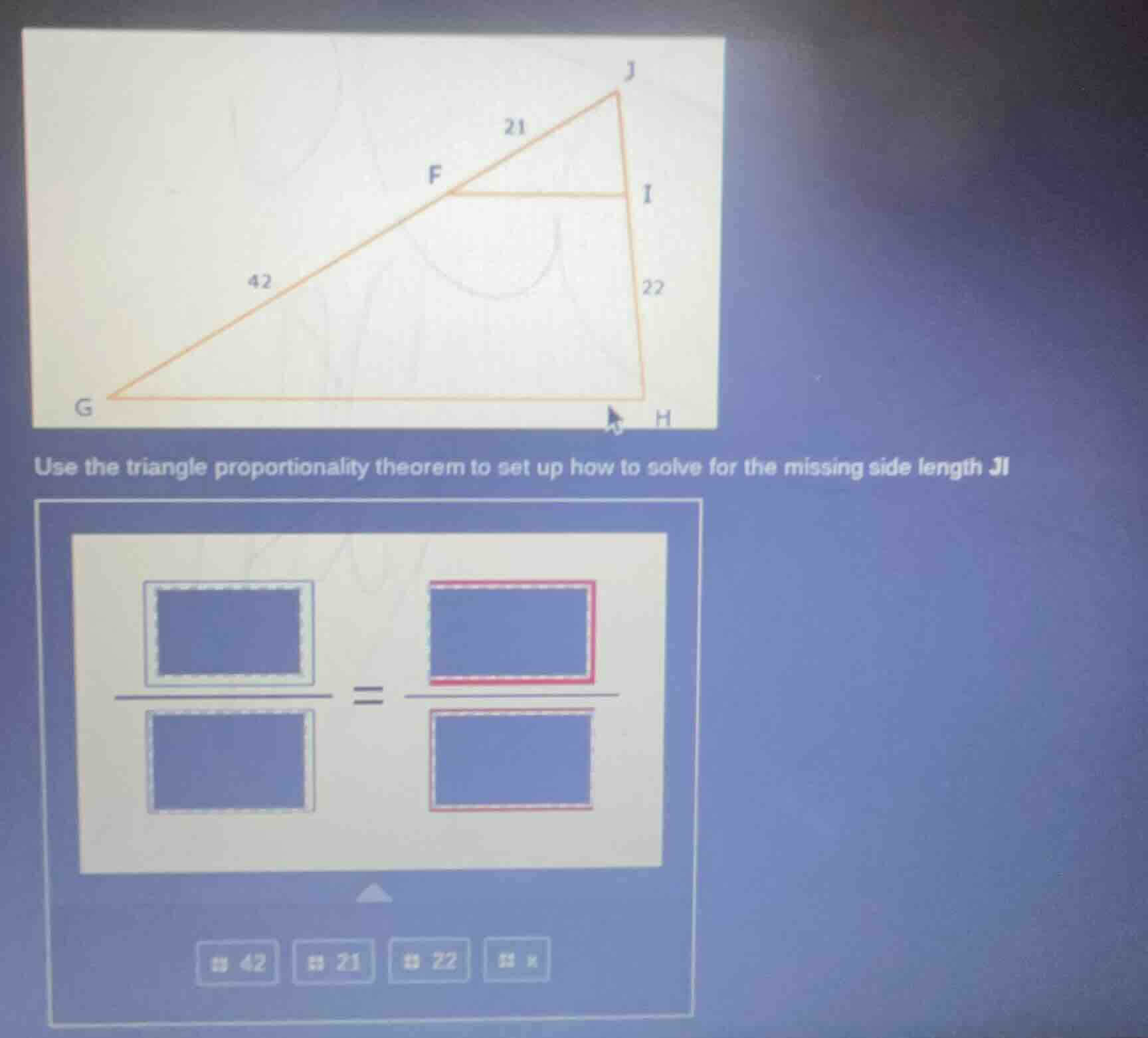
use the triangle proportionality theorem to set up how to solve for the missing side length ji
Step1: Recall Triangle Proportionality Theorem
The Triangle Proportionality Theorem (also known as the Basic Proportionality Theorem or Thales' theorem) states that if a line is drawn parallel to one side of a triangle, intersecting the other two sides, then it divides those sides proportionally. In this diagram, \( FI \parallel GH \), so we have the proportion \(\frac{JF}{FG}=\frac{JI}{IH}\).
We know \( JF = 21 \), \( FG = 42 \), \( IH = 22 \), and let \( JI=x\).
Step2: Substitute the known values into the proportion
Substituting the values into the proportion \(\frac{JF}{FG}=\frac{JI}{IH}\), we get \(\frac{21}{42}=\frac{x}{22}\).

Snap & solve any problem in the app
Get step-by-step solutions on Sovi AI
Photo-based solutions with guided steps
Explore more problems and detailed explanations
The proportion to solve for \( JI \) (where \( JI = x \)) is \(\frac{21}{42}=\frac{x}{22}\) (or equivalently \(\frac{21}{42}=\frac{JI}{22}\)). If we were to solve for \( x \), we could cross - multiply: \( 42x=21\times22 \), then \( x = \frac{21\times22}{42}=11 \), but the setup is \(\frac{21}{42}=\frac{x}{22}\) (or with \( JI \) instead of \( x \), \(\frac{21}{42}=\frac{JI}{22}\)).