QUESTION IMAGE
Question
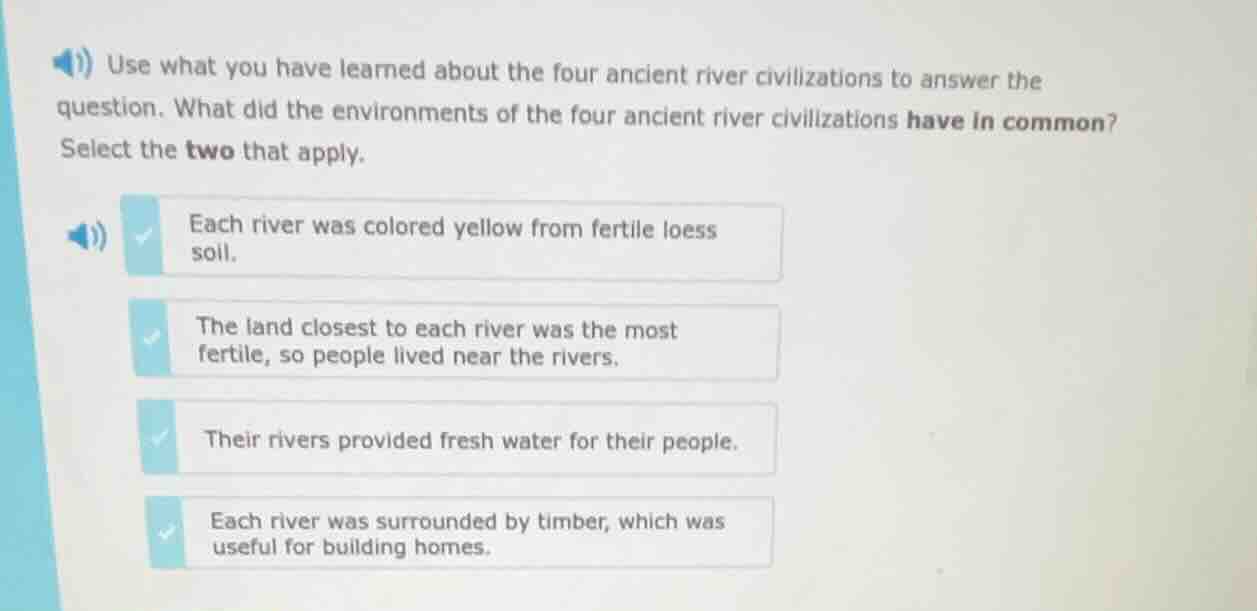
use what you have learned about the four ancient river civilizations to answer the question. what did the environments of the four ancient river civilizations have in common? select the two that apply.
each river was colored yellow from fertile loess soil.
the land closest to each river was the most fertile, so people lived near the rivers.
their rivers provided fresh water for their people.
each river was surrounded by timber, which was useful for building homes.
- Analyze "Each river was colored yellow from fertile loess soil": Only the Yellow River (in the Chinese civilization) has yellow loess - colored water. The Nile, Tigris - Euphrates, and Indus rivers do not have this characteristic. So this is incorrect.
- Analyze "The land closest to each river was the most fertile, so people lived near the rivers": For the Nile (Egyptian), Tigris - Euphrates (Mesopotamian), Indus (Indus Valley), and Yellow River (Chinese) civilizations, the river - adjacent land was fertile due to silt deposition (from floods or natural processes), which supported agriculture. People settled near rivers for farming, water supply, etc. This is correct.
- Analyze "Their rivers provided fresh water for their people": All four ancient river civilizations (Nile, Tigris - Euphrates, Indus, Yellow River) relied on their rivers for fresh water. The rivers were used for drinking, irrigation, and other daily needs. This is correct.
- Analyze "Each river was surrounded by timber, which was useful for building homes": The environments of these river civilizations (especially Mesopotamia and Egypt) were not characterized by abundant timber. Mesopotamia had more reed - based resources, and Egypt had desert - like surroundings with limited timber. So this is incorrect.

Snap & solve any problem in the app
Get step-by-step solutions on Sovi AI
Photo-based solutions with guided steps
Explore more problems and detailed explanations
B. The land closest to each river was the most fertile, so people lived near the rivers
C. Their rivers provided fresh water for their people