QUESTION IMAGE
Question
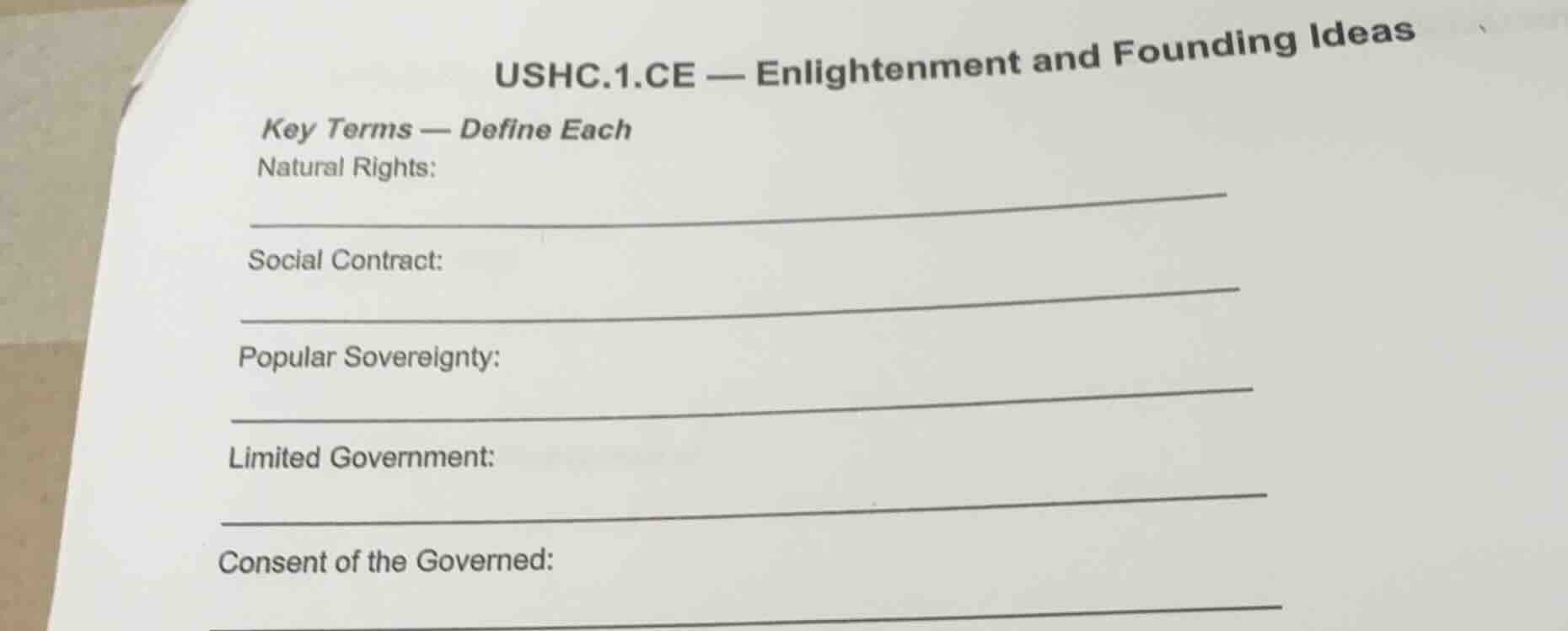
ushc.1.ce — enlightenment and founding ideas
key terms — define each
natural rights:
_____________________________
social contract:
_____________________________
popular sovereignty:
_____________________________
limited government:
_____________________________
consent of the governed:
_____________________________
Brief Explanations
- Natural Rights: Rights inherent to all humans (life, liberty, property, per Locke) regardless of law, social status, etc.
- Social Contract: An agreement (explicit/implicit) among people to form a society/government, where people give up some freedoms for order/protection (Rousseau, Locke, Hobbes).
- Popular Sovereignty: The principle that the authority of a government comes from the consent of the governed (the people are the ultimate source of power).
- Limited Government: A government whose power is restricted by law (e.g., constitution, legal limits) to protect individual rights and prevent tyranny.
- Consent of the Governed: The idea that a government’s legitimacy and authority come from the approval/agreement of the people it governs (core to democratic governance).

Snap & solve any problem in the app
Get step-by-step solutions on Sovi AI
Photo-based solutions with guided steps
Explore more problems and detailed explanations
- Natural Rights: Rights that all people have inherently, such as the right to life, liberty, and property (or pursuit of happiness), existing independent of government or law.
- Social Contract: An agreement among individuals to form a society and establish a government, where people surrender some natural freedoms in exchange for order, protection, and the benefits of a structured community.
- Popular Sovereignty: The concept that the ultimate political authority in a society rests with the people, who are the source of a government’s power.
- Limited Government: A government whose powers are restricted by a constitution, laws, or other legal means to prevent abuse of power and protect individual rights.
- Consent of the Governed: The idea that a government’s legitimacy and right to rule come from the voluntary agreement or approval of the people it governs.