QUESTION IMAGE
Question
using the area to calculate the altitude of a parallelogram
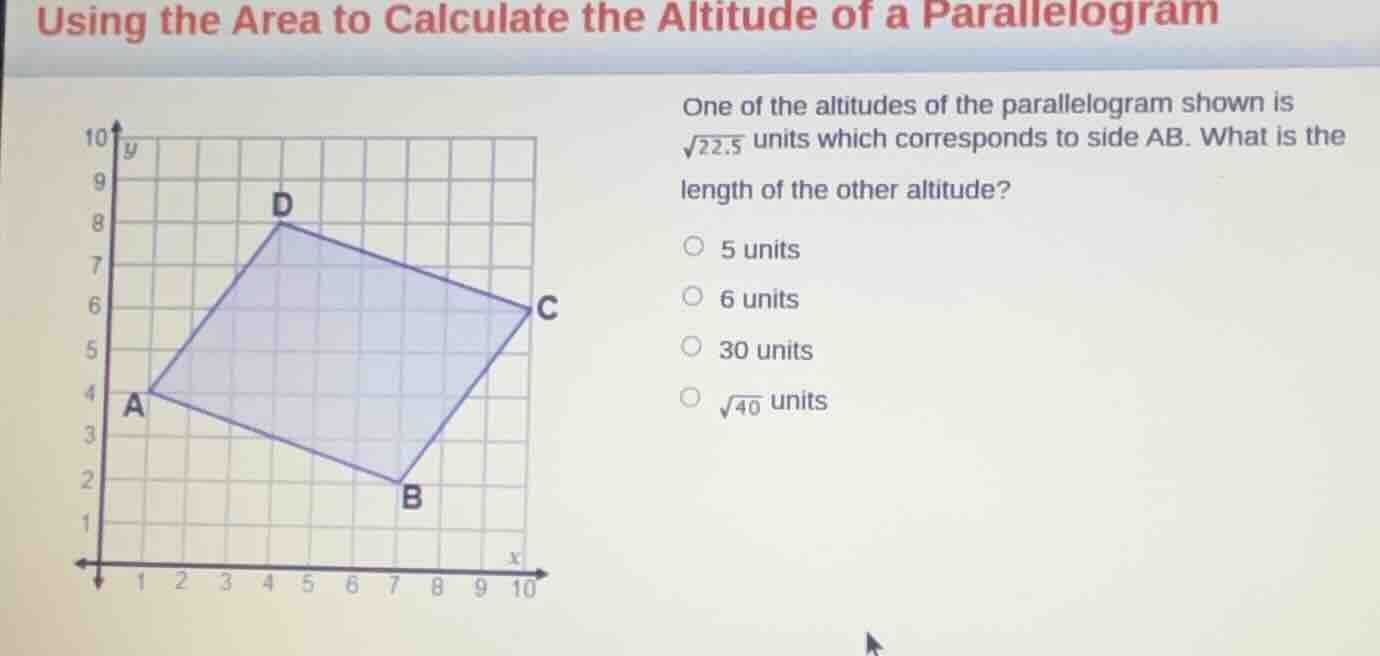
one of the altitudes of the parallelogram shown is (sqrt{22.5}) units which corresponds to side ab. what is the length of the other altitude?
( circ ) 5 units
( circ ) 6 units
( circ ) 30 units
( circ ) (sqrt{40}) units
Step 1: Find length of AB
First, find coordinates of A and B. From graph, A is at (1, 4), B is at (7, 2). Use distance formula: $d = \sqrt{(x_2 - x_1)^2 + (y_2 - y_1)^2}$. So $AB = \sqrt{(7 - 1)^2 + (2 - 4)^2} = \sqrt{36 + 4} = \sqrt{40}$ units.
Step 2: Calculate area using AB and its altitude
Area of parallelogram is base × height. For base AB (length $\sqrt{40}$) and altitude $\sqrt{22.5}$, area $A = \sqrt{40} \times \sqrt{22.5}$. Simplify: $\sqrt{40 \times 22.5} = \sqrt{900} = 30$ square units.
Step 3: Find length of another side (e.g., AD or DC)
Find coordinates of A (1, 4) and D (4, 8). Distance formula: $AD = \sqrt{(4 - 1)^2 + (8 - 4)^2} = \sqrt{9 + 16} = \sqrt{25} = 5$ units? Wait, no, wait. Wait, maybe another side. Wait, let's check coordinates of B (7,2) and C (10,6). Wait, no, better: Let's find length of another base. Wait, maybe I made a mistake. Wait, actually, let's find the length of the side corresponding to the other altitude. Wait, alternatively, let's find the length of, say, the horizontal or vertical difference. Wait, maybe the other base: Let's find the length of, for example, the side from A(1,4) to D(4,8): distance is $\sqrt{(4 - 1)^2 + (8 - 4)^2} = \sqrt{9 + 16} = 5$? No, wait, $\sqrt{25}=5$? Wait, no, 3²+4²=25, so 5. Wait, but maybe the other base is 5? Wait, no, wait the area is 30. Then, if we take another base, say length 5? Wait, no, wait let's recalculate. Wait, AB is $\sqrt{40}$, altitude $\sqrt{22.5}$, area is $\sqrt{40} \times \sqrt{22.5} = \sqrt{40 \times 22.5} = \sqrt{900} = 30$. Now, let's find the length of the other side. Let's take points A(1,4) and D(4,8): distance is $\sqrt{(4 - 1)^2 + (8 - 4)^2} = \sqrt{9 + 16} = 5$? Wait, no, 3 and 4, so 5. Wait, but maybe the other base is 5? Wait, no, wait the other altitude: area = base × altitude, so altitude = area / base. If area is 30, and the other base is 5? Wait, no, wait let's check coordinates of D(4,8) and C(10,6): distance is $\sqrt{(10 - 4)^2 + (6 - 8)^2} = \sqrt{36 + 4} = \sqrt{40}$, same as AB. Wait, maybe the other side is from B(7,2) to C(10,6): distance is $\sqrt{(10 - 7)^2 + (6 - 2)^2} = \sqrt{9 + 16} = 5$? Wait, 3 and 4, so 5. Ah, so the other side (base) is 5 units? Wait, no, wait B(7,2) to C(10,6): x difference 3, y difference 4, so distance 5. So the length of the other base is 5 units? Wait, no, wait the side BC: from (7,2) to (10,6): 3 right, 4 up, so 5. So the other base is 5 units? Wait, no, area is 30, so altitude = area / base = 30 / 5 = 6? Wait, no, wait I'm confused. Wait, let's re-express:
Wait, AB is $\sqrt{40}$, altitude to AB is $\sqrt{22.5}$, area is $\sqrt{40} \times \sqrt{22.5} = \sqrt{40 \times 22.5} = \sqrt{900} = 30$. Now, the other altitude corresponds to the other base. Let's find the length of the other base. Let's take points A(1,4) and D(4,8): distance is $\sqrt{(4 - 1)^2 + (8 - 4)^2} = \sqrt{9 + 16} = 5$? Wait, no, 3 and 4, so 5. Wait, A(1,4) to D(4,8): 3 units right, 4 units up, so distance 5. So the length of AD is 5 units? Wait, no, 3² + 4² = 9 + 16 = 25, so $\sqrt{25}=5$. So AD is 5 units. So the other base is 5 units? Wait, no, AD is a side, so the base can be AD (length 5) or AB (length $\sqrt{40}$). So the area is 30, so if we take base AD (length 5), then altitude is area / base = 30 / 5 = 6. So the other altitude is 6 units.
Step 4: Verify
Area with base AB ($\sqrt{40}$) and altitude $\sqrt{22.5}$: $\sqrt{40} \times \sqrt{22.5} = \sqrt{40 \times 22.5} = \sqrt{900} = 30$. Area with base AD (5) and altitude 6: 5 × 6 = 30. Correct. So the other altitude is 6 units.

Snap & solve any problem in the app
Get step-by-step solutions on Sovi AI
Photo-based solutions with guided steps
Explore more problems and detailed explanations
6 units