QUESTION IMAGE
Question
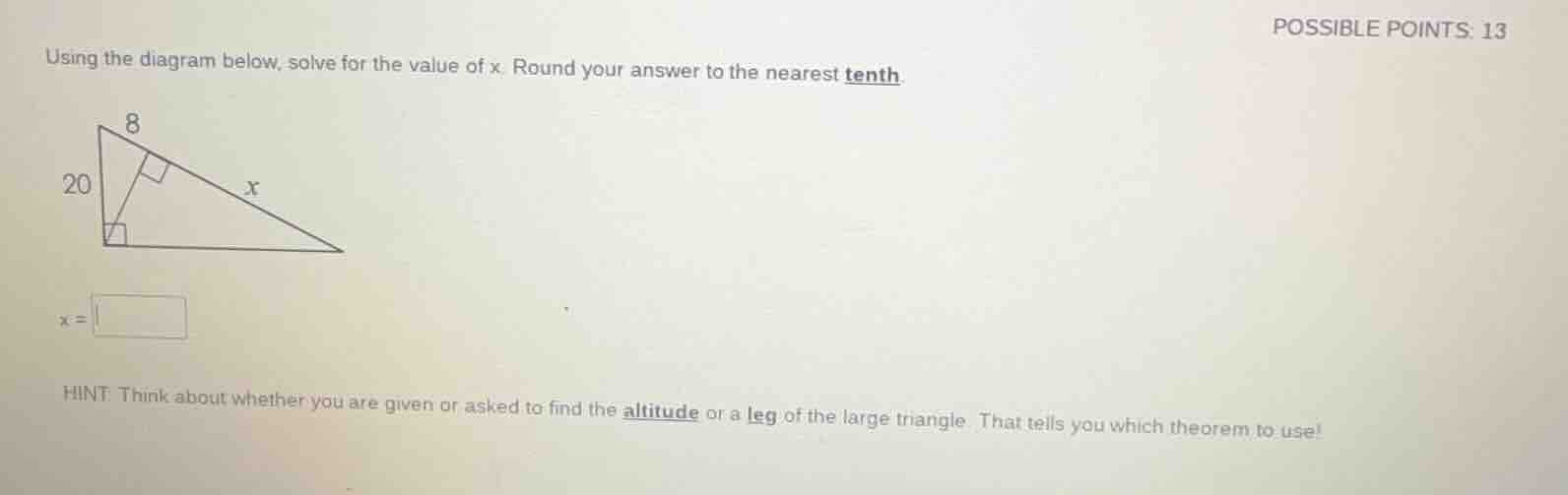
using the diagram below, solve for the value of x. round your answer to the nearest tenth.
x =
hint: think about whether you are given or asked to find the altitude or a leg of the large triangle. that tells you which theorem to use!
Step1: Identify the geometric theorem
We use the geometric mean (leg) theorem, which states that in a right triangle, the length of a leg is the geometric mean of the length of the hypotenuse segment adjacent to that leg and the length of the entire hypotenuse. Here, the leg of length \(20\) and the segment of the hypotenuse \(8\) and the entire hypotenuse \(x\) satisfy the relationship \(20^2 = 8\times x\).
Step2: Solve for \(x\)
From \(20^2 = 8x\), we have \(400 = 8x\). Then, divide both sides by \(8\): \(x=\frac{400}{8}= 50\)? Wait, no, wait. Wait, the geometric mean for the leg: actually, the correct theorem is that in a right triangle, when an altitude is drawn to the hypotenuse, each leg is the geometric mean of the hypotenuse and the adjacent segment. Wait, let's re - examine the diagram. The large triangle is a right triangle, with one leg \(20\), the other leg? Wait, no, the altitude is drawn to the hypotenuse. Wait, maybe I mixed up. Let's denote the segments: let the hypotenuse be divided into two segments, one of length \(8\) and the other (let's say \(y\)), and the legs are \(20\) and \(x\) (the hypotenuse of the large triangle). Wait, no, the correct formula is: if in right triangle \(ABC\) with right angle \(C\), and altitude \(CD\) to hypotenuse \(AB\), then \(AC^{2}=AD\times AB\), \(BC^{2}=BD\times AB\), and \(CD^{2}=AD\times BD\).
In our case, let's assume the right triangle has legs \(20\) and (let's say) the other leg is, and the hypotenuse is \(x\). The altitude is drawn to the hypotenuse, and one of the segments of the hypotenuse is \(8\). Wait, the leg of length \(20\) is adjacent to the segment of length \(8\) on the hypotenuse. So by the leg - geometric mean theorem: \(20^{2}=8\times x\). Wait, no, that would be if the leg is the geometric mean of the adjacent segment and the hypotenuse. So \(leg^{2}=segment\times hypotenuse\). So \(20^{2}=8\times x\), then \(x = \frac{20^{2}}{8}=\frac{400}{8} = 50\)? But that seems too big. Wait, maybe I got the segments wrong. Wait, maybe the \(8\) is the length of the altitude? No, the altitude is perpendicular. Wait, no, the diagram: the triangle is a right triangle, with one leg \(20\), the hypotenuse is \(x\), and there is an altitude drawn to the hypotenuse, creating a smaller right triangle with one leg \(8\). Wait, no, maybe the \(8\) is the length of the segment of the hypotenuse adjacent to the leg of length \(x\)? Wait, let's re - derive.
Let the right triangle be \( \triangle ABC\), right - angled at \(C\). Let \(CD\) be the altitude to hypotenuse \(AB\), with \(AD = 8\), \(AC = 20\), and \(AB=x\). Then by the geometric mean theorem for the leg \(AC\): \(AC^{2}=AD\times AB\). So \(20^{2}=8\times x\), so \(x=\frac{400}{8}=50\). Wait, but let's check with the other leg. If \(x = 50\), then the other segment \(DB=x - 8=42\), and the other leg \(BC\) would satisfy \(BC^{2}=DB\times AB=42\times50 = 2100\), so \(BC=\sqrt{2100}\approx45.8\), and the altitude \(CD\) would be \(\sqrt{AD\times DB}=\sqrt{8\times42}=\sqrt{336}\approx18.3\). But maybe the diagram is such that the leg is \(20\), the segment is \(8\), and we need to find the hypotenuse. So according to the leg - geometric mean theorem, \(leg^{2}=segment\times hypotenuse\), so \(x=\frac{leg^{2}}{segment}=\frac{20^{2}}{8}=\frac{400}{8}=50\).

Snap & solve any problem in the app
Get step-by-step solutions on Sovi AI
Photo-based solutions with guided steps
Explore more problems and detailed explanations
\(x = 50.0\)