QUESTION IMAGE
Question
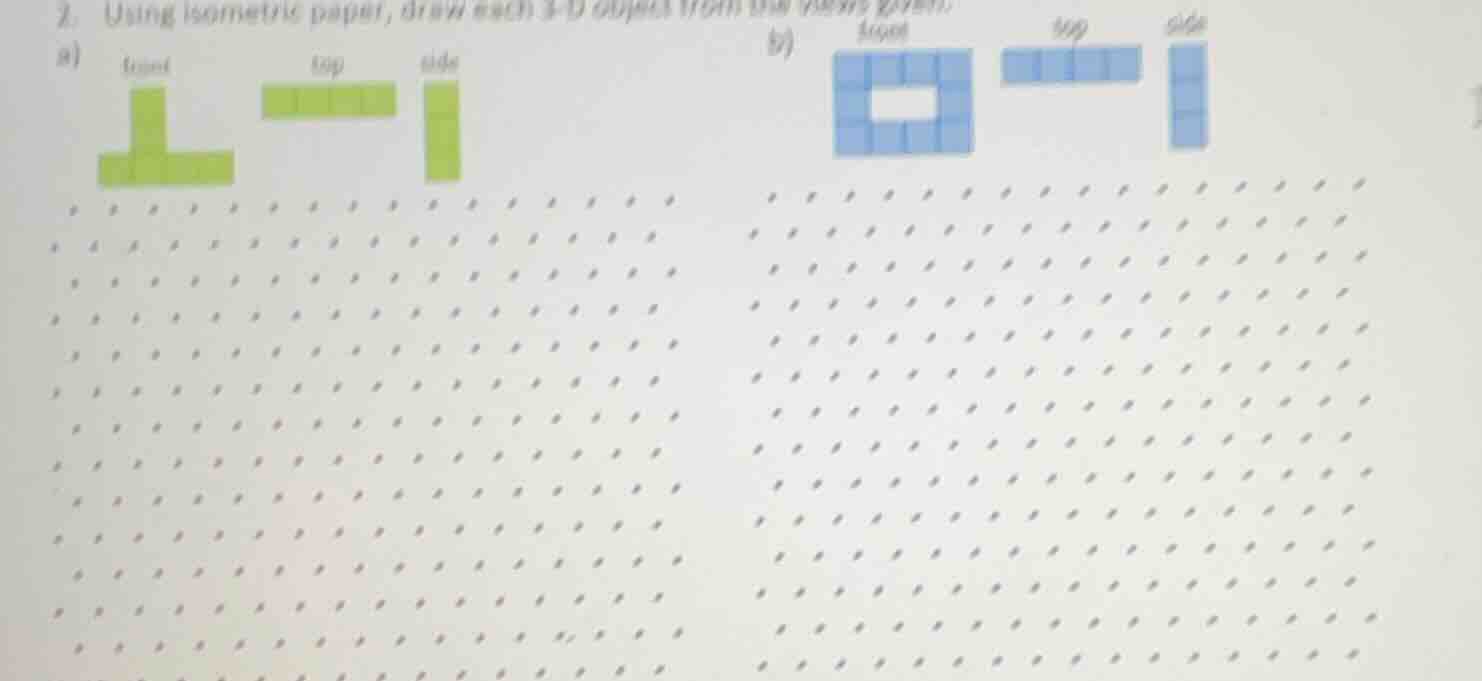
- using isometric paper, draw each 3 - d object from the views given.
a)
b)
(for part a as an example, similar logic applies to part b):
Step1: Analyze Front View
The front view (green) has a base of 4 units (horizontal) and a vertical block on the second unit from the left, 2 units tall. So, in isometric, the front layer will have a horizontal row of 4 cubes (along the x - y plane, with y as depth, x as horizontal, z as vertical) and a cube stacked on the second cube (from left) in the z - direction.
Step2: Analyze Top View
The top view is a horizontal row of 4 cubes. This means the depth (y - direction) is 1 unit for the base layer (since top view shows the x - y plane). So the base layer (z = 1) has 4 cubes in a row (x from 1 to 4, y = 1).
Step3: Analyze Side View
The side view is a vertical column of 2 cubes. The side view is along the y - z plane. Since the top view has y = 1 (depth 1), the side view shows that in the z - direction, there are 2 cubes for the column. This matches the front view's vertical block.
Step4: Draw in Isometric
- Start with the base layer: 4 cubes in a row (along the isometric x - y axis, with each cube having sides at 120 - degree angles).
- Then, on the second cube (from the left) in the base layer, stack another cube (in the z - direction, which is the vertical axis in isometric, but at a 30 - degree angle from the vertical in standard isometric drawing).
For part b:
Step1: Analyze Front View
The front view (blue) has a 3x3 square with a 1x1 square missing in the center (so 8 cubes in the front layer, z = 1: 3 rows and 3 columns, minus the center). The height (z - direction) of the outer cubes: looking at the side view, the side view is a vertical column of 3 cubes. Wait, no, the side view (blue) is a vertical column of 3 cubes? Wait, the side view for b is a vertical column of 3 cubes? Wait, the front view: let's count the cubes. The front view has 3 rows (vertical) and 4 columns? Wait, no, the front view in b: the blue front view: let's see, it's a rectangle with a hole? Wait, the front view is a 3 (height) x 4 (width) rectangle with a 1x1 hole in the center? Wait, no, the top view is a horizontal row of 4 cubes (so depth y = 1, x from 1 to 4). The side view is a vertical column of 3 cubes (z from 1 to 3, y = 1).
Step2: Analyze Top View
Top view is 4 cubes in a row (x from 1 to 4, y = 1), so depth is 1.
Step3: Analyze Side View
Side view is 3 cubes in a column (z from 1 to 3, y = 1), so height is 3.
Step4: Analyze Front View
Front view: since top view is x from 1 - 4, y = 1, and side view is z from 1 - 3, y = 1. The front view (x - z plane) should have, for each x from 1 - 4, z from 1 - 3, except maybe a hole? Wait, the front view has a hole? Wait, the front view in b is a 3 (z) x 4 (x) rectangle with a 1x1 hole? Wait, no, the front view: let's count the squares. The front view has 3 rows (vertical) and 4 columns? Wait, the front view is blue, with a white square in the center. So in the front layer (z = 1), x from 1 - 4, z from 1 - 3? No, maybe the front view is a 3 - layer (z) by 4 - column (x) structure, with the center (x = 2, z = 2) missing? Wait, no, let's re - examine. The top view is 4 cubes in a row (x from 1 - 4, y = 1). The side view is 3 cubes in a column (z from 1 - 3, y = 1). So the 3 - D object is a 4 (x) x 1 (y) x 3 (z) rectangular prism, with a hole? Wait, the front view has a hole, so maybe in the x - z plane (front view), at x = 2, z = 2, there is no cube. So the object is:
- Base layer (y = 1, z = 1): 4 cubes (x = 1 - 4, y = 1, z = 1)
- Middle layer (y = 1, z = 2): 4 cubes (x = 1 - 4, y = 1, z = 2), but x = 2, z = 2 is missing? W…

Snap & solve any problem in the app
Get step-by-step solutions on Sovi AI
Photo-based solutions with guided steps
Explore more problems and detailed explanations
(Drawing Instructions Summary):
For part a:
- Draw a base row of 4 cubes (isometric, with each cube having sides at 120° angles).
- Stack a cube on the second cube (from the left) in the base row.
For part b:
- Draw a base row of 4 cubes (x = 1 - 4, y = 1, z = 1).
- In the middle layer (z = 2, y = 1), draw cubes at x = 1,3,4 (skip x = 2).
- In the top layer (z = 3, y = 1), draw a row of 4 cubes (x = 1 - 4).
(Note: Since this is a drawing problem, the key is to translate the 2D views (front, top, side) into a 3D isometric drawing by analyzing the number of cubes in each layer (x, y, z directions) and their positions.)