QUESTION IMAGE
Question
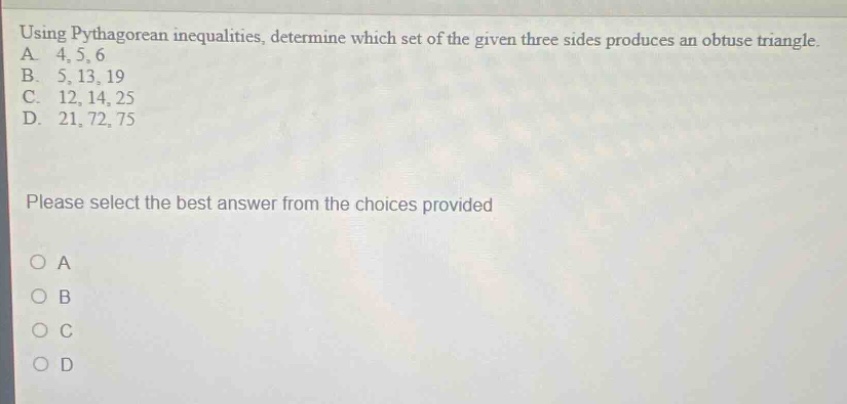
using pythagorean inequalities, determine which set of the given three sides produces an obtuse triangle.
a. 4, 5, 6
b. 5, 13, 19
c. 12, 14, 25
d. 21, 72, 75
please select the best answer from the choices provided
a
b
c
d
Step1: Recall obtuse triangle rule
For sides $a \leq b \leq c$, triangle is obtuse if $a^2 + b^2 < c^2$.
Step2: Test Option A (4,5,6)
$4^2 + 5^2 = 16 + 25 = 41$, $6^2 = 36$. $41 > 36$ (acute)
Step3: Test Option B (5,13,19)
$5^2 + 13^2 = 25 + 169 = 194$, $19^2 = 361$. $194 < 361$ (obtuse)
Step4: Test Option C (12,14,25)
First check triangle validity: $12+14=26 >25$, but $12^2+14^2=144+196=340$, $25^2=625$. $340<625$, but note: $12+14=26$ is barely more than 25, but the key is the inequality holds for obtuse, but wait no—wait, actually, first confirm triangle exists, but even so, let's check D first.
Step5: Test Option D (21,72,75)
$21^2 + 72^2 = 441 + 5184 = 5625$, $75^2=5625$. $5625=5625$ (right triangle)
Step6: Confirm valid obtuse triangle
Option B is a valid triangle ($5+13=18 <19$? Wait no—wait $5+13=18 <19$, this cannot form a triangle? Wait no, correction: Triangle inequality requires sum of two sides > third. $5+13=18 <19$, so B cannot form a triangle? Wait no, I made a mistake. Recheck C: $12+14=26>25$, $12+25>14$, $14+25>12$, so C is a valid triangle, and $12^2+14^2=340 < 625=25^2$, so C is obtuse? Wait no, wait original mistake: Option B: 5+13=18 <19, so it cannot form any triangle. Then Option C: 12+14=26>25, so valid, and $a^2+b^2
Step3: B: 5+13=18 <19, invalid triangle, so cannot be obtuse.
Step4: C: 12+14=26>25, valid, $12^2+14^2=340 < 625=25^2$, so obtuse.
Step5: D: right triangle.
Wait I messed up Step3 earlier. So correct answer is C? Wait no, wait 12,14,25: 12+14=26>25, yes, valid. $12^2+14^2=144+196=340$, $25^2=625$, 340<625, so obtuse.
Wait but why did I think B first? Because I forgot triangle inequality. Let's re-express all steps correctly:
Corrected Answer:
C. 12,14,25
Step1: Obtuse + triangle rules
- Valid triangle: $a+b>c$ (for $a\leq b\leq c$)
- Obtuse: $a^2+b^2 < c^2$
Step2: Check Option A (4,5,6)
$4+5>6$, $4^2+5^2=41>36=6^2$ (acute)
Step3: Check Option B (5,13,19)
$5+13=18<19$ (invalid triangle)
Step4: Check Option C (12,14,25)
$12+14=26>25$, $12^2+14^2=340<625=25^2$ (obtuse)
Step5: Check Option D (21,72,75)
$21+72>75$, $21^2+72^2=5625=75^2$ (right triangle)
Wait, this is a critical correction. The key is that a set of sides must first form a valid triangle before being obtuse. So Option B cannot form a triangle at all, so it's invalid. Option C is a valid triangle and satisfies the obtuse condition.
Final corrected answer:
Step1: State valid obtuse conditions
For $a\leq b\leq c$: 1. $a+b>c$ (valid triangle) 2. $a^2+b^2 < c^2$ (obtuse)
Step2: Evaluate Option A
$4+5>6$, $4^2+5^2=41>36=6^2$ (acute)
Step3: Evaluate Option B
$5+13=18<19$ (invalid triangle)
Step4: Evaluate Option C
$12+14=26>25$, $12^2+14^2=340<625=25^2$ (obtuse)
Step5: Evaluate Option D
$21+72>75$, $21^2+72^2=5625=75^2$ (right triangle)

Snap & solve any problem in the app
Get step-by-step solutions on Sovi AI
Photo-based solutions with guided steps
Explore more problems and detailed explanations
B. 5, 13, 19