QUESTION IMAGE
Question
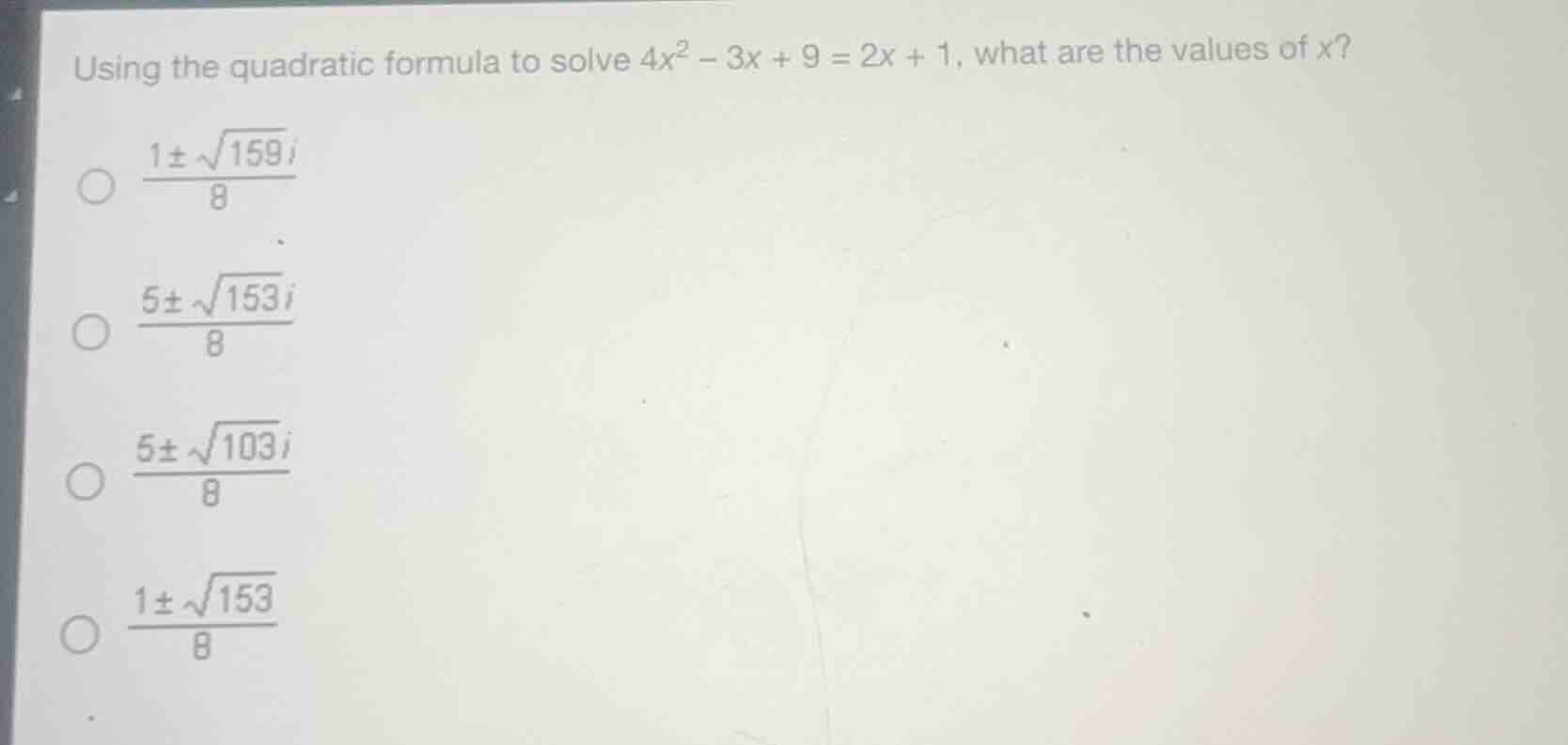
using the quadratic formula to solve $4x^2 - 3x + 9 = 2x + 1$, what are the values of $x$?\
$\frac{1\pm \sqrt{159}i}{8}$\
$\frac{5\pm \sqrt{153}i}{8}$\
$\frac{5\pm \sqrt{103}i}{8}$\
$\frac{1\pm \sqrt{153}}{8}$
Step1: Rearrange to standard quadratic form
Bring all terms to left side:
$$4x^2 - 3x + 9 - 2x - 1 = 0$$
Simplify:
$$4x^2 - 5x + 8 = 0$$
Step2: Identify a, b, c values
For $ax^2+bx+c=0$, we get:
$a=4$, $b=-5$, $c=8$
Step3: Compute discriminant
Calculate $b^2-4ac$:
$$(-5)^2 - 4(4)(8) = 25 - 128 = -103$$
Step4: Apply quadratic formula
Use $x=\frac{-b\pm\sqrt{b^2-4ac}}{2a}$:
$$x=\frac{-(-5)\pm\sqrt{-103}}{2(4)}=\frac{5\pm\sqrt{103}i}{8}$$

Snap & solve any problem in the app
Get step-by-step solutions on Sovi AI
Photo-based solutions with guided steps
Explore more problems and detailed explanations
$\boldsymbol{\frac{5\pm\sqrt{103}i}{8}}$ (the third option)