QUESTION IMAGE
Question
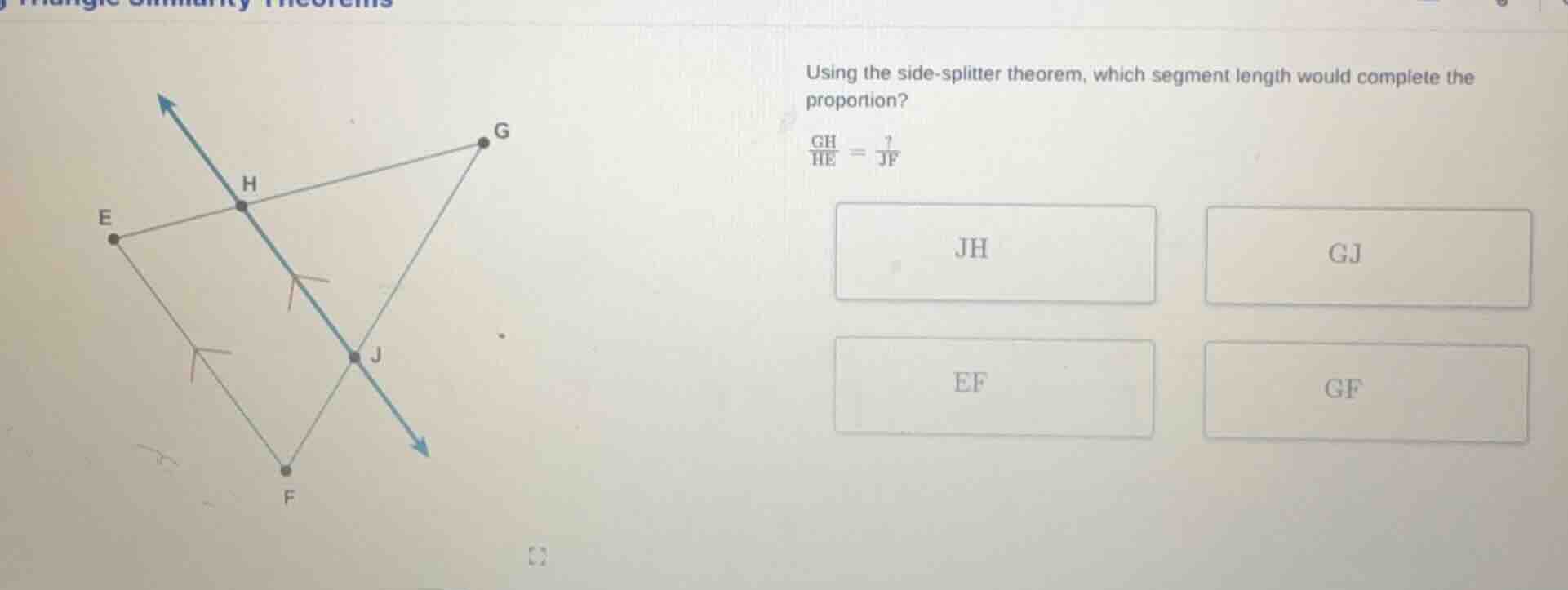
using the side - splitter theorem, which segment length would complete the proportion?
\frac{gh}{he}=\frac{?}{jf}
options: jh, gj, ef, gf
Step1: Recall Side - Splitter Theorem
The Side - Splitter Theorem states that if a line is parallel to one side of a triangle and intersects the other two sides, then it divides those sides proportionally. In the context of the triangle and the parallel line (the blue line with points H and J) in the diagram, we have two triangles (or a triangle with a parallel line cutting two sides) where the line \(HJ\) is parallel to \(EF\) (from the markings on the sides).
For the proportion \(\frac{GH}{HE}=\frac{?}{JF}\), we need to find the segment that corresponds to \(GH\) on the other side of the proportion. By the Side - Splitter Theorem, the ratio of the segments on one side of the triangle (formed by the parallel line) should be equal to the ratio of the corresponding segments on the other side.
Looking at the segments, \(GH\) and \(GF\) are related in the same way as \(HE\) and \(JF\) in terms of the proportionality from the Side - Splitter Theorem. Let's think about the triangles: \(\triangle GHJ\) and \(\triangle GEF\) (or the two - part division of the sides). The ratio of \(GH\) to \(HE\) should be equal to the ratio of \(GJ\) to \(JF\)? Wait, no, let's re - examine. Wait, the correct correspondence: if we consider the line \(HJ\) parallel to \(EF\), then in \(\triangle GEF\), the line \(HJ\) cuts \(GE\) at \(H\) and \(GF\) at \(J\). So by the Side - Splitter Theorem, \(\frac{GH}{HE}=\frac{GJ}{JF}\)? Wait, no, maybe I made a mistake. Wait, the segments: \(GE\) is split into \(GH\) and \(HE\), and \(GF\) is split into \(GJ\) and \(JF\)? No, wait, the points: \(E\), \(H\), \(G\) on one side and \(F\), \(J\), \(G\) on the other? Wait, no, the diagram: \(E\) and \(F\) are the base vertices, \(G\) is the top vertex. The line \(HJ\) is parallel to \(EF\), intersecting \(GE\) at \(H\) and \(GF\) at \(J\). So by the Side - Splitter Theorem, \(\frac{GH}{HE}=\frac{GJ}{JF}\)? Wait, no, the Side - Splitter Theorem formula is \(\frac{AH}{HB}=\frac{AC}{CD}\) if a line parallel to \(BD\) intersects \(AB\) at \(A\), \(B\) and \(AD\) at \(C\), \(D\). Wait, maybe I got the segments wrong. Let's look at the proportion given: \(\frac{GH}{HE}=\frac{?}{JF}\). So we need to find the segment that is in the same ratio as \(GH\) to \(HE\) with respect to \(JF\).
Looking at the sides, \(GH\) and \(GF\) - no. Wait, the correct segment: since \(HJ\parallel EF\), the triangles \(\triangle GHJ\) and \(\triangle GEF\) are similar (by AA similarity, since \(\angle G\) is common and \(\angle GHJ=\angle GEF\) because \(HJ\parallel EF\)). So the ratio of corresponding sides: \(\frac{GH}{GE}=\frac{GJ}{GF}\), but that's not the proportion we have. Wait, the given proportion is \(\frac{GH}{HE}=\frac{?}{JF}\). Let's express \(GE = GH+HE\) and \(GF=GJ + JF\). From the Side - Splitter Theorem, \(\frac{GH}{HE}=\frac{GJ}{JF}\). Wait, but the options are \(JH\), \(GJ\), \(EF\), \(GF\). Wait, maybe I misread the proportion. The proportion is \(\frac{GH}{HE}=\frac{?}{JF}\). So the numerator of the right - hand side should be a segment that is in the same ratio as \(GH\) to \(HE\). Let's think about the triangles. If we consider \(\triangle HJE\) and \(\triangle...\) no, wait, the correct answer: by the Side - Splitter Theorem, when a line is parallel to one side of a triangle and intersects the other two sides, it divides those sides proportionally. So in this case, the line \(HJ\) is parallel to \(EF\), intersecting \(GE\) at \(H\) and \(GF\) at \(J\). Therefore, \(\frac{GH}{HE}=\frac{GJ}{JF}\). Wait, but the options: \(GJ\) is one of the options. Wait, but let's check ag…

Snap & solve any problem in the app
Get step-by-step solutions on Sovi AI
Photo-based solutions with guided steps
Explore more problems and detailed explanations
GJ