QUESTION IMAGE
Question
using the supplementary consecutive angles theorem
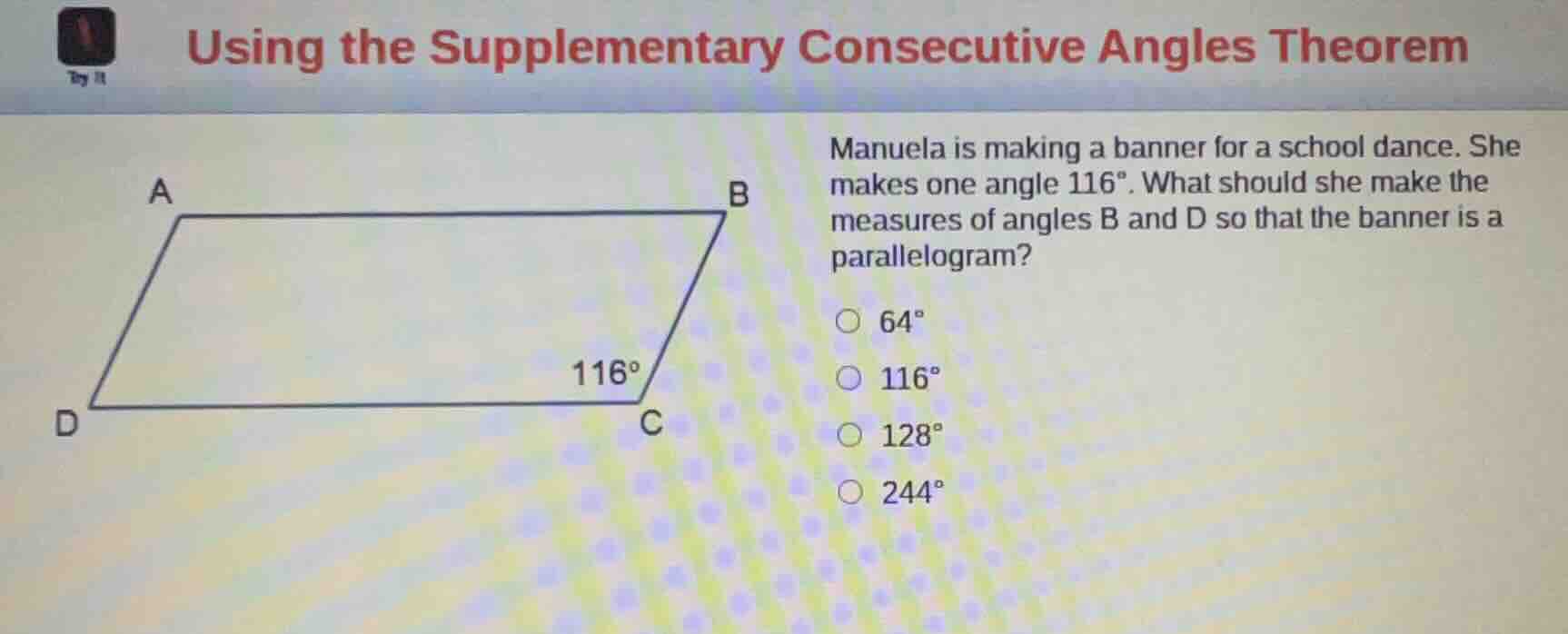
manuela is making a banner for a school dance. she makes one angle 116°. what should she make the measures of angles b and d so that the banner is a parallelogram?
○ 64°
○ 116°
○ 128°
○ 244°
Step1: Recall parallelogram angle property
In a parallelogram, consecutive angles are supplementary (sum to \(180^\circ\)). Also, opposite angles are equal.
Step2: Find measure of angle B
Angle \(C = 116^\circ\), angle \(B\) and angle \(C\) are consecutive angles. So \(m\angle B + m\angle C = 180^\circ\). Substitute \(m\angle C = 116^\circ\): \(m\angle B = 180^\circ - 116^\circ = 64^\circ\)? Wait, no, wait. Wait, in the parallelogram \(ABCD\), angle \(A\) and angle \(B\) are consecutive? Wait, the diagram: \(A\), \(B\), \(C\), \(D\) in order, so \(AB\parallel CD\) and \(AD\parallel BC\). So angle \(C\) and angle \(B\) are consecutive (since \(BC\) is a transversal for \(AB\) and \(CD\))? Wait, no, angle \(C\) and angle \(B\): \(AB\parallel CD\), so angle \(B\) and angle \(C\) are same - side interior angles, so they should be supplementary. Wait, but also, angle \(A\) and angle \(D\) are supplementary, angle \(A\) and angle \(B\) are supplementary? Wait, no, let's correct. In parallelogram \(ABCD\), \(AB\parallel CD\) and \(AD\parallel BC\). So consecutive angles: \(\angle A\) and \(\angle B\) (since \(AD\parallel BC\), \(AB\) is transversal), \(\angle B\) and \(\angle C\) ( \(AB\parallel CD\), \(BC\) is transversal), \(\angle C\) and \(\angle D\) ( \(AD\parallel BC\), \(CD\) is transversal), \(\angle D\) and \(\angle A\) ( \(AB\parallel CD\), \(AD\) is transversal). So consecutive angles are supplementary. Also, opposite angles: \(\angle A=\angle C\), \(\angle B = \angle D\).
Given angle \(C = 116^\circ\), so angle \(B\) (consecutive to \(C\)): \(m\angle B=180 - 116 = 64^\circ\)? But wait, the options: 64, 116, 128, 244. Wait, but also, angle \(D\): angle \(D\) is opposite to angle \(B\)? No, angle \(D\) is opposite to angle \(B\)? Wait, no, angle \(A\) is opposite to angle \(C\), angle \(B\) is opposite to angle \(D\). Wait, if angle \(C = 116^\circ\), then angle \(A = 116^\circ\) (opposite angles). Then angle \(B\) and angle \(A\) are consecutive, so \(m\angle B=180 - 116 = 64^\circ\), and angle \(D = \angle B = 64^\circ\)? Wait, but the question is "What should she make the measures of angles B and D". Wait, maybe I misread the angle. Wait, the problem says "She makes one angle \(116^\circ\)". Wait, maybe angle \(A\) is \(116^\circ\)? Wait, the diagram: angle at \(C\) is \(116^\circ\). Wait, in the parallelogram, angle \(C\) and angle \(A\) are opposite, so angle \(A = 116^\circ\). Then angle \(B\) (consecutive to \(A\)): \(m\angle B=180 - 116 = 64^\circ\), and angle \(D\) is equal to angle \(B\) (opposite angles), so angle \(D = 64^\circ\)? But the options are single - choice? Wait, the options are 64°, 116°, 128°, 244°. Wait, maybe the question is about angle \(B\) (or angle \(D\))? Wait, maybe I made a mistake. Wait, let's re - express: In parallelogram, consecutive angles are supplementary. So if one angle is \(116^\circ\), its consecutive angle is \(180 - 116 = 64^\circ\). Opposite angles are equal. So angle \(B\) (consecutive to angle \(C = 116^\circ\)) is \(64^\circ\), and angle \(D\) (opposite to angle \(B\)) is also \(64^\circ\)? But the options have 64° as an option. Wait, but maybe the angle given is angle \(A = 116^\circ\), then angle \(B\) (consecutive) is \(64^\circ\), angle \(D\) (opposite to angle \(B\)) is \(64^\circ\). So the measure of angle \(B\) and angle \(D\) should be \(64^\circ\). Wait, but the options are single - choice? Wait, the question is "What should she make the measures of angles B and D". Wait, maybe the options are for each? But the options are 64°, 116°, 128°, 244°. So the correct measu…

Snap & solve any problem in the app
Get step-by-step solutions on Sovi AI
Photo-based solutions with guided steps
Explore more problems and detailed explanations
\(64^\circ\) (corresponding to the option "64°")