QUESTION IMAGE
Question
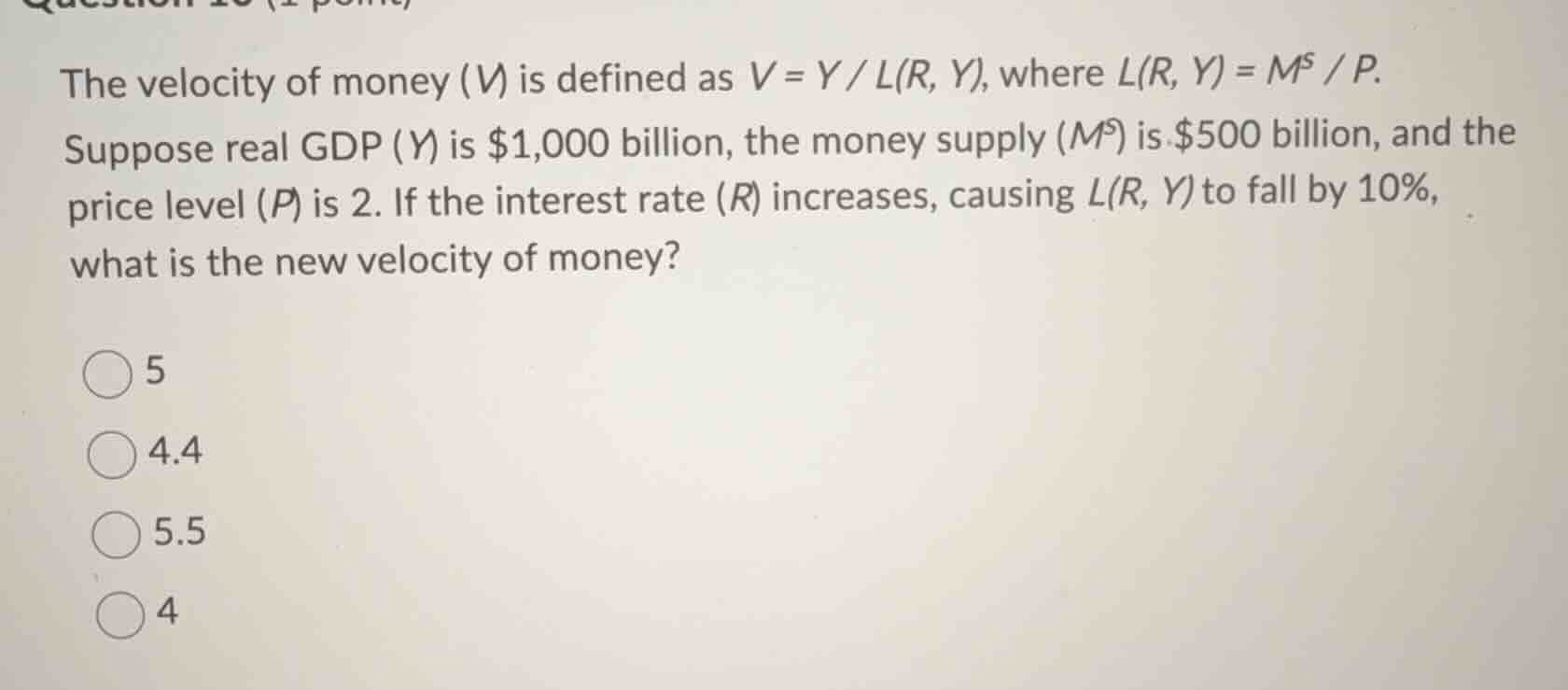
the velocity of money (v) is defined as v = y / l(r, y), where l(r, y) = m^s / p. suppose real gdp (y) is $1,000 billion, the money supply (m^s) is $500 billion, and the price level (p) is 2. if the interest rate (r) increases, causing l(r, y) to fall by 10%, what is the new velocity of money? 5 4.4 5.5 4
Step 1: Calculate the initial \( L(R, Y) \)
Given \( L(R, Y)=\frac{M^s}{P} \), substitute \( M^s = 500 \) billion and \( P = 2 \).
\( L(R, Y)=\frac{500}{2}=250 \) billion.
Step 2: Find the new \( L(R, Y) \) after a 10% fall
A 10% fall means the new \( L(R, Y) \) is \( 250\times(1 - 0.1)=250\times0.9 = 225 \) billion.
Step 3: Calculate the new velocity of money \( V \)
Using \( V=\frac{Y}{L(R, Y)} \), substitute \( Y = 1000 \) billion and the new \( L(R, Y)=225 \) billion.
\( V=\frac{1000}{225}=\frac{40}{9}\approx4.44\approx4.4 \) (rounded to one decimal place). Wait, wait, let's recalculate: Wait, no, wait, 1000 divided by 225: 2254 = 900, 1000 - 900 = 100, 100/225 = 4/9 ≈ 0.444, so total is 4.444..., which is approximately 4.4? Wait, but let's check again. Wait, initial L is 250. After 10% fall, 2500.9=225. Then Y is 1000. So 1000/225 = 40/9 ≈ 4.444..., which is approximately 4.4 (if we take one decimal place) or 4.44. But the options have 4.4, 5, etc. Wait, maybe I made a mistake? Wait, no, let's check the steps again.
Wait, initial L: \( M^s / P = 500 / 2 = 250 \). Correct. Then 10% fall: 250 - 25 = 225. Correct. Then V = Y / L = 1000 / 225 = 4.444... So the closest option is 4.4.

Snap & solve any problem in the app
Get step-by-step solutions on Sovi AI
Photo-based solutions with guided steps
Explore more problems and detailed explanations
4.4 (corresponding to the option with 4.4, e.g., if the options are as given, the answer is the option with 4.4, like the second option: 4.4)