QUESTION IMAGE
Question
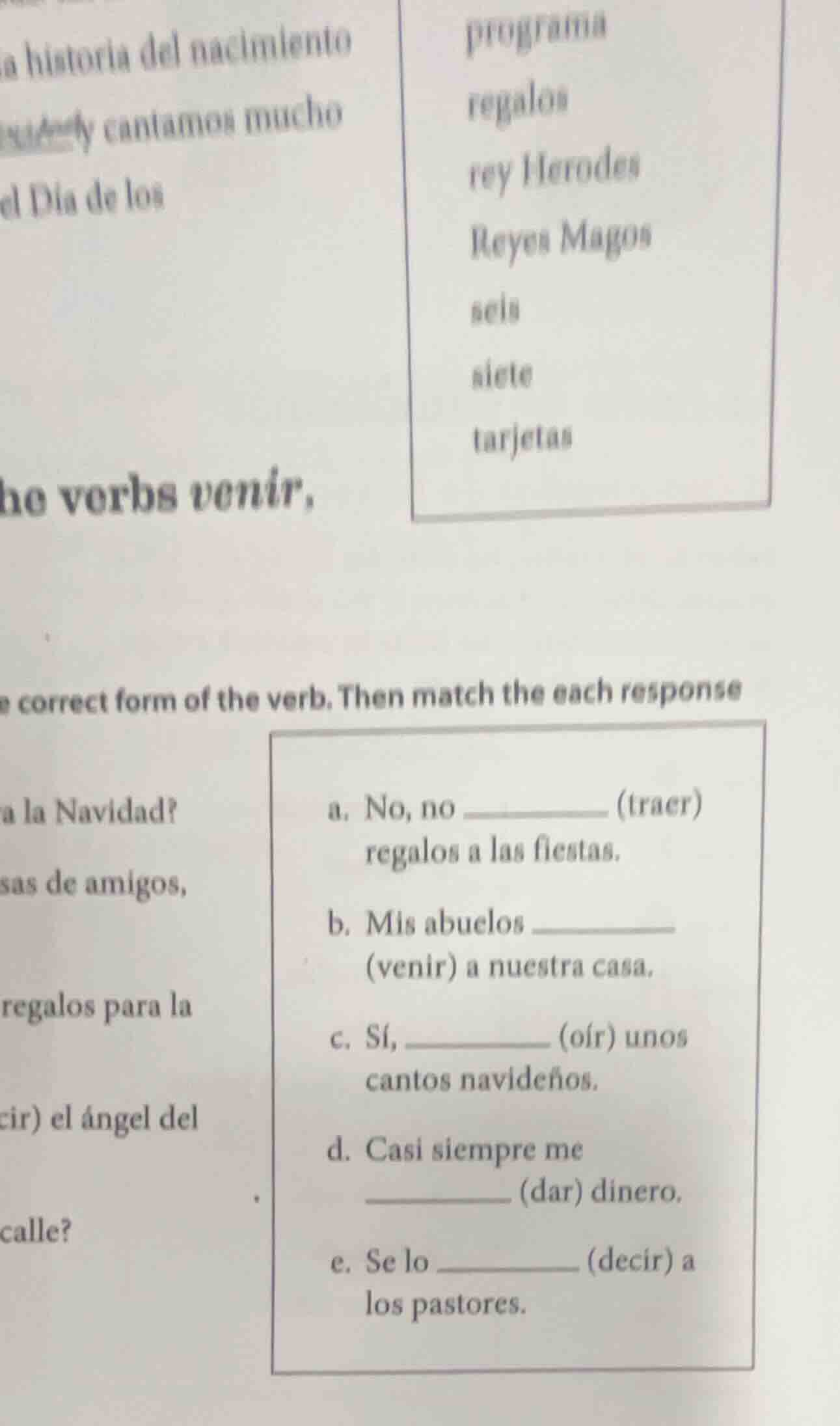
the verbs venir, correct form of the verb. then match the each response a la navidad? sas de amigos, regalos para la cir) el ángel del calle? a. no, no _____ (traer) regalos a las fiestas. b. mis abuelos ___ (venir) a nuestra casa. c. sí, ___ (oír) unos cantos navideños. d. casi siempre me ___ (dar) dinero. e. se lo _____ (decir) a los pastores.
To solve this, we need to conjugate the Spanish verbs correctly. Let's go through each part:
Part a
The verb is traer (to bring). The subject here is implied (probably "yo" or a singular subject, but in negative form "no traigo" for first person singular. Wait, the sentence is "No, no __ (traer) regalos a las fiestas." Let's check the subject. If we assume it's "yo", the conjugation of traer in present tense is: yo traigo, tú traes, él/ella/Ud. trae, nosotros traemos, vosotros traéis, ellos/ellas/Uds. traen. But in negative, "no traigo" for yo. Wait, maybe the subject is "yo"? Wait, the sentence structure: "No, no __ (traer) regalos a las fiestas." Let's see, maybe it's "yo" so "traigo" but negative: "No, no traigo regalos a las fiestas." Wait, no, the negative form for "yo" is "no traigo". Wait, maybe the subject is "tú"? No, "tú traes". Wait, maybe the subject is "él/ella/Ud."? "trae". Wait, maybe the context is "yo" so:
Step 1: Identify the verb and subject for part a
Verb: traer, subject (implied, maybe "yo"). Conjugation of traer in present tense: yo traigo.
So "No, no traigo regalos a las fiestas."
Part b
Verb: venir (to come). The subject is "Mis abuelos" (my grandparents), which is plural (ellos/ellas/Uds.). Conjugation of venir: yo vengo, tú vienes, él/ella/Ud. viene, nosotros venimos, vosotros venís, ellos/ellas/Uds. vienen. So for "Mis abuelos" (ellos), the conjugation is "vienen".
So "Mis abuelos vienen a nuestra casa."
Part c
Verb: oír (to hear). The subject is implied (maybe "yo" or "tú"). Wait, the sentence is "Sí, ____ (oír) unos cantos navideños." Let's check conjugation. oír: yo oigo, tú oyes, él/ella/Ud. oye, nosotros oímos, vosotros oís, ellos/ellas/Uds. oyen. If the subject is "yo", then "oigo". So "Sí, oigo unos cantos navideños."
Part d
Verb: dar (to give). The subject is "me" (indirect object, the subject is implied, maybe "ellos" or "mi abuelo" etc. Wait, "Casi siempre me ____ (dar) dinero." Let's check conjugation. dar: yo doy, tú das, él/ella/Ud. da, nosotros damos, vosotros dais, ellos/ellas/Uds. dan. If the subject is "él/ella/Ud." (like a grandparent), then "da". If it's "ellos", "dan". But "me" is indirect object. Let's see, "me da" (he/she gives me) or "me dan" (they give me). Since "casi siempre" (almost always), maybe singular or plural. Let's assume singular (like a parent or grandparent), so "da". Wait, but maybe "ellos" (plural), so "dan". Wait, the verb dar: for "yo" is "doy", "tú" "das", "él/ella/Ud." "da", "nosotros" "damos", "vosotros" "dais", "ellos/ellas/Uds." "dan". So if the subject is "él/ella/Ud." (like a grandparent), then "da". So "Casi siempre me da dinero." (if singular) or "dan" (if plural). Let's check the context. Maybe singular, so "da".
Part e
Verb: decir (to say/tell). The sentence is "Se lo __ (decir) a los pastores." The subject is implied (maybe "yo" or "él/ella/Ud."). Conjugation of decir: yo digo, tú dices, él/ella/Ud. dice, nosotros decimos, vosotros decís, ellos/ellas/Uds. dicen. So if the subject is "yo", "digo". If it's "él/ella/Ud.", "dice". Let's see the context. "Se lo __ (decir) a los pastores." Let's assume the subject is "yo", so "digo". Wait, "Se lo digo a los pastores."
Wait, maybe I made some mistakes. Let's recheck:
Correct conjugations:
- traer: present tense conjugation:
- yo: traigo
- tú: traes
- él/ella/Ud.: trae
- nosotros: traemos
- vosotros: traéis
- ellos/ellas/Uds.: traen
- venir:
- yo: vengo
- tú: vienes
- él/ella/Ud.: viene
- nosotros: venimos
- vosot…

Snap & solve any problem in the app
Get step-by-step solutions on Sovi AI
Photo-based solutions with guided steps
Explore more problems and detailed explanations
To solve this, we need to conjugate the Spanish verbs correctly. Let's go through each part:
Part a
The verb is traer (to bring). The subject here is implied (probably "yo" or a singular subject, but in negative form "no traigo" for first person singular. Wait, the sentence is "No, no __ (traer) regalos a las fiestas." Let's check the subject. If we assume it's "yo", the conjugation of traer in present tense is: yo traigo, tú traes, él/ella/Ud. trae, nosotros traemos, vosotros traéis, ellos/ellas/Uds. traen. But in negative, "no traigo" for yo. Wait, maybe the subject is "yo"? Wait, the sentence structure: "No, no __ (traer) regalos a las fiestas." Let's see, maybe it's "yo" so "traigo" but negative: "No, no traigo regalos a las fiestas." Wait, no, the negative form for "yo" is "no traigo". Wait, maybe the subject is "tú"? No, "tú traes". Wait, maybe the subject is "él/ella/Ud."? "trae". Wait, maybe the context is "yo" so:
Step 1: Identify the verb and subject for part a
Verb: traer, subject (implied, maybe "yo"). Conjugation of traer in present tense: yo traigo.
So "No, no traigo regalos a las fiestas."
Part b
Verb: venir (to come). The subject is "Mis abuelos" (my grandparents), which is plural (ellos/ellas/Uds.). Conjugation of venir: yo vengo, tú vienes, él/ella/Ud. viene, nosotros venimos, vosotros venís, ellos/ellas/Uds. vienen. So for "Mis abuelos" (ellos), the conjugation is "vienen".
So "Mis abuelos vienen a nuestra casa."
Part c
Verb: oír (to hear). The subject is implied (maybe "yo" or "tú"). Wait, the sentence is "Sí, ____ (oír) unos cantos navideños." Let's check conjugation. oír: yo oigo, tú oyes, él/ella/Ud. oye, nosotros oímos, vosotros oís, ellos/ellas/Uds. oyen. If the subject is "yo", then "oigo". So "Sí, oigo unos cantos navideños."
Part d
Verb: dar (to give). The subject is "me" (indirect object, the subject is implied, maybe "ellos" or "mi abuelo" etc. Wait, "Casi siempre me ____ (dar) dinero." Let's check conjugation. dar: yo doy, tú das, él/ella/Ud. da, nosotros damos, vosotros dais, ellos/ellas/Uds. dan. If the subject is "él/ella/Ud." (like a grandparent), then "da". If it's "ellos", "dan". But "me" is indirect object. Let's see, "me da" (he/she gives me) or "me dan" (they give me). Since "casi siempre" (almost always), maybe singular or plural. Let's assume singular (like a parent or grandparent), so "da". Wait, but maybe "ellos" (plural), so "dan". Wait, the verb dar: for "yo" is "doy", "tú" "das", "él/ella/Ud." "da", "nosotros" "damos", "vosotros" "dais", "ellos/ellas/Uds." "dan". So if the subject is "él/ella/Ud." (like a grandparent), then "da". So "Casi siempre me da dinero." (if singular) or "dan" (if plural). Let's check the context. Maybe singular, so "da".
Part e
Verb: decir (to say/tell). The sentence is "Se lo __ (decir) a los pastores." The subject is implied (maybe "yo" or "él/ella/Ud."). Conjugation of decir: yo digo, tú dices, él/ella/Ud. dice, nosotros decimos, vosotros decís, ellos/ellas/Uds. dicen. So if the subject is "yo", "digo". If it's "él/ella/Ud.", "dice". Let's see the context. "Se lo __ (decir) a los pastores." Let's assume the subject is "yo", so "digo". Wait, "Se lo digo a los pastores."
Wait, maybe I made some mistakes. Let's recheck:
Correct conjugations:
- traer: present tense conjugation:
- yo: traigo
- tú: traes
- él/ella/Ud.: trae
- nosotros: traemos
- vosotros: traéis
- ellos/ellas/Uds.: traen
- venir:
- yo: vengo
- tú: vienes
- él/ella/Ud.: viene
- nosotros: venimos
- vosotros: venís
- ellos/ellas/Uds.: vienen
- oír:
- yo: oigo
- tú: oyes
- él/ella/Ud.: oye
- nosotros: oímos
- vosotros: oís
- ellos/ellas/Uds.: oyen
- dar:
- yo: doy
- tú: das
- él/ella/Ud.: da
- nosotros: damos
- vosotros: dais
- ellos/ellas/Uds.: dan
- decir:
- yo: digo
- tú: dices
- él/ella/Ud.: dice
- nosotros: decimos
- vosotros: decís
- ellos/ellas/Uds.: dicen
So let's redo each part with correct conjugations:
Part a
Sentence: "No, no ____ (traer) regalos a las fiestas." Let's assume the subject is "yo" (first person singular). So traer conjugation for yo: traigo. So "No, no traigo regalos a las fiestas."
Part b
Subject: "Mis abuelos" (ellos/ellas/Uds.), verb venir. Conjugation for ellos: vienen. So "Mis abuelos vienen a nuestra casa."
Part c
Sentence: "Sí, ____ (oír) unos cantos navideños." Assume subject is "yo" (first person singular). oír conjugation for yo: oigo. So "Sí, oigo unos cantos navideños."
Part d
Sentence: "Casi siempre me ____ (dar) dinero." Assume subject is "él/ella/Ud." (singular, like a grandparent) or "ellos/ellas/Uds." (plural). If singular (él/ella/Ud.), dar conjugation: da. If plural (ellos/ellas/Uds.), dan. Let's check the context. "Casi siempre" (almost always) – maybe singular, so "da". So "Casi siempre me da dinero." (if singular) or "dan" (if plural). Let's go with singular (maybe "mi abuelo" or "mi abuela"), so "da".
Part e
Sentence: "Se lo ____ (decir) a los pastores." Assume subject is "yo" (first person singular). decir conjugation for yo: digo. So "Se lo digo a los pastores."
Now, let's summarize the answers:
a. traigo
b. vienen
c. oigo
d. da (or dan, but let's check context. If "me" is from a singular subject, "da"; if plural, "dan". But maybe the subject is "él/ella/Ud." so "da".)
e. digo
Wait, maybe I made a mistake in part d. Let's check again. "Casi siempre me ____ (dar) dinero." If the subject is "mis abuelos" (plural), then "dan". So "Casi siempre me dan dinero." That might be more appropriate because "mis abuelos" is plural, but in part d, the subject is not "mis abuelos" (part b is "mis abuelos"). So part d's subject is different. Maybe "mi padre" (singular) so "da", or "mis padres" (plural) so "dan". Let's assume plural, so "dan".
So correcting part d: "Casi siempre me dan dinero."
So final answers:
a. traigo
b. vienen
c. oigo
d. dan
e. digo
Wait, let's verify each conjugation again:
- traer: yo traigo ✔️
- venir: ellos vienen ✔️ (mis abuelos is plural)
- oír: yo oigo ✔️
- dar: ellos dan (if subject is plural) ✔️
- decir: yo digo ✔️
Yes, that makes sense. So:
a. traigo
b. vienen
c. oigo
d. dan
e. digo