QUESTION IMAGE
Question
viewing discussion questions
setting
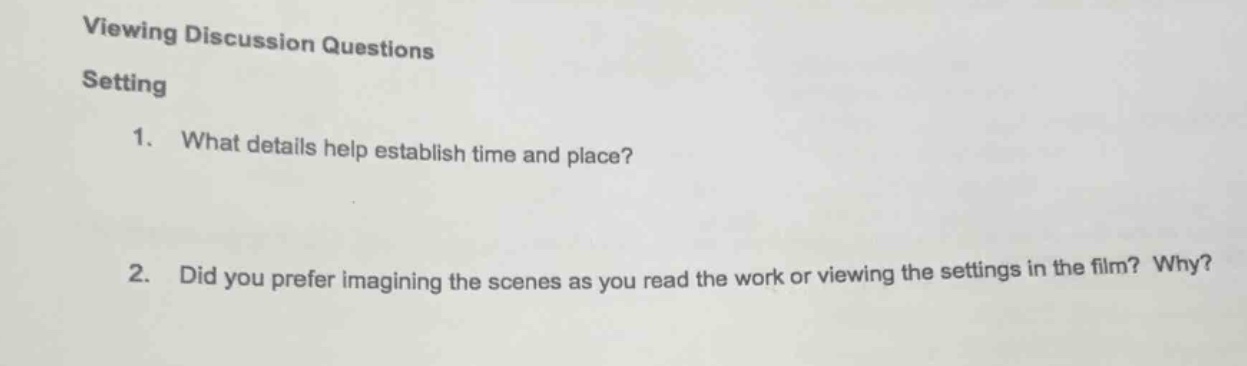
- what details help establish time and place?
- did you prefer imagining the scenes as you read the work or viewing the settings in the film? why?
The problem here seems to be related to analyzing literary or film settings, which falls under the Arts discipline, specifically Literature (as it involves reading a work and comparing with a film adaptation). Since these are discussion questions without calculations, we'll use the Answer - Explanation Format.
For Question 1:
To establish time and place (setting), details like descriptive language (e.g., "Victorian - era London" with cobblestone streets, gas lamps for time; geographic features, cultural norms for place), historical references, weather, architecture, clothing, and social customs are used. For example, in a novel set in 1920s America, flapper dresses, speakeasies, and post - WWI social changes indicate time, while city skylines, regional accents, or rural landscapes indicate place.
Preferences depend on individual engagement with text vs. visual media. Imagining scenes while reading allows for personal interpretation, creativity, and deeper connection to internalized characters/settings. Viewing film settings provides concrete, visually - rich, and collaborative (director - led) imagery, reducing ambiguity. For example, a reader might prefer imagining as it lets them customize the setting to their emotions, while another likes film for its immersive, detailed visuals.

Snap & solve any problem in the app
Get step-by-step solutions on Sovi AI
Photo-based solutions with guided steps
Explore more problems and detailed explanations
Details such as descriptive language (e.g., historical references, architecture, clothing, social customs, geographic features, weather) help establish time (e.g., era - specific elements) and place (e.g., regional/cultural identifiers).