QUESTION IMAGE
Question
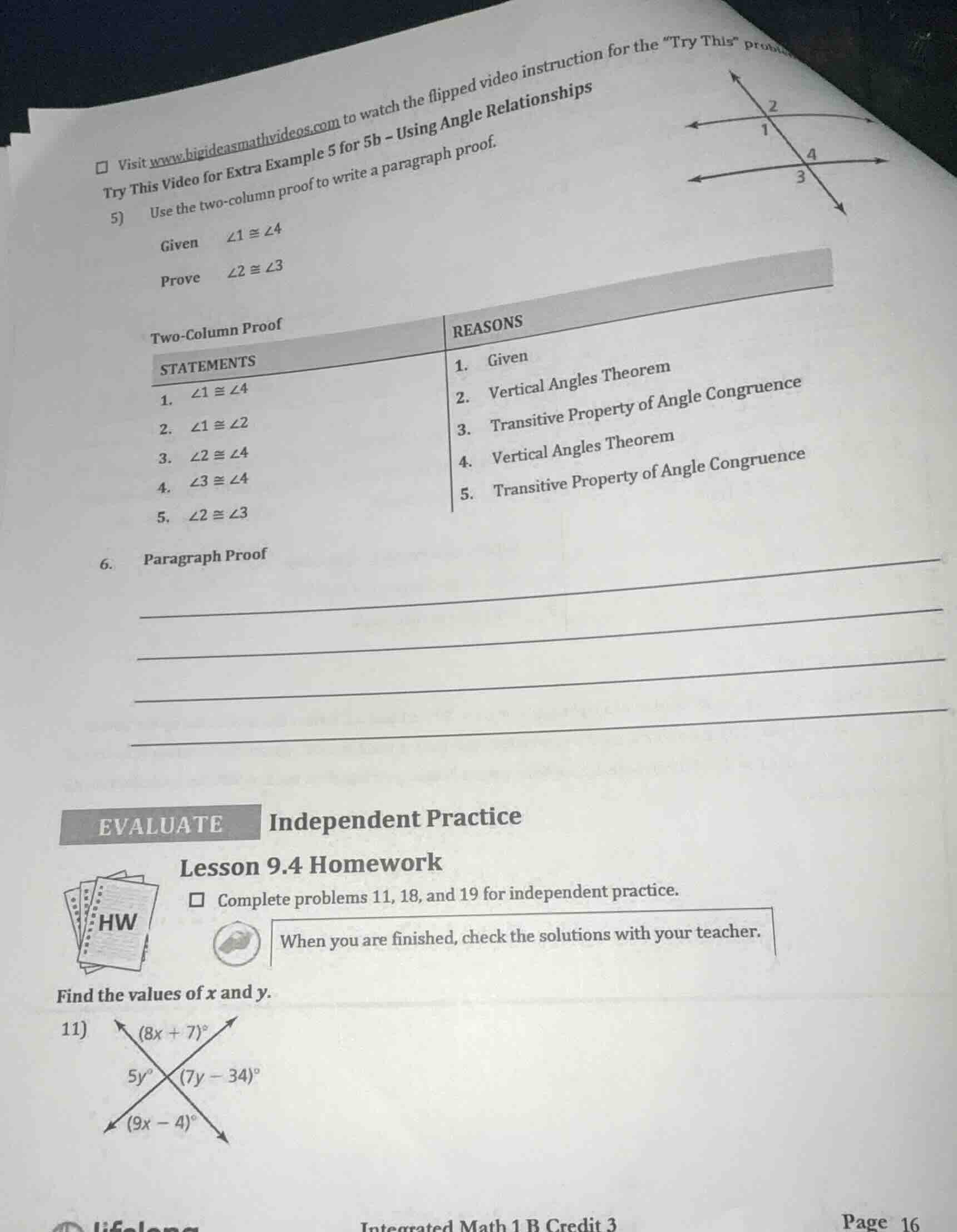
visit www.bigideasmathvideos.com to watch the flipped video instruction for the “try this” pro try this video for extra example 5 for 5b - using angle relationships 5) use the two - column proof to write a paragraph proof. given ∠1 ≅ ∠4 prove ∠2 ≅ ∠3 two - column proof statements reasons 1. ∠1 ≅ ∠4 1. given 2. ∠1 ≅ ∠2 2. vertical angles theorem 3. ∠2 ≅ ∠4 3. transitive property of angle congruence 4. ∠3 ≅ ∠4 4. vertical angles theorem 5. ∠2 ≅ ∠3 5. transitive property of angle congruence 6. paragraph proof ___________________________________________________________________ _________________________________________________________________ _________________________________________________________________ ___________________________________________________________________ evaluate independent practice lesson 9.4 homework □ complete problems 11, 18, and 19 for independent practice. when you are finished, check the solutions with your teacher. find the values of x and y. 11) (8x + 7)° 5y° (7y - 34)° (9x - 4)°
Step1: Solve for x using vertical angles
Vertical angles are congruent, so set $8x + 7 = 9x - 4$.
Rearrange: $9x - 8x = 7 + 4$
$x = 11$
Step2: Solve for y using vertical angles
Vertical angles are congruent, so set $5y = 7y - 34$.
Rearrange: $7y - 5y = 34$
$2y = 34$
$y = 17$
Step3: Write paragraph proof
Start with given $\angle 1 \cong \angle 4$. By Vertical Angles Theorem, $\angle 1 \cong \angle 2$ and $\angle 3 \cong \angle 4$. Use Transitive Property: $\angle 2 \cong \angle 4$, then $\angle 2 \cong \angle 3$.

Snap & solve any problem in the app
Get step-by-step solutions on Sovi AI
Photo-based solutions with guided steps
Explore more problems and detailed explanations
For the paragraph proof:
We are given that $\angle 1 \cong \angle 4$. By the Vertical Angles Theorem, $\angle 1$ and $\angle 2$ are vertical angles so $\angle 1 \cong \angle 2$, and $\angle 3$ and $\angle 4$ are vertical angles so $\angle 3 \cong \angle 4$. Using the Transitive Property of Angle Congruence, since $\angle 1 \cong \angle 2$ and $\angle 1 \cong \angle 4$, we can conclude $\angle 2 \cong \angle 4$. Then, because $\angle 3 \cong \angle 4$, applying the Transitive Property again gives $\angle 2 \cong \angle 3$.
For problem 11:
$x = 11$, $y = 17$