QUESTION IMAGE
Question
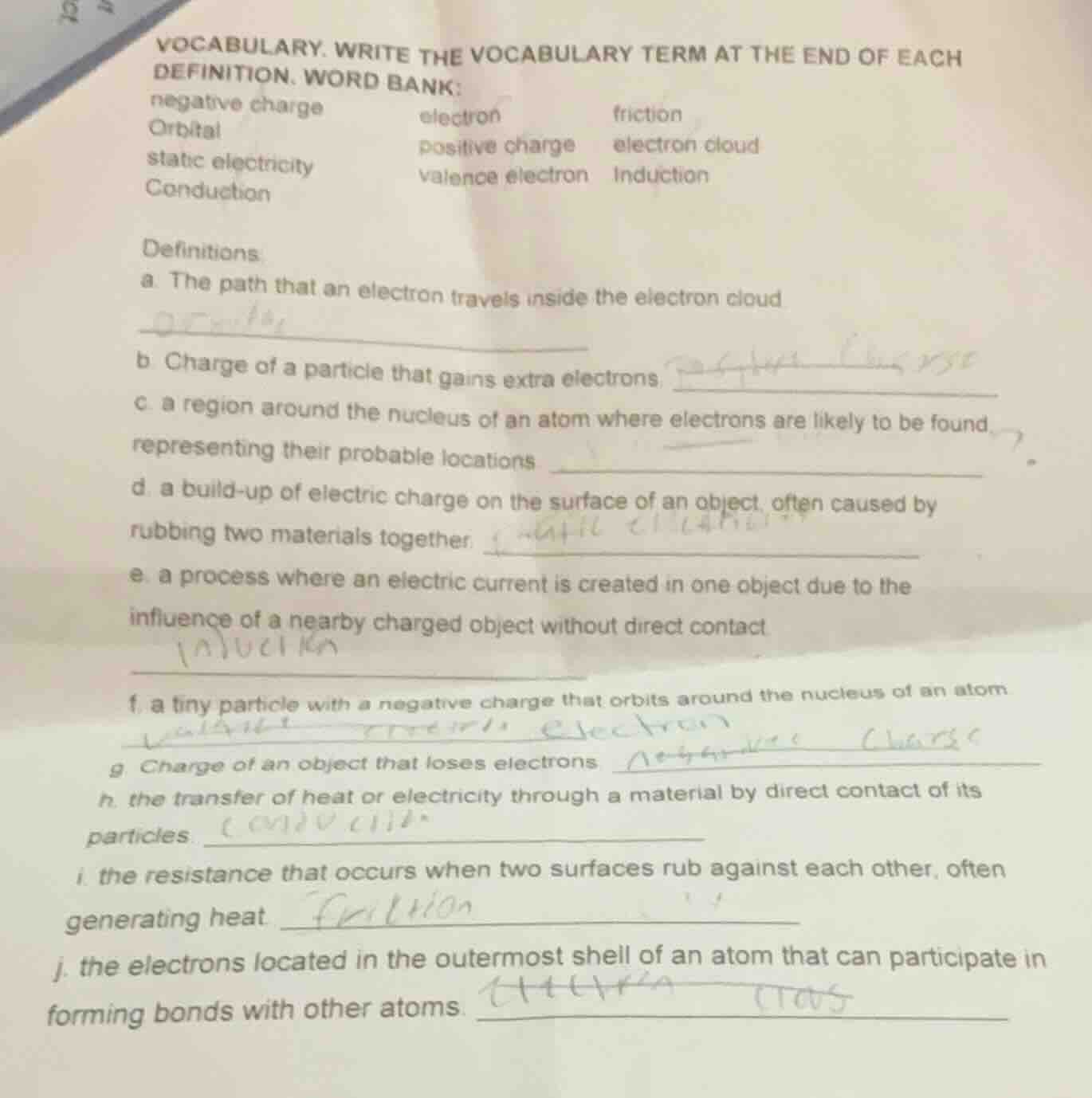
vocabulary. write the vocabulary term at the end of each definition. word bank:
negative charge\telectron\tfriction
orbital\tpositive charge\telectron cloud
static electricity\tvalence electron\tinduction
conduction
definitions
a. the path that an electron travels inside the electron cloud
_________________________________________
b. charge of a particle that gains extra electrons
_________________________________________
c. a region around the nucleus of an atom where electrons are likely to be found representing their probable locations
_________________________________________
d. a build-up of electric charge on the surface of an object, often caused by rubbing two materials together
_________________________________________
e. a process where an electric current is created in one object due to the influence of a nearby charged object without direct contact
_________________________________________
f. a tiny particle with a negative charge that orbits around the nucleus of an atom
_________________________________________
g. charge of an object that loses electrons
_________________________________________
h. the transfer of heat or electricity through a material by direct contact of its particles
_________________________________________
i. the resistance that occurs when two surfaces rub against each other, often generating heat
_________________________________________
j. the electrons located in the outermost shell of an atom that can participate in forming bonds with other atoms
_________________________________________
Each definition is matched to the correct term from the provided word bank based on standard scientific definitions:
a. Matches the path electrons take in the electron cloud.
b. Gaining electrons results in this charge.
c. Describes the region of probable electron locations.
d. Rubbing materials creates this surface charge buildup.
e. This process causes charge transfer without direct contact.
f. This is the negatively charged subatomic particle orbiting the nucleus.
g. Losing electrons results in this charge.
h. This is the transfer of energy/charge via direct contact.
i. Rubbing surfaces create this resistance.
j. These are the outermost electrons involved in bonding.

Snap & solve any problem in the app
Get step-by-step solutions on Sovi AI
Photo-based solutions with guided steps
Explore more problems and detailed explanations
a. Orbital
b. negative charge
c. electron cloud
d. static electricity
e. Induction
f. electron
g. positive charge
h. Conduction
i. friction
j. valence electron