QUESTION IMAGE
Question
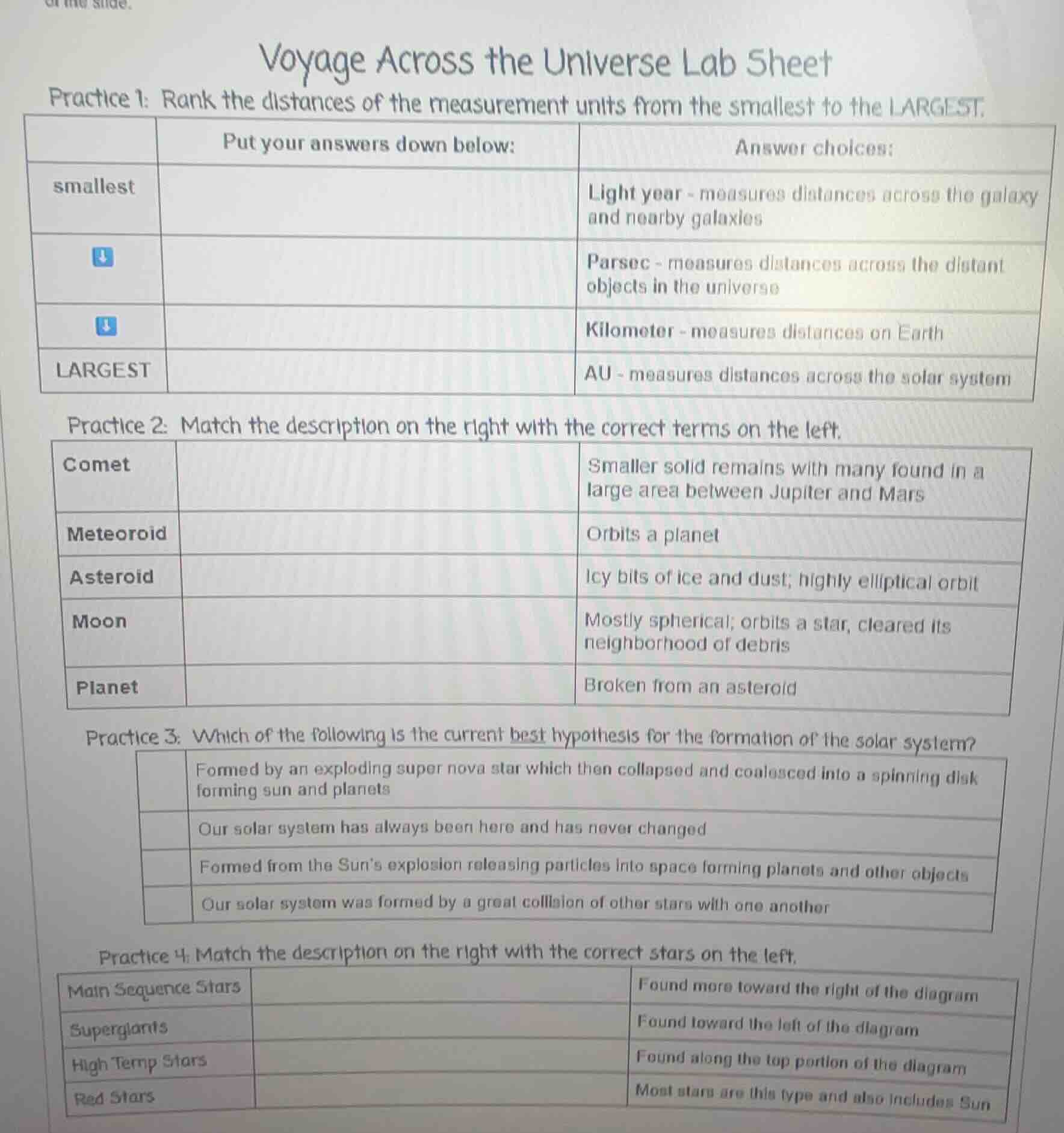
voyage across the universe lab sheet
practice 1: rank the distances of the measurement units from the smallest to the largest.
put your answers down below:
answer choices:
smallest
light year - measures distances across the galaxy and nearby galaxies
parsec - measures distances across the distant objects in the universe
kilometer - measures distances on earth
largest
au - measures distances across the solar system
practice 2: match the description on the right with the correct terms on the left.
comet
smaller solid remains with many found in a large area between jupiter and mars
meteoroid
orbits a planet
asteroid
icy bits of ice and dust; highly elliptical orbit
moon
mostly spherical; orbits a star, cleared its neighborhood of debris
planet
broken from an asteroid
practice 3: which of the following is the current best hypothesis for the formation of the solar system?
formed by an exploding super nova star which then collapsed and coalesced into a spinning disk forming sun and planets
our solar system has always been here and has never changed
formed from the suns explosion releasing particles into space forming planets and other objects
our solar system was formed by a great collision of other stars with one another
practice 4: match the description on the right with the correct stars on the left.
main sequence stars
found more toward the right of the diagram
supergiants
found toward the left of the diagram
high temp stars
found along the top portion of the diagram
red stars
most stars are this type and also includes sun
Practice 1 (Ranking Distances)
Step1: Define unit magnitudes
Kilometer (km): ~$10^3$ m; AU: ~$1.5\times10^8$ km; Light-year: ~$9.5\times10^{12}$ km; Parsec: ~$3.26$ light-years
Step2: Order from smallest to largest
Sort units by increasing distance scale.
Match each term to its defining characteristic based on astronomical definitions:
- Comets are icy, dust-rich bodies with stretched orbits.
- Meteoroids are fragments broken from asteroids/comets.
- Asteroids are rocky bodies concentrated between Mars and Jupiter.
- Moons are natural satellites that orbit planets.
- Planets are spherical, orbit stars, and cleared their orbital zones.
The leading scientific model for solar system formation is the nebular hypothesis, which states the system formed from the collapse of a giant molecular cloud (triggered by a supernova shockwave) into a spinning disk, with the Sun forming at the center and planets coalescing from disk material. Other options are outdated or unsupported.

Snap & solve any problem in the app
Get step-by-step solutions on Sovi AI
Photo-based solutions with guided steps
Explore more problems and detailed explanations
smallest: Kilometer - measures distances on Earth
↓: AU - measures distances across the solar system
↓: Light year - measures distances across the galaxy and nearby galaxies
LARGEST: Parsec - measures distances across the distant objects in the universe
---