QUESTION IMAGE
Question
vus.5a
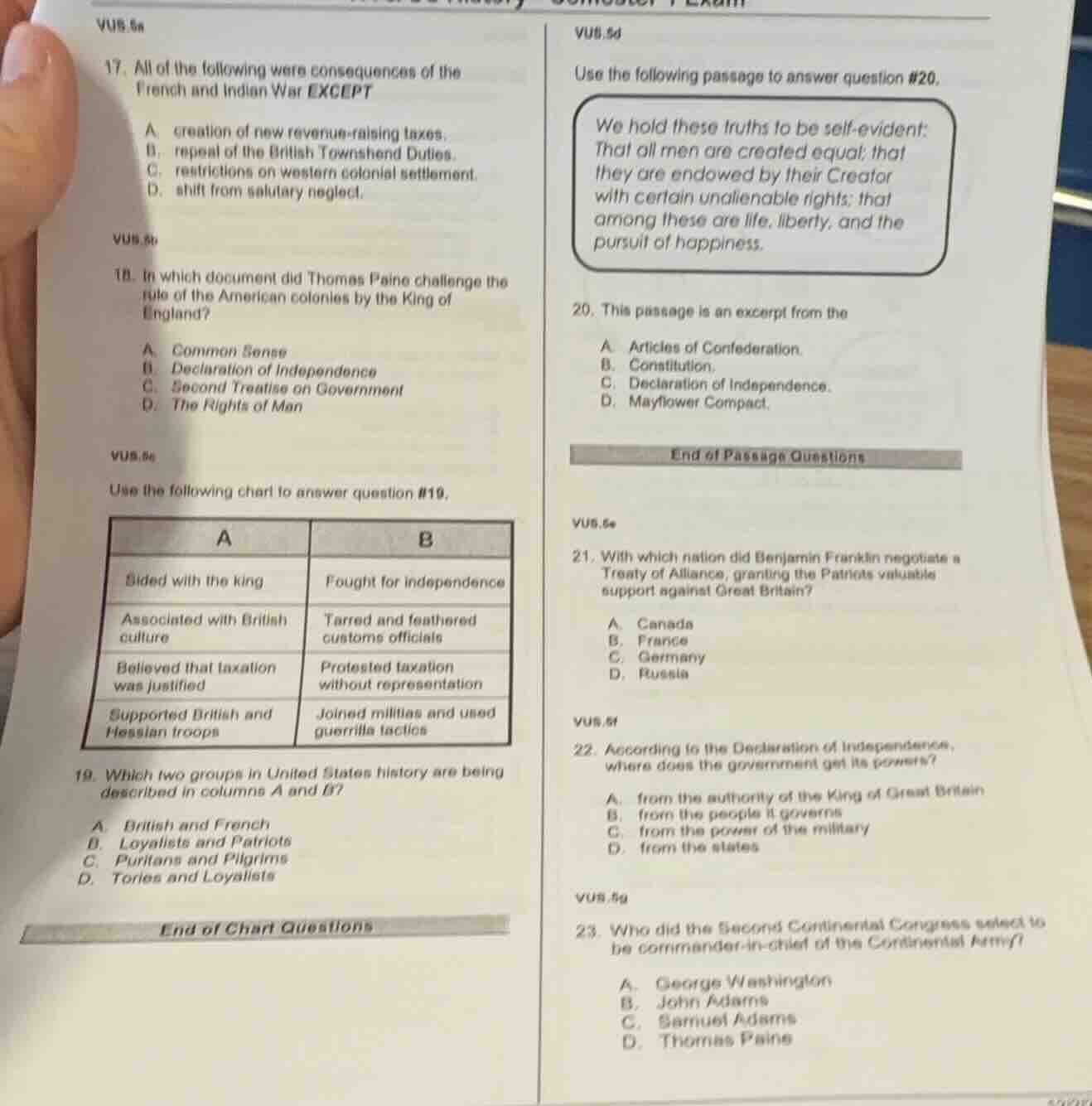
- all of the following were consequences of the french and indian war except
a. creation of new revenue - raising taxes.
b. repeal of the british townshend duties.
c. restrictions on western colonial settlement.
d. shift from salutary neglect.
vus.5b
- in which document did thomas paine challenge the rule of the american colonies by the king of england?
a. common sense
b. declaration of independence
c. second treatise on government
d. the rights of man
vus.5c
use the following chart to answer question #19.
| a | b |
|---|---|
| associated with british culture | tarred and feathered customs officials |
| believed that taxation was justified | protested taxation without representation |
| supported british and hessian troops | joined militias and used guerrilla tactics |
- which two groups in united states history are being described in columns a and b?
a. british and french
b. loyalists and patriots
c. puritans and pilgrims
d. tories and loyalists
end of chart questions
vus.5d
use the following passage to answer question #20.
we hold these truths to be self - evident:
that all men are created equal; that
they are endowed by their creator
with certain unalienable rights; that
among these are life, liberty, and the
pursuit of happiness.
- this passage is an excerpt from the
a. articles of confederation.
b. constitution.
c. declaration of independence.
d. mayflower compact.
end of passage questions
vus.5e
- with which nation did benjamin franklin negotiate a treaty of alliance, granting the patriots valuable support against great britain?
a. canada
b. france
c. germany
d. russia
vus.5f
- according to the declaration of independence, where does the government get its powers?
a. from the authority of the king of great britain
b. from the people it governs
c. from the power of the military
d. from the states
vus.5g
- who did the second continental congress select to be commander - in - chief of the continental army?
a. george washington
b. john adams
c. samuel adams
d. thomas paine
- The French and Indian War led to new taxes, western settlement restrictions, and end of salutary neglect. Townshend Duties were repealed later, unrelated to this war.
- Thomas Paine's Common Sense argued against British royal rule over colonies.
- Column A describes Loyalists (pro-British, supported the king), Column B describes Patriots (fought for independence, protested taxation).
- The quoted passage is a famous excerpt from the Declaration of Independence.
- Benjamin Franklin negotiated the 1778 Treaty of Alliance with France, gaining critical support for the Patriots.
- The Declaration of Independence states government derives its power from the consent of the governed (the people it governs).
- The Second Continental Congress chose George Washington as commander-in-chief of the Continental Army.

Snap & solve any problem in the app
Get step-by-step solutions on Sovi AI
Photo-based solutions with guided steps
Explore more problems and detailed explanations
- B. repeal of the British Townshend Duties.
- A. Common Sense
- B. Loyalists and Patriots
- C. Declaration of Independence.
- B. France
- B. from the people it governs
- A. George Washington