QUESTION IMAGE
Question
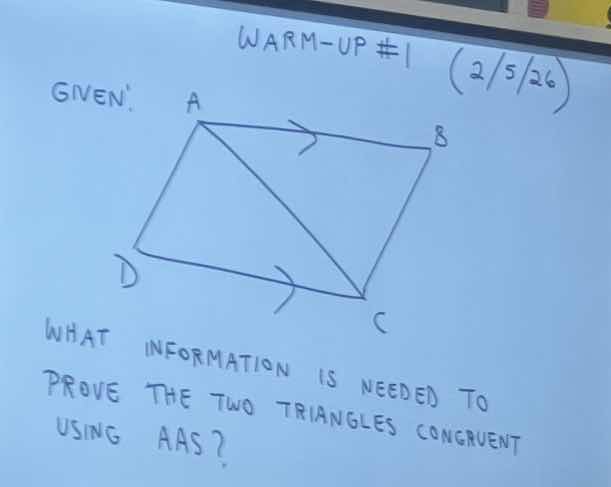
warm-up #1 (2/5/26)
given:
what information is needed to prove the two triangles congruent using aas?
Step1: Recall AAS Congruence
AAS (Angle - Angle - Side) congruence criterion states that if two angles and a non - included side of one triangle are congruent to the corresponding two angles and non - included side of another triangle, then the two triangles are congruent.
In the parallelogram \(ABCD\) (implied by \(AB\parallel DC\) and \(AD\parallel BC\) from the arrows), we have \(\triangle ADC\) and \(\triangle CBA\). We know that \(\angle DAC=\angle BCA\) (alternate interior angles, since \(AD\parallel BC\) and \(AC\) is a transversal) and \(\angle DCA = \angle BAC\) (alternate interior angles, since \(AB\parallel DC\) and \(AC\) is a transversal). Also, \(AC\) is a common side. But for AAS, we need two angles and a non - included side.
Looking at the triangles \(\triangle ACD\) and \(\triangle CAB\):
- We already have that \(AB\parallel DC\) and \(AD\parallel BC\) (from the arrows on the sides, indicating parallel sides, so it's a parallelogram). So, \(\angle D=\angle B\) (opposite angles of a parallelogram are equal) and \(\angle DAC=\angle BCA\) (alternate interior angles) or \(\angle DCA=\angle BAC\) (alternate interior angles).
- To use AAS, we need either:
- One pair of equal angles (other than the ones from parallel lines) and a pair of equal non - included sides. Or, since we know that \(AC\) is common, if we know that \(\angle D=\angle B\), \(\angle DAC=\angle BCA\) and \(AD = BC\) (or \(\angle DCA=\angle BAC\) and \(DC = AB\)) or \(\angle D=\angle B\), \(\angle DCA=\angle BAC\) and \(DC=AB\) (or \(AD = BC\)). But more precisely, in the triangles \(\triangle ADC\) and \(\triangle CBA\):
- We know that \(AC\) is a side common to both triangles. For AAS, we need two angles and a non - included side. Let's consider the angles:
- Since \(AB\parallel DC\) and \(AD\parallel BC\), \(\angle D\) and \(\angle B\) are equal (opposite angles of parallelogram). Also, \(\angle DAC=\angle BCA\) (alternate interior angles) and \(\angle DCA=\angle BAC\) (alternate interior angles).
- To apply AAS, we need either:
- \(\angle D=\angle B\), \(\angle DAC=\angle BCA\) and \(AD = BC\) (because in \(\triangle ADC\), the angles \(\angle D\) and \(\angle DAC\) have non - included side \(AD\), and in \(\triangle CBA\), the angles \(\angle B\) and \(\angle BCA\) have non - included side \(BC\)).
- Or \(\angle D=\angle B\), \(\angle DCA=\angle BAC\) and \(DC = AB\) (because in \(\triangle ADC\), the angles \(\angle D\) and \(\angle DCA\) have non - included side \(DC\), and in \(\triangle CBA\), the angles \(\angle B\) and \(\angle BAC\) have non - included side \(AB\)).
- Alternatively, since \(AC\) is common, if we know that \(\angle D=\angle B\), and either \(\angle DAC=\angle BCA\) with \(AD = BC\) or \(\angle DCA=\angle BAC\) with \(DC = AB\), we can use AAS. But the key information needed is: We need to know that two angles and a non - included side are congruent. In the context of the parallelogram (from the diagram with parallel sides), we know that \(AB\parallel DC\) and \(AD\parallel BC\), so \(\angle D=\angle B\) (opposite angles of parallelogram). Then, if we know that \(\angle DAC=\angle BCA\) and \(AD = BC\) (or \(\angle DCA=\angle BAC\) and \(DC = AB\)), we can use AAS. But more simply, since \(AC\) is a common side, and we have \(\angle D=\angle B\) (from parallelogram), we need one more pair of angles (like \(\angle DAC=\angle BCA\) or \(\angle DCA=\angle BAC\)) and the non - included side ( \(AD = BC\) or \(DC = AB\)). But the most direct way: In \(\triangle ADC\) and \(\tri…

Snap & solve any problem in the app
Get step-by-step solutions on Sovi AI
Photo-based solutions with guided steps
Explore more problems and detailed explanations
To prove \(\triangle ACD\cong\triangle CAB\) (the two triangles formed by diagonal \(AC\)) using AAS, we need:
- Two pairs of congruent angles (e.g., \(\boldsymbol{\angle D=\angle B}\) (opposite angles of the parallelogram) and \(\boldsymbol{\angle DAC=\angle BCA}\) (alternate interior angles, since \(AD\parallel BC\)) or \(\boldsymbol{\angle DCA=\angle BAC}\) (alternate interior angles, since \(AB\parallel DC\)))
- One pair of congruent non - included sides (e.g., \(\boldsymbol{AD = BC}\) or \(\boldsymbol{DC = AB}\) (opposite sides of the parallelogram)).
(In the context of the diagram, since \(AB\parallel DC\) and \(AD\parallel BC\) (arrows indicate parallel sides, so it is a parallelogram), \(AD = BC\), \(DC = AB\), and \(\angle D=\angle B\) are already implied. Thus, confirming \(\angle DAC=\angle BCA\) (or \(\angle DCA=\angle BAC\)) along with the existing equal angles and sides satisfies AAS.)