QUESTION IMAGE
Question
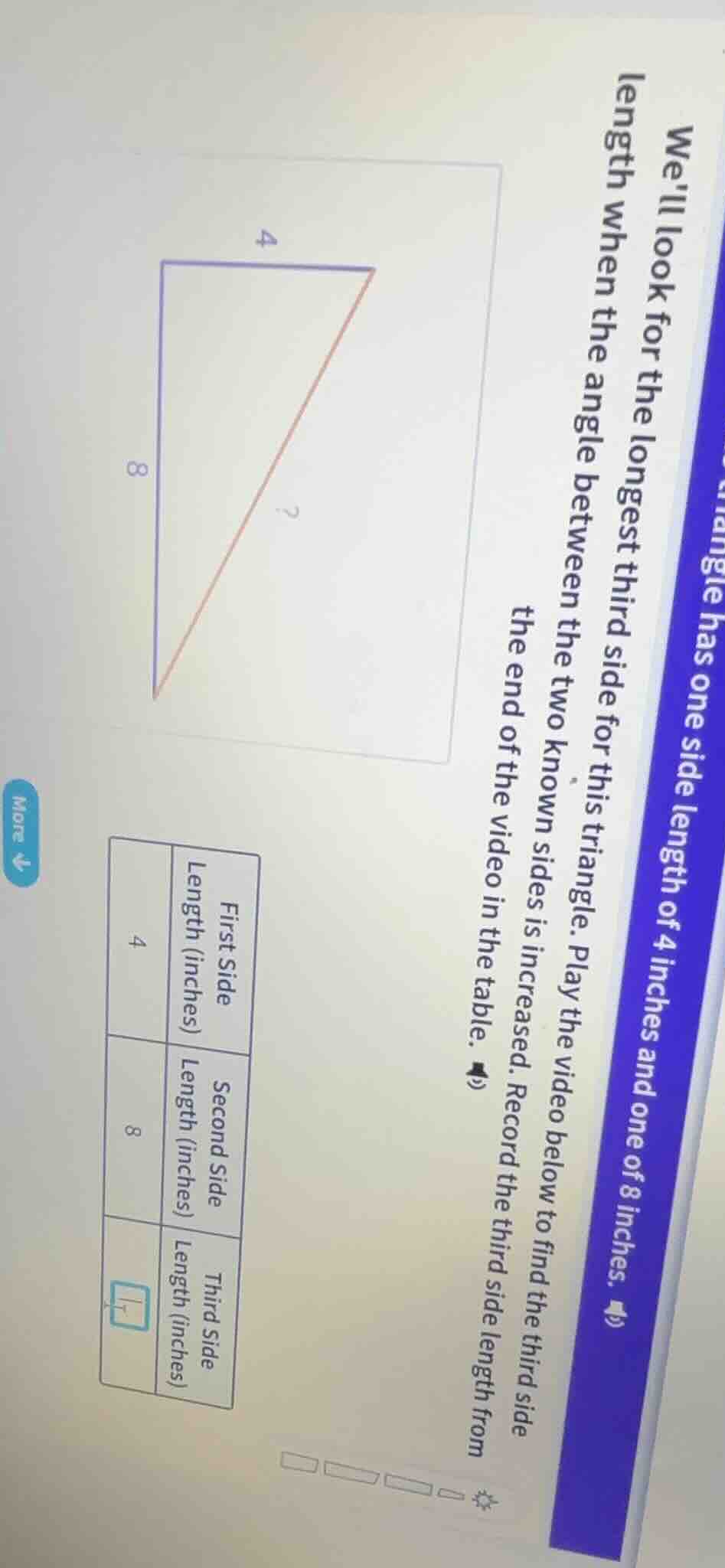
well look for the longest third side for this triangle. play the video below to find the third side when the angle between the two known sides is increased. record the third side length from the end of the video in the table.
(the triangle has one side length of 4 inches and one of 8 inches. the table has: first side length (inches): 4; second side length (inches): 8; third side length (inches): blank)
Step1: Identify the triangle type
The triangle has sides 4 and 8, and we assume it's a right triangle (since it looks like a right - angled triangle from the diagram). So we can use the Pythagorean theorem. The Pythagorean theorem states that for a right triangle with legs \(a\) and \(b\) and hypotenuse \(c\), \(c^{2}=a^{2}+b^{2}\). Here, \(a = 4\) and \(b = 8\).
Step2: Apply the Pythagorean theorem
Substitute the values of \(a\) and \(b\) into the formula. \(c^{2}=4^{2}+8^{2}\). Calculate \(4^{2}=16\) and \(8^{2}=64\). Then \(c^{2}=16 + 64=80\).
Step3: Find the value of \(c\)
Take the square root of 80. \(c=\sqrt{80}=\sqrt{16\times5}=4\sqrt{5}\approx8.94\) (if we want a decimal approximation). But if we consider the problem might be expecting an exact form or a simplified radical form, the length of the third side (hypotenuse) is \(4\sqrt{5}\) inches or approximately 8.94 inches.

Snap & solve any problem in the app
Get step-by-step solutions on Sovi AI
Photo-based solutions with guided steps
Explore more problems and detailed explanations
If we consider the right - triangle and use the Pythagorean theorem, the length of the third side is \(4\sqrt{5}\approx8.94\) inches. (If we need to write it as an exact value, it is \(4\sqrt{5}\) inches; if as a decimal, approximately 8.94 inches)