QUESTION IMAGE
Question
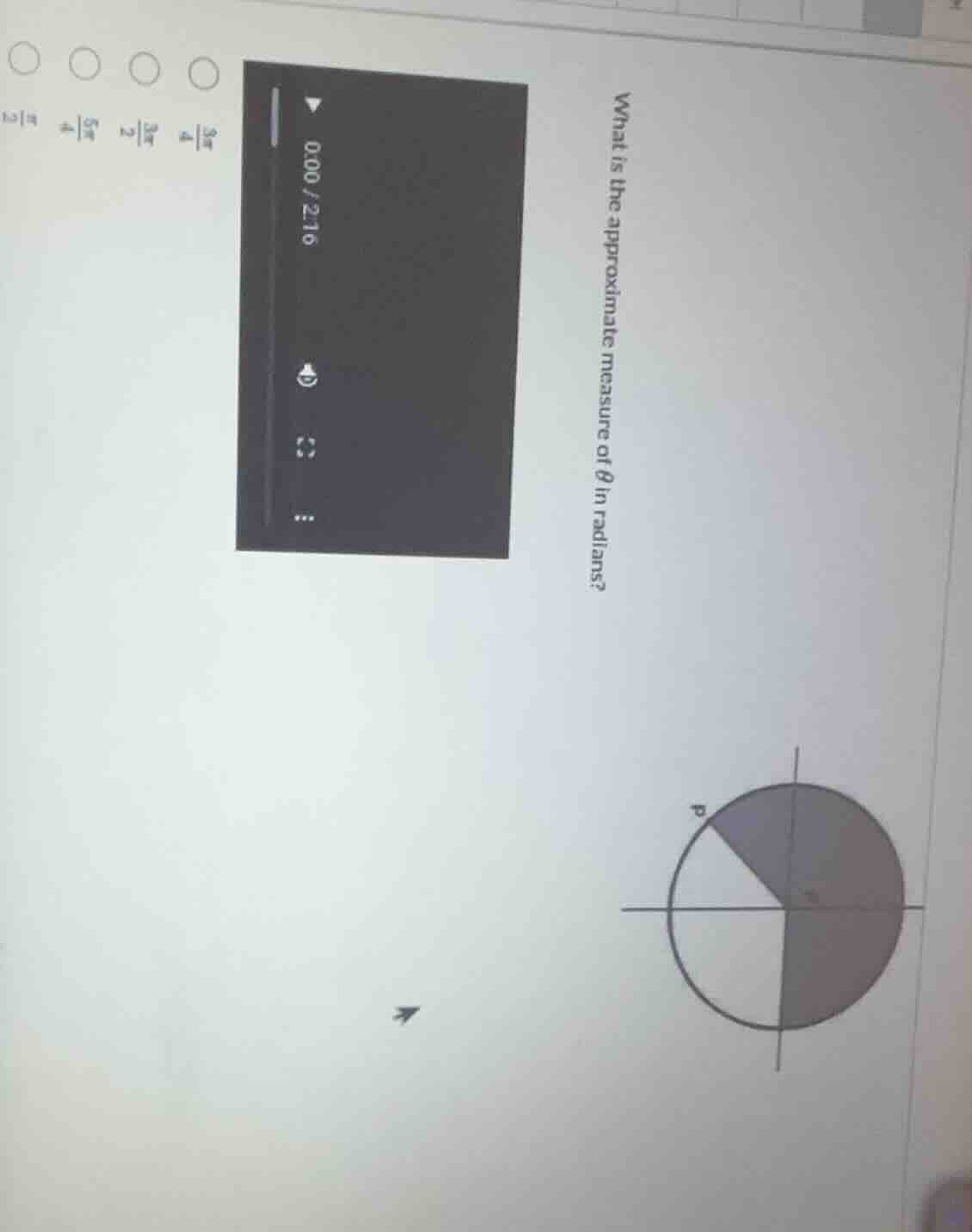
what is the approximate measure of \\(\theta\\) in radians? options: \\(\frac{3\pi}{4}\\), \\(\frac{3\pi}{2}\\), \\(\frac{5\pi}{4}\\), \\(\pi\\) chart: a circle with a shaded sector and a point p, and a coordinate system with axes through the center of the circle
Step1: Identify full circle radians
A full circle is $2\pi$ radians.
Step2: Analyze shaded portion
The shaded area covers $\frac{3}{4}$ of the circle? No, wait: the unshaded is $\frac{1}{4}$, so shaded $\theta = 2\pi - \frac{\pi}{2} = \frac{3\pi}{2}$? No, no—wait, the angle $\theta$ is the shaded central angle. Wait, the unshaded is a right angle ($\frac{\pi}{2}$), so shaded $\theta = 2\pi - \frac{\pi}{2} = \frac{3\pi}{2}$? No, no, looking at the options: $\frac{5\pi}{4}$ is an option. Wait, no—wait, the circle: the shaded area is 3 parts? No, wait, the angle from positive x-axis to point P is $\frac{3\pi}{4}$, but the shaded angle is the reflex angle? No, no, the question asks for $\theta$, the measure of the shaded angle. Wait, let's calculate each option:
$\frac{3\pi}{4}=2.356$, $\frac{3\pi}{2}=4.712$, $\frac{5\pi}{4}=3.927$, $\frac{\pi}{2}=1.571$.
The shaded area is 3/4? No, no, the diagram shows shaded area is 3 quadrants? No, no, the unshaded is the top-left quadrant (1/4 circle), so shaded is 3/4, which is $\frac{3}{4} \times 2\pi = \frac{3\pi}{2}$, but that's an option? Wait no, the options are $\frac{3\pi}{4}$, $\frac{3\pi}{2}$, $\frac{5\pi}{4}$, $\frac{\pi}{2}$. Wait, no—wait, maybe $\theta$ is the angle for the shaded sector, not the reflex. Wait, no, the shaded area is a sector that goes from positive x-axis clockwise to negative y-axis, plus the top right? No, no, the diagram: the shaded area is the right half (positive x-axis, all) plus the bottom left, and the top right? Wait, no, the unshaded is the top left quadrant. So the shaded angle is $2\pi - \frac{\pi}{2} = \frac{3\pi}{2}$? But wait, $\frac{5\pi}{4}$ is 225 degrees, which is 5/8 of the circle. Wait, no, maybe I misread the diagram. Wait, the options: $\frac{5\pi}{4}$ is 225°, which is 5/8 of 360. Wait, no, let's check:
Wait, the standard position: positive x-axis is 0, counterclockwise. The shaded area: from positive x-axis counterclockwise to negative y-axis is $\frac{3\pi}{2}$, but the unshaded is a small sector? No, no, the diagram shows the unshaded is a 90-degree sector (top left), so shaded is 270 degrees, which is $\frac{3\pi}{2}$. But wait, the option $\frac{3\pi}{2}$ is there. Wait, no, wait the user's diagram: the point P is on the left side, top left. Oh! Wait, $\theta$ is the angle of the shaded sector, which is the major arc? No, no, the question says "approximate measure of $\theta$ in radians". Wait, maybe $\theta$ is the angle from positive x-axis to point P, counterclockwise? That would be $\frac{3\pi}{4}$, but the shaded area is the rest. No, no, the question says "the approximate measure of $\theta$" referring to the shaded angle. Wait, let's calculate each option:
$\frac{5\pi}{4} = 225^\circ$, which is 5/8 of the circle. $\frac{3\pi}{2}=270^\circ$, 3/4. The diagram shows shaded area is 3/4? No, the diagram has shaded area covering right half, bottom half, and top right? No, the unshaded is top left. So 3/4, which is $\frac{3\pi}{2}$. But wait, maybe I'm wrong. Wait, no, the options: let's check again. The options are:
- $\frac{3\pi}{4}$
- $\frac{3\pi}{2}$
- $\frac{5\pi}{4}$
- $\frac{\pi}{2}$
Wait, maybe $\theta$ is the minor shaded angle? No, the shaded area is the larger part. Wait, no, maybe the diagram is the shaded area is 5/8? No, no, the diagram: the vertical and horizontal axes divide the circle into 4 quadrants. The shaded area is quadrant 1, 4, 3, and half of quadrant 2? No, point P is on quadrant 2, so the shaded sector is from positive x-axis to point P, counterclockwise? No, that would be $\frac{3\pi}{4}$. But the shad…

Snap & solve any problem in the app
Get step-by-step solutions on Sovi AI
Photo-based solutions with guided steps
Explore more problems and detailed explanations
$\frac{5\pi}{4}$