QUESTION IMAGE
Question
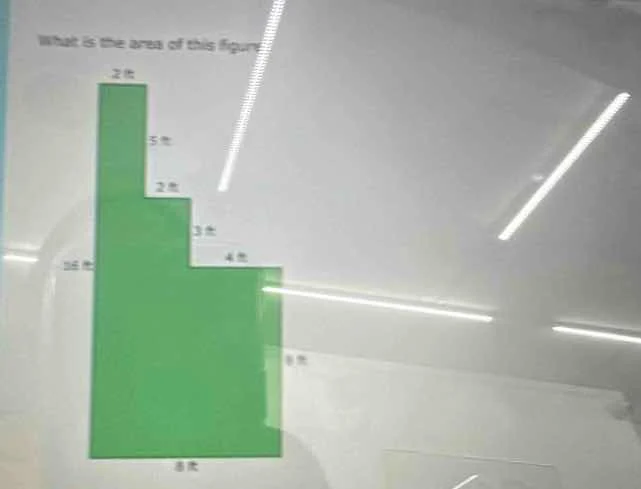
what is the area of this figure
2 m
5 m
2 m
3 m
4 m
16 m
8 m
8 m
Step1: Analyze the figure's structure
The figure can be divided into three rectangles. Let's identify their dimensions:
- First rectangle (top): width = 2 m, height = 5 m.
- Second rectangle (middle): width = 2 + 2 = 4 m? Wait, no. Wait, looking at the diagram, maybe better to split into three parts: bottom, middle, top. Wait, the bottom part: width 8 m, height 8 m? Wait, no, the total height is 16 m? Wait, maybe the figure is composed of three rectangles:
Wait, let's re-express:
- Bottom rectangle: width = 8 m, height = 8 m (since the bottom part's height is 8 m, as per the diagram: 8 m height, 8 m width? Wait, no, the middle part: height 3 m, width: 8 - 4 = 4? Wait, maybe I misread. Let's try again.
Wait, the figure has three sections:
- Top section: width 2 m, height 5 m.
- Middle section: width (2 + 2) = 4 m? Wait, no, the middle section's width: 2 (top) + 2 (middle) = 4? Wait, the middle section's height is 3 m, and its width is 2 + 2 = 4? Then the bottom section: width 8 m, height 16 - 5 - 3 = 8 m? Wait, 5 + 3 + 8 = 16, which matches the total height of 16 m. And the bottom width is 8 m.
Wait, maybe:
- Top rectangle: \( \text{width} = 2 \, \text{m}, \text{height} = 5 \, \text{m} \)
- Middle rectangle: \( \text{width} = 2 + 2 = 4 \, \text{m}? \) No, wait, the middle part's width: 2 (top) + 2 (middle) = 4? Wait, the middle section's height is 3 m, and its width is \( 2 + 2 = 4 \, \text{m} \) (since the top is 2, middle adds 2, so 2 + 2 = 4). Then the bottom section: \( \text{width} = 8 \, \text{m}, \text{height} = 8 \, \text{m} \) (since total height is 16, 16 - 5 - 3 = 8).
Wait, alternatively, maybe the figure is:
- Bottom rectangle: width 8 m, height 8 m (area \( 8 \times 8 \))
- Middle rectangle: width (8 - 4) = 4 m? Wait, no, the middle part's width: 8 - 4 = 4? Wait, the middle section's height is 3 m, and its width is 8 - 4 = 4? Then the top section: width 2 m, height 5 m.
Wait, maybe a better approach: split the figure into three rectangles:
- Top: \( 2 \times 5 \)
- Middle: \( (2 + 2) \times 3 = 4 \times 3 \) (since the middle section's width is 2 (top) + 2 (middle) = 4)
- Bottom: \( 8 \times 8 \) (since bottom width is 8, height is 16 - 5 - 3 = 8)
Wait, let's check the total width: bottom is 8, middle is 4? No, that can't be. Wait, the bottom width is 8, so the middle and top must fit into that. Wait, maybe the top is 2 m wide, middle is (2 + 2) = 4 m wide, and bottom is 8 m wide. So total width: 8 m (bottom) = 2 (top) + 2 (middle) + 4 (bottom)? No, that doesn't make sense. Wait, maybe the figure is:
- Bottom rectangle: width 8 m, height 8 m (area \( 8 \times 8 \))
- Middle rectangle: width (8 - 4) = 4 m? Wait, 8 - 4 = 4, so middle width 4 m, height 3 m (area \( 4 \times 3 \))
- Top rectangle: width 2 m, height 5 m (area \( 2 \times 5 \))
Wait, but 4 + 2 = 6, which is less than 8. No, that's not right. Wait, maybe the correct split is:
- Bottom part: width 8 m, height 8 m (area \( 8 \times 8 \))
- Middle part: width (8 - 4) = 4 m? No, 8 - 4 = 4, height 3 m (area \( 4 \times 3 \))
- Top part: width 2 m, height 5 m (area \( 2 \times 5 \))
Wait, but 4 + 2 = 6, and 8 - 6 = 2, which is missing. Oh, maybe I made a mistake. Let's look at the diagram again. The bottom width is 8 m, the middle part's width is 8 - 4 = 4 m? Wait, the middle part has a 4 m indent? No, the diagram shows:
- Top: 2 m wide, 5 m tall.
- Middle: 2 m (top) + 2 m (middle) = 4 m wide, 3 m tall.
- Bottom: 8 m wide, 16 - 5 - 3 = 8 m tall.
Yes, that makes sense. So:
- Top area: \( 2 \times 5 = 10 \, \text{m}^2 \)
- Middle area: \( (…

Snap & solve any problem in the app
Get step-by-step solutions on Sovi AI
Photo-based solutions with guided steps
Explore more problems and detailed explanations
\boxed{86} (in square meters)