QUESTION IMAGE
Question
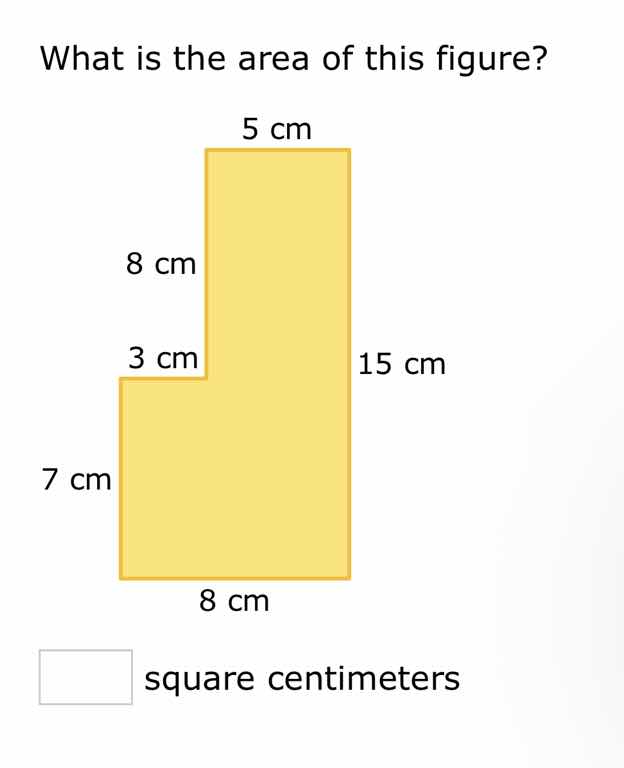
what is the area of this figure?
5 cm
8 cm
3 cm
15 cm
7 cm
8 cm
square centimeters
Step1: Divide the figure into two rectangles
We can split the L - shaped figure into two rectangles. One rectangle has dimensions \(5\space\text{cm}\times15\space\text{cm}\) (wait, no, actually a better way: the lower rectangle has length \(8\space\text{cm}\) and height \(7\space\text{cm}\), and the upper rectangle has length \(5\space\text{cm}\) and height \(8\space\text{cm}\) (since \(15 - 7=8\))? Wait, no, let's re - examine. The total height is \(15\space\text{cm}\), the lower part is \(7\space\text{cm}\) tall, and the upper part is \(15 - 7 = 8\space\text{cm}\) tall. The width of the lower rectangle is \(8\space\text{cm}\), and the width of the upper rectangle is \(5\space\text{cm}\) (since the total width is \(8\space\text{cm}\), and the part that is not part of the upper rectangle is \(8 - 5=3\space\text{cm}\), which matches the given \(3\space\text{cm}\)).
Step2: Calculate the area of the lower rectangle
The area of a rectangle is given by the formula \(A = l\times h\), where \(l\) is the length and \(h\) is the height. For the lower rectangle, \(l = 8\space\text{cm}\) and \(h=7\space\text{cm}\). So the area \(A_1=8\times7 = 56\space\text{cm}^2\).
Step3: Calculate the area of the upper rectangle
For the upper rectangle, \(l = 5\space\text{cm}\) and \(h = 15 - 7=8\space\text{cm}\). So the area \(A_2=5\times8=40\space\text{cm}^2\).
Step4: Calculate the total area
The total area of the figure is the sum of the areas of the two rectangles. So \(A = A_1+A_2\).
\(A=56 + 40=96\space\text{cm}^2\). Wait, another way: The figure can also be considered as a large rectangle minus a smaller rectangle. The large rectangle would have dimensions \(8\space\text{cm}\times15\space\text{cm}\), and the smaller rectangle that is missing has dimensions \(3\space\text{cm}\times8\space\text{cm}\) (since \(8 - 5 = 3\) and the height of the missing part is \(8\space\text{cm}\) (because \(15-7 = 8\))? Wait, no, let's check with this method. The area of the large rectangle (if we consider the outer rectangle) is \(8\times15=120\space\text{cm}^2\). The area of the missing rectangle: the width of the missing part is \(8 - 5=3\space\text{cm}\), and the height is \(15 - 7 = 8\space\text{cm}\). So the area of the missing rectangle is \(3\times8 = 24\space\text{cm}^2\). Then the area of the figure is \(120-24 = 96\space\text{cm}^2\).

Snap & solve any problem in the app
Get step-by-step solutions on Sovi AI
Photo-based solutions with guided steps
Explore more problems and detailed explanations
\(96\)