QUESTION IMAGE
Question
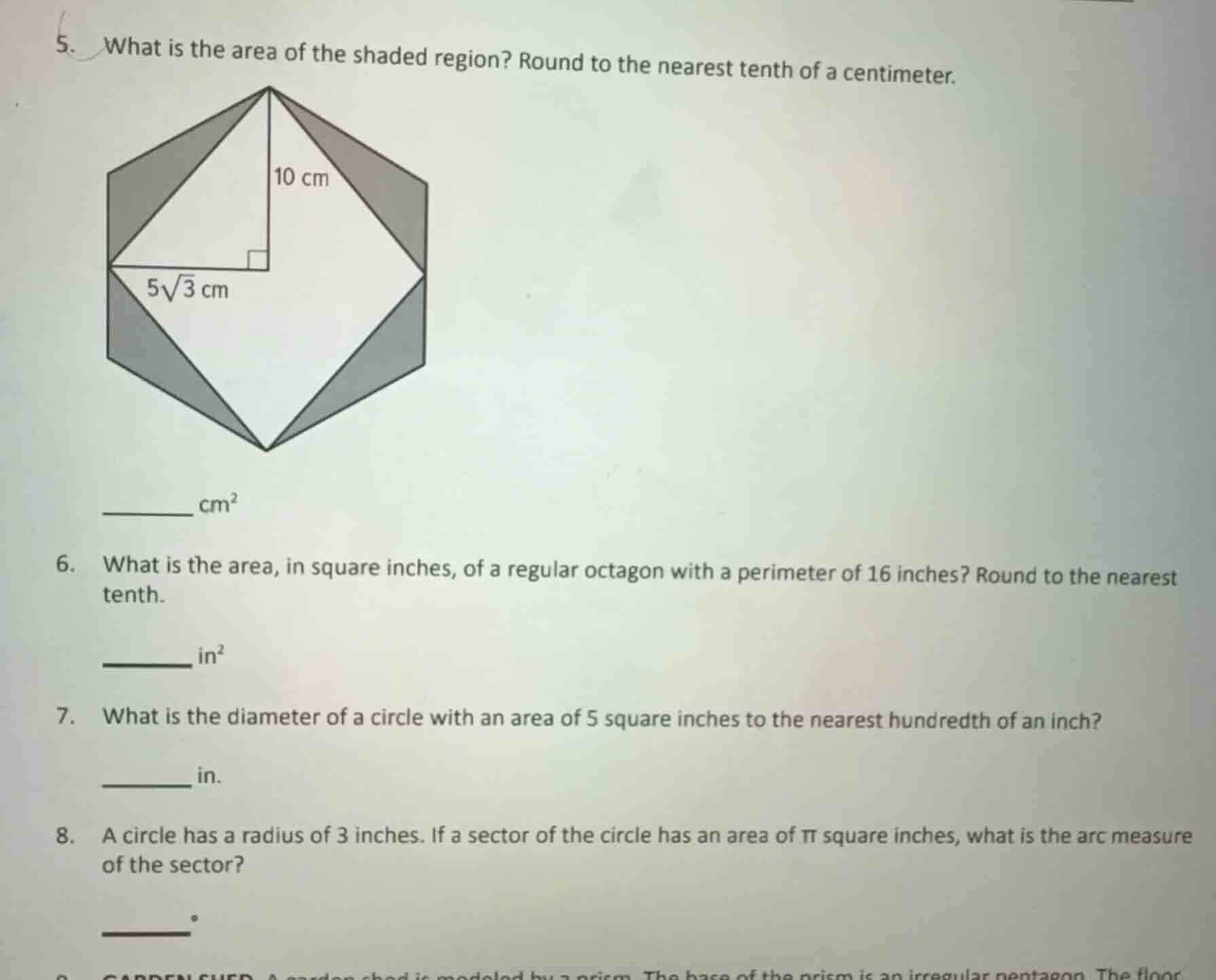
- what is the area of the shaded region? round to the nearest tenth of a centimeter.
______ cm²
- what is the area, in square inches, of a regular octagon with a perimeter of 16 inches? round to the nearest tenth.
______ in²
- what is the diameter of a circle with an area of 5 square inches to the nearest hundredth of an inch?
______ in.
- a circle has a radius of 3 inches. if a sector of the circle has an area of π square inches, what is the arc measure of the sector?
______°
Question 5
Step1: Find area of regular hexagon
A regular hexagon can be divided into 6 equilateral triangles, or alternatively, using the formula for the area of a regular polygon \( A = \frac{1}{2} \times perimeter \times apothem \). Here, the apothem (height of the right triangle) is \( 10 \) cm, and the base of the right triangle is \( 5\sqrt{3} \) cm, so the side length \( s \) of the hexagon can be related, but also, the area of the hexagon can be calculated as 6 times the area of the triangle with base \( 5\sqrt{3} \times 2 = 10\sqrt{3} \) cm (wait, no, the right triangle has legs \( 5\sqrt{3} \) and \( 10 \), so the area of one of those triangles is \( \frac{1}{2} \times 5\sqrt{3} \times 10 = 25\sqrt{3} \). Since the hexagon has 6 such triangles? Wait, no, looking at the diagram, the white region is a square? Wait, no, the hexagon has a white quadrilateral (maybe a square) and four shaded triangles? Wait, maybe better: the regular hexagon can be divided into 6 equilateral triangles, but here, the apothem is 10, and the side length \( s \) of the hexagon: in a regular hexagon, the apothem \( a = \frac{\sqrt{3}}{2} s \), but here, the right triangle has base \( 5\sqrt{3} \), so the side length \( s = 2 \times 5\sqrt{3} \times \frac{2}{\sqrt{3}} \)? Wait, no, maybe the area of the hexagon is \( 6 \times \frac{1}{2} \times s \times a \), but here, the given triangle has base \( 5\sqrt{3} \) and height \( 10 \), so area of one triangle (part of hexagon) is \( \frac{1}{2} \times 5\sqrt{3} \times 10 = 25\sqrt{3} \). There are 6 such triangles? Wait, no, the diagram shows a hexagon with a white square (or rhombus) and four shaded triangles? Wait, maybe the hexagon's area is \( 6 \times 25\sqrt{3} = 150\sqrt{3} \approx 259.8 \) cm². Then the white region: the white part has a square? Wait, the right triangle has legs \( 5\sqrt{3} \) and \( 10 \), so the white region is a quadrilateral with four triangles? Wait, no, maybe the white region is a square with side length \( 10 \times 2 \)? No, wait, the shaded region: let's see, the hexagon has 6 triangles, and the white region is 4 of them? Wait, no, the diagram has four shaded triangles. Wait, maybe the area of the hexagon is \( 6 \times \frac{1}{2} \times 5\sqrt{3} \times 10 = 150\sqrt{3} \approx 259.8 \) cm². The white region: the white part is a square? Wait, the right triangle has base \( 5\sqrt{3} \) and height \( 10 \), so the white region is a quadrilateral with area \( (5\sqrt{3} \times 2) \times 10 \)? No, maybe the white region is a square with side length \( 10 \times 2 \)? Wait, no, let's re-examine. The regular hexagon can be divided into 6 equilateral triangles, each with area \( \frac{\sqrt{3}}{4} s^2 \). But here, the apothem (distance from center to a side) is \( 10 \) cm. The formula for apothem \( a = \frac{s\sqrt{3}}{2} \), so \( s = \frac{2a}{\sqrt{3}} = \frac{20}{\sqrt{3}} = \frac{20\sqrt{3}}{3} \) cm. Then the area of the hexagon is \( \frac{3\sqrt{3}}{2} s^2 = \frac{3\sqrt{3}}{2} \times \frac{400 \times 3}{9} = \frac{3\sqrt{3}}{2} \times \frac{400}{3} = 200\sqrt{3} \approx 346.4 \) cm². Wait, that's conflicting. Alternatively, the diagram shows a right triangle with legs \( 5\sqrt{3} \) and \( 10 \), so the area of that triangle is \( \frac{1}{2} \times 5\sqrt{3} \times 10 = 25\sqrt{3} \). There are 6 such triangles in the hexagon? No, 6 would be \( 150\sqrt{3} \approx 259.8 \). Now, the white region: looking at the diagram, there are four white triangles? No, the white region is a square? Wait, maybe the shaded region is the area of the hexagon minus the area of the white…
Step1: Find side length of regular octagon
Perimeter of regular octagon is 16 inches, so side length \( s = \frac{16}{8} = 2 \) inches.
Step2: Area of regular octagon
The formula for the area of a regular octagon is \( A = 2(1 + \sqrt{2}) s^2 \). Plugging in \( s = 2 \):
\( A = 2(1 + \sqrt{2}) \times 2^2 = 2(1 + \sqrt{2}) \times 4 = 8(1 + \sqrt{2}) \approx 8(1 + 1.4142) = 8(2.4142) \approx 19.3136 \)
Rounding to the nearest tenth, \( 19.3 \) square inches.
Step1: Recall area formula for circle
The area of a circle is \( A = \pi r^2 \), where \( r \) is the radius. We know \( A = 5 \) square inches, so solve for \( r \):
\( \pi r^2 = 5 \)
\( r^2 = \frac{5}{\pi} \)
\( r = \sqrt{\frac{5}{\pi}} \)
Step2: Find diameter
Diameter \( d = 2r = 2\sqrt{\frac{5}{\pi}} \)
Calculating:
\( \sqrt{\frac{5}{\pi}} \approx \sqrt{1.5915} \approx 1.2616 \)
Then \( d \approx 2 \times 1.2616 \approx 2.5232 \), rounding to nearest hundredth is \( 2.52 \) inches.

Snap & solve any problem in the app
Get step-by-step solutions on Sovi AI
Photo-based solutions with guided steps
Explore more problems and detailed explanations
\( \boxed{173.2} \) (rounded to nearest tenth)