QUESTION IMAGE
Question
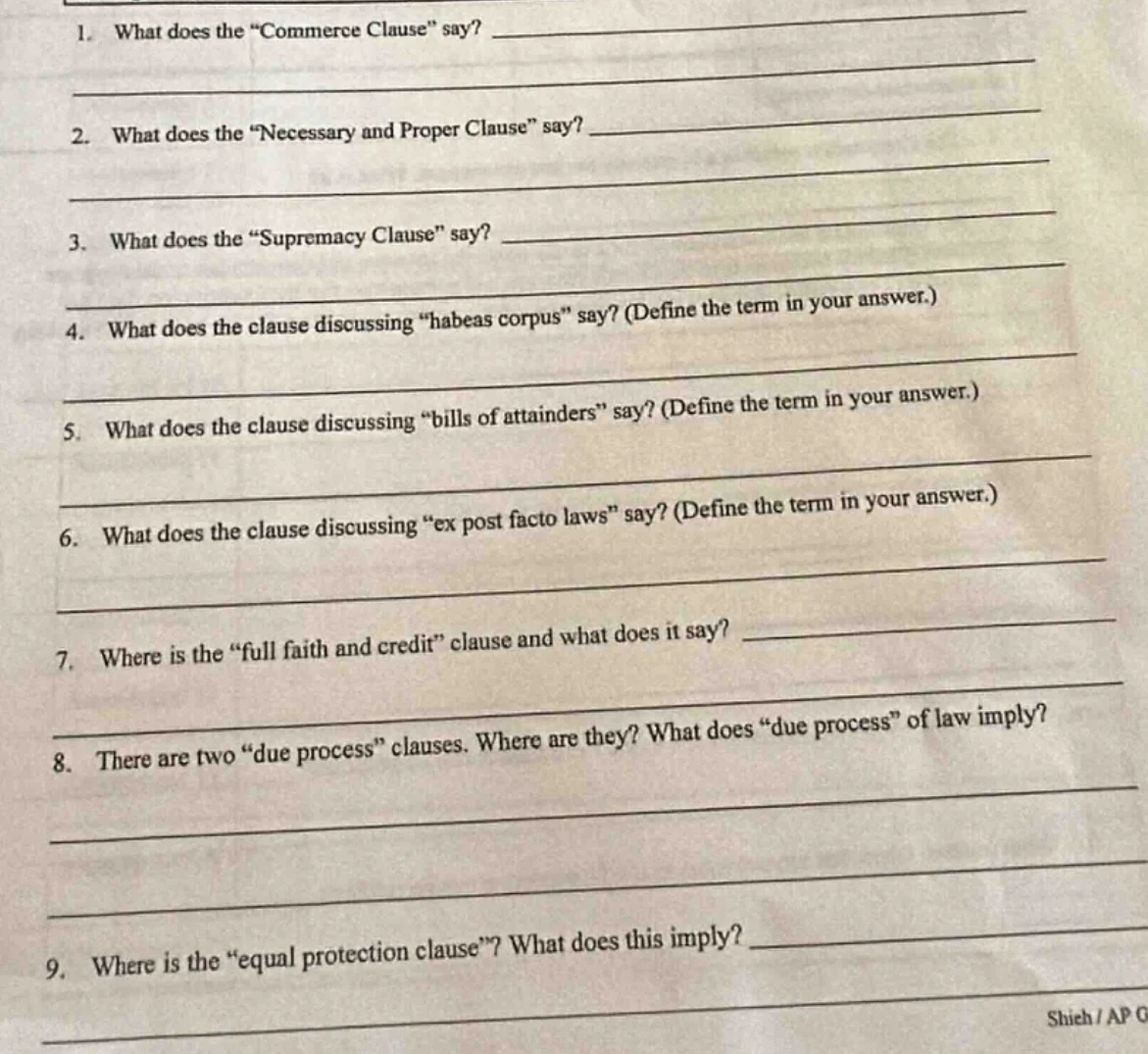
- what does the \commerce clause\ say?
- what does the
ecessary and proper clause\ say?
- what does the \supremacy clause\ say?
- what does the clause discussing \habeas corpus\ say? (define the term in your answer.)
- what does the clause discussing \bills of attainders\ say? (define the term in your answer.)
- what does the clause discussing \ex post facto laws\ say? (define the term in your answer.)
- where is the \full faith and credit\ clause and what does it say?
- there are two \due process\ clauses. where are they? what does \due process\ of law imply?
- where is the \equal protection clause\? what does this imply?
shieh / ap g
1. What does the “Commerce Clause” say?
The Commerce Clause (Article I, Section 8, Clause 3 of the U.S. Constitution) gives Congress the power to regulate commerce with foreign nations, among the several states, and with the Indian tribes. This includes the authority to regulate interstate and international trade, as well as trade with Native American tribes, to ensure a unified national economic system and address issues like trade barriers between states.
The Necessary and Proper Clause (also known as the Elastic Clause, found in Article I, Section 8, Clause 18 of the U.S. Constitution) states that Congress shall have the power to make all laws which shall be necessary and proper for carrying into execution the foregoing powers, and all other powers vested by this Constitution in the government of the United States, or in any department or officer thereof. It allows Congress to exercise implied powers to fulfill its enumerated powers, enabling flexibility in governing.
The Supremacy Clause (Article VI, Clause 2 of the U.S. Constitution) establishes that the Constitution, federal laws made pursuant to it, and treaties made under the authority of the United States, shall be the supreme law of the land; and the judges in every state shall be bound thereby, anything in the Constitution or laws of any State to the contrary notwithstanding. This means federal law is supreme over state law when there is a conflict, ensuring a uniform national legal framework.

Snap & solve any problem in the app
Get step-by-step solutions on Sovi AI
Photo-based solutions with guided steps
Explore more problems and detailed explanations
The Commerce Clause (Article I, Section 8, Clause 3 of the U.S. Constitution) grants Congress the power to regulate commerce with foreign nations, among the several states, and with the Indian tribes.