QUESTION IMAGE
Question
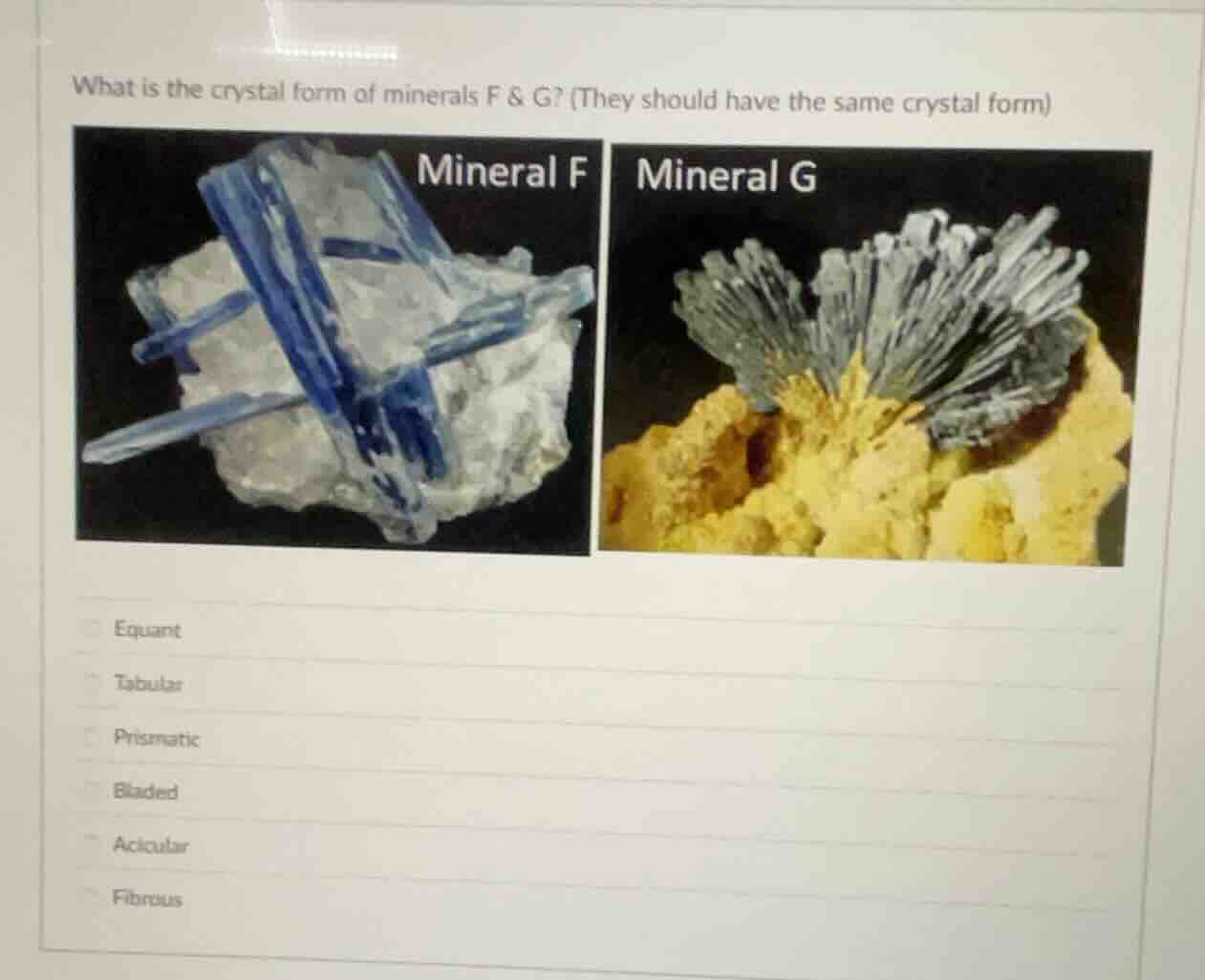
what is the crystal form of minerals f & g? (they should have the same crystal form)
mineral f mineral g
equant
tabular
prismatic
bladed
acicular
fibrous
Brief Explanations
To determine the crystal form of Minerals F and G, we analyze their visual characteristics:
- Equant: Crystals with roughly equal dimensions in all directions (e.g., cubes or octahedrons). Minerals F and G are elongated, so this is incorrect.
- Tabular: Flat, plate - like crystals (e.g., thin, sheet - like structures). The minerals here are elongated and not flat - plate - like, so this is wrong.
- Prismatic: Crystals with a long, slender, and often hexagonal or rectangular cross - section, typically elongated along one axis. Mineral F has long, slender, rod - like (prismatic) crystals, and Mineral G has a similar elongated, prismatic - like (though in a radiating cluster) form. This matches.
- Bladed: Flat, blade - like crystals (more like thin, flat blades than prismatic rods). The minerals here are more rod - like than blade - like, so this is incorrect.
- Acicular: Very thin, needle - like crystals (extremely slender, almost hair - like). The crystals here are thicker and more robust than acicular, so this is incorrect.
- Fibrous: Crystals arranged in long, thin, thread - like fibers (e.g., asbestos). The minerals here are more individual, elongated rods (or clusters of rods) rather than fibrous, so this is incorrect.

Snap & solve any problem in the app
Get step-by-step solutions on Sovi AI
Photo-based solutions with guided steps
Explore more problems and detailed explanations
Prismatic (the option corresponding to "Prismatic" in the given choices)