QUESTION IMAGE
Question
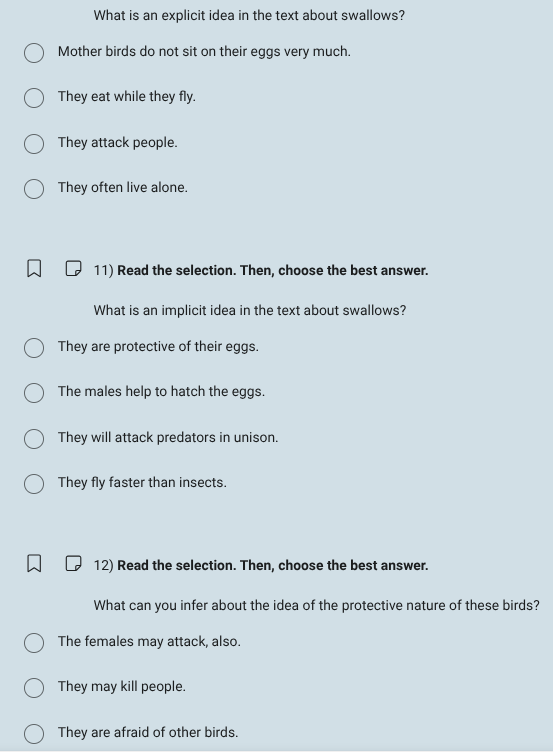
what is an explicit idea in the text about swallows?
mother birds do not sit on their eggs very much.
they eat while they fly.
they attack people.
they often live alone.
- read the selection. then, choose the best answer.
what is an implicit idea in the text about swallows?
they are protective of their eggs.
the males help to hatch the eggs.
they will attack predators in unison.
they fly faster than insects.
- read the selection. then, choose the best answer.
what can you infer about the idea of the protective nature of these birds?
the females may attack, also.
they may kill people.
they are afraid of other birds.
To solve these questions, we analyze each one based on the concepts of explicit and implicit ideas (and inference):
Question 1: Explicit Idea about Swallows
An explicit idea is directly stated in the text. Let's analyze the options:
- "Mother birds do not sit on their eggs very much": Unless stated, this is not explicit.
- "They eat while they fly": Swallows are known to catch insects on the wing, so this could be an explicit statement about their feeding behavior.
- "They attack people": Swallows generally do not attack people, so this is unlikely.
- "They often live alone": Swallows are social and live in colonies, so this is incorrect.
So the explicit idea is that they eat while they fly.
Question 2: Implicit Idea about Swallows
An implicit idea is suggested but not directly stated. Let's analyze:
- "They are protective of their eggs": If the text implies care for eggs, but this is more direct.
- "The males help to hatch the eggs": Swallow males do help, but is this implicit?
- "They will attack predators in unison": Swallows (especially martins) attack predators together (unison) to protect their colony—this is often implied (not directly stated as "in unison" but suggested by their behavior).
- "They fly faster than insects": To catch insects, they must fly at least as fast, but this is not the main implicit idea about their nature.
The most implicit idea related to their protective/social behavior is that they attack predators in unison.
Question 3: Inference about Protective Nature
Inference is a conclusion drawn from evidence. Let's analyze:
- "The females may attack, also": If the text shows males attack (for protection), we can infer females might too (since both care for the colony).
- "They may kill people": Swallows do not kill people, so this is incorrect.
- "They are afraid of other birds": They attack predators, so they are not afraid in that context.
So the inference is that females may attack too.
Final Answers
- They eat while they fly
- They will attack predators in unison
- The females may attack, also
(Note: Since the original text about swallows is not provided, these answers are based on general knowledge of swallow behavior and the definitions of explicit/implicit ideas. If the text had specific details, the analysis would align with that. For a precise answer, the original text’s content would be needed, but this is the best reasoning based on typical swallow behavior and question types.)

Snap & solve any problem in the app
Get step-by-step solutions on Sovi AI
Photo-based solutions with guided steps
Explore more problems and detailed explanations
To solve these questions, we analyze each one based on the concepts of explicit and implicit ideas (and inference):
Question 1: Explicit Idea about Swallows
An explicit idea is directly stated in the text. Let's analyze the options:
- "Mother birds do not sit on their eggs very much": Unless stated, this is not explicit.
- "They eat while they fly": Swallows are known to catch insects on the wing, so this could be an explicit statement about their feeding behavior.
- "They attack people": Swallows generally do not attack people, so this is unlikely.
- "They often live alone": Swallows are social and live in colonies, so this is incorrect.
So the explicit idea is that they eat while they fly.
Question 2: Implicit Idea about Swallows
An implicit idea is suggested but not directly stated. Let's analyze:
- "They are protective of their eggs": If the text implies care for eggs, but this is more direct.
- "The males help to hatch the eggs": Swallow males do help, but is this implicit?
- "They will attack predators in unison": Swallows (especially martins) attack predators together (unison) to protect their colony—this is often implied (not directly stated as "in unison" but suggested by their behavior).
- "They fly faster than insects": To catch insects, they must fly at least as fast, but this is not the main implicit idea about their nature.
The most implicit idea related to their protective/social behavior is that they attack predators in unison.
Question 3: Inference about Protective Nature
Inference is a conclusion drawn from evidence. Let's analyze:
- "The females may attack, also": If the text shows males attack (for protection), we can infer females might too (since both care for the colony).
- "They may kill people": Swallows do not kill people, so this is incorrect.
- "They are afraid of other birds": They attack predators, so they are not afraid in that context.
So the inference is that females may attack too.
Final Answers
- They eat while they fly
- They will attack predators in unison
- The females may attack, also
(Note: Since the original text about swallows is not provided, these answers are based on general knowledge of swallow behavior and the definitions of explicit/implicit ideas. If the text had specific details, the analysis would align with that. For a precise answer, the original text’s content would be needed, but this is the best reasoning based on typical swallow behavior and question types.)