QUESTION IMAGE
Question
b. what is the force between charge 2 and 3?
c. what is the net force acting on q₂?
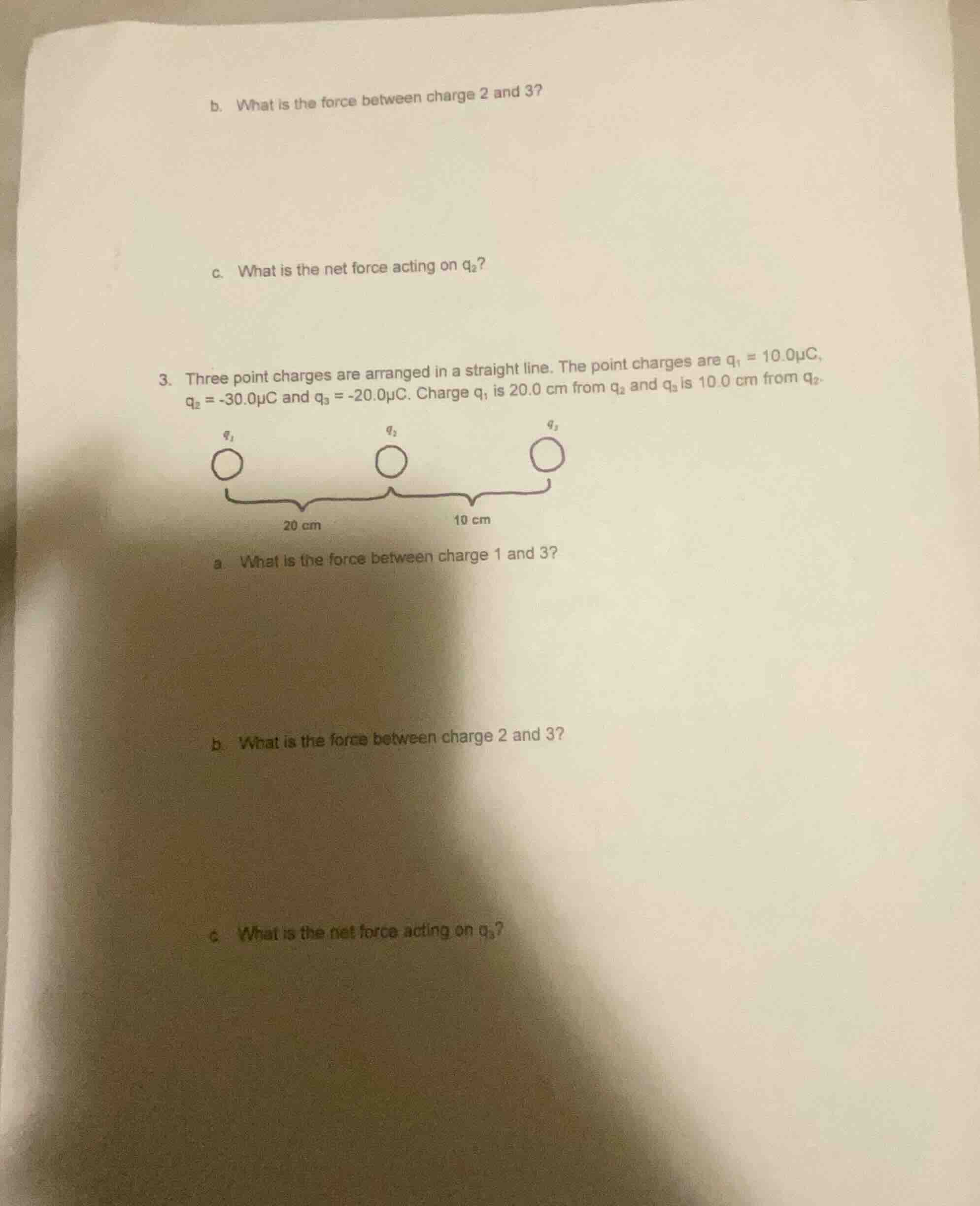
- three point charges are arranged in a straight line. the point charges are q₁ = 10.0μc, q₂ = -30.0μc and q₃ = -20.0μc. charge q₁ is 20.0 cm from q₂ and q₃ is 10.0 cm from q₂.
diagram of three charges in a line: q₁---20 cm---q₂---10 cm---q₃
a. what is the force between charge 1 and 3?
b. what is the force between charge 2 and 3?
c. what is the net force acting on q₃?
Part a: Force between charge 1 and 3
Step1: Recall Coulomb's Law
Coulomb's Law is $F = k\frac{|q_1 q_2|}{r^2}$, where $k = 9.0 \times 10^9 \, \text{N·m}^2/\text{C}^2$, $q_1, q_2$ are charges, and $r$ is the distance between them.
Step2: Determine distance between $q_1$ and $q_3$
$q_1$ is 20.0 cm from $q_2$, and $q_3$ is 10.0 cm from $q_2$. So $r_{13} = 20.0 \, \text{cm} + 10.0 \, \text{cm} = 30.0 \, \text{cm} = 0.30 \, \text{m}$.
Step3: Convert charges to coulombs
$q_1 = 10.0 \, \mu\text{C} = 10.0 \times 10^{-6} \, \text{C}$, $q_3 = -20.0 \, \mu\text{C} = -20.0 \times 10^{-6} \, \text{C}$. The magnitude of the product is $|q_1 q_3| = |10.0 \times 10^{-6} \times -20.0 \times 10^{-6}| = 2.0 \times 10^{-10} \, \text{C}^2$.
Step4: Calculate the force
Substitute into Coulomb's Law:
$$F_{13} = 9.0 \times 10^9 \times \frac{2.0 \times 10^{-10}}{(0.30)^2}$$
$$F_{13} = 9.0 \times 10^9 \times \frac{2.0 \times 10^{-10}}{0.09}$$
$$F_{13} = 9.0 \times 10^9 \times 2.222 \times 10^{-9}$$
$$F_{13} = 20 \, \text{N}$$ (Attractive, since charges are opposite, but magnitude is 20 N.)
Part b: Force between charge 2 and 3
Step1: Recall Coulomb's Law
Use $F = k\frac{|q_2 q_3|}{r^2}$.
Step2: Determine distance between $q_2$ and $q_3$
$r_{23} = 10.0 \, \text{cm} = 0.10 \, \text{m}$.
Step3: Convert charges to coulombs
$q_2 = -30.0 \, \mu\text{C} = -30.0 \times 10^{-6} \, \text{C}$, $q_3 = -20.0 \, \mu\text{C} = -20.0 \times 10^{-6} \, \text{C}$. Magnitude of product: $|q_2 q_3| = |-30.0 \times 10^{-6} \times -20.0 \times 10^{-6}| = 6.0 \times 10^{-10} \, \text{C}^2$.
Step4: Calculate the force
Substitute into Coulomb's Law:
$$F_{23} = 9.0 \times 10^9 \times \frac{6.0 \times 10^{-10}}{(0.10)^2}$$
$$F_{23} = 9.0 \times 10^9 \times \frac{6.0 \times 10^{-10}}{0.01}$$
$$F_{23} = 9.0 \times 10^9 \times 6.0 \times 10^{-8}$$
$$F_{23} = 540 \, \text{N}$$ (Repulsive, since charges are same sign, magnitude is 540 N.)
Part c: Net force acting on $q_3$
Step1: Identify forces on $q_3$
Forces are $F_{13}$ (from $q_1$) and $F_{23}$ (from $q_2$). Let’s define direction: let right be positive.
- $F_{13}$: $q_1$ is positive, $q_3$ is negative → attractive, so $F_{13}$ acts to the left (toward $q_1$) → $F_{13} = -20 \, \text{N}$ (negative for left).
- $F_{23}$: $q_2$ and $q_3$ are negative → repulsive, so $F_{23}$ acts to the right (away from $q_2$) → $F_{23} = +540 \, \text{N}$ (positive for right).
Step2: Sum the forces
Net force $F_{\text{net}} = F_{13} + F_{23}$
$$F_{\text{net}} = -20 + 540 = 520 \, \text{N}$$ (Positive, so direction is right.)

Snap & solve any problem in the app
Get step-by-step solutions on Sovi AI
Photo-based solutions with guided steps
Explore more problems and detailed explanations
s:
a. Force between $q_1$ and $q_3$: $\boldsymbol{20 \, \text{N}}$ (attractive, magnitude 20 N)
b. Force between $q_2$ and $q_3$: $\boldsymbol{540 \, \text{N}}$ (repulsive, magnitude 540 N)
c. Net force on $q_3$: $\boldsymbol{520 \, \text{N}}$ (to the right)