QUESTION IMAGE
Question
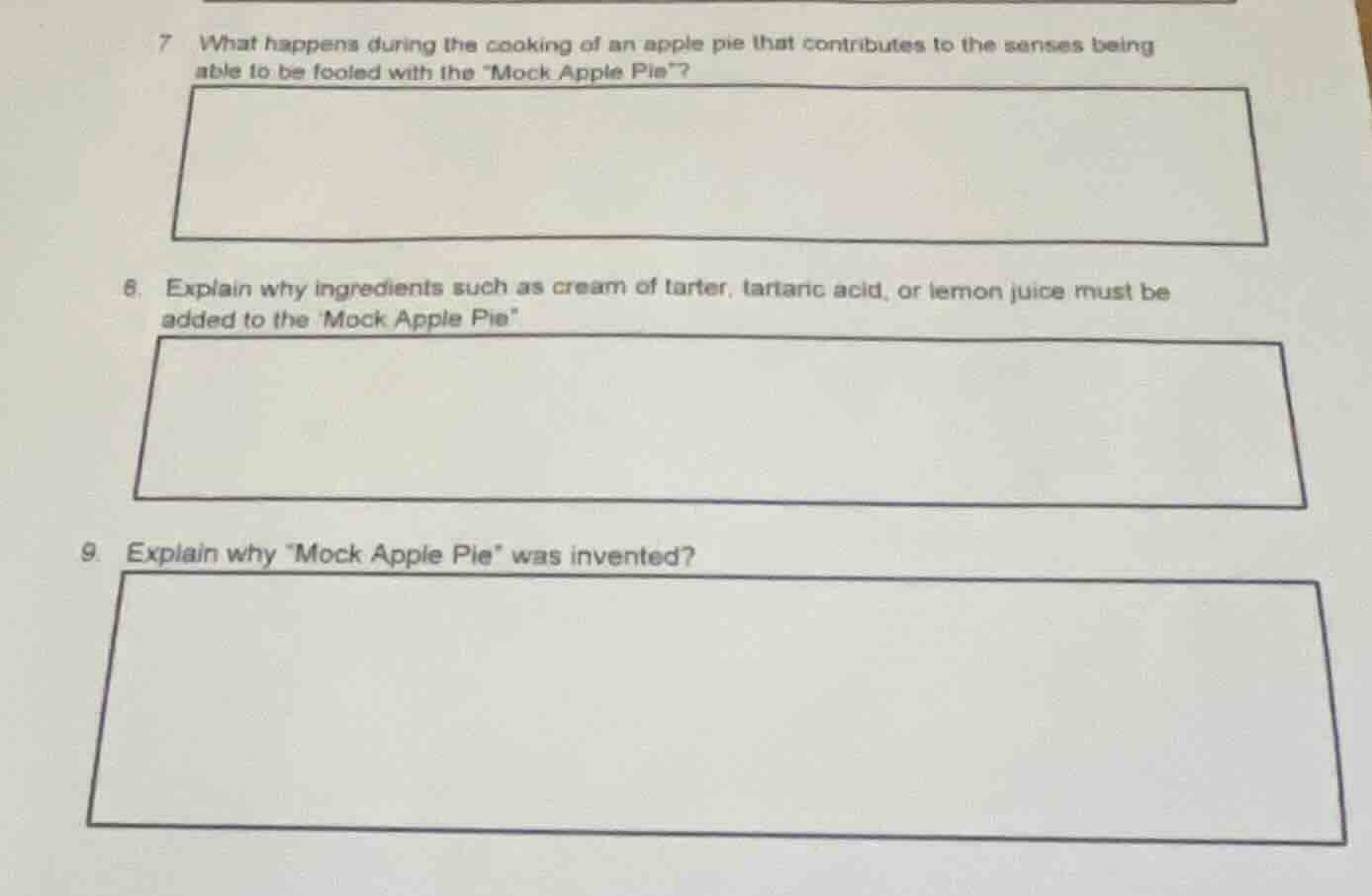
- what happens during the cooking of an apple pie that contributes to the senses being able to be fooled with the \mock apple pie\?
- explain why ingredients such as cream of tarter, tartaric acid, or lemon juice must be added to the \mock apple pie\
- explain why \mock apple pie\ was invented?
For Question 7:
Mock apple pie is typically made with crackers (like Ritz) instead of apples. During baking, the crackers break down, absorb the sweet, spiced liquid (sugar, cinnamon, etc.), and soften to a texture similar to cooked apples. The spices, sweetener, and the browning from baking also mimic the aroma and appearance of a real apple pie. These combined sensory cues (texture, smell, taste, look) trick the senses into perceiving it as apple pie.
For Question 8:
Mock apple pie uses crackers, which are neutral and lack the tartness of real apples. Ingredients like cream of tartar, tartaric acid, or lemon juice add acidic, tart notes. This tartness replicates the natural tang of apples, balancing the sweetness of the pie filling and making the flavor profile match that of a traditional apple pie.
For Question 9:
Mock apple pie was invented primarily out of necessity. Historically, apples were not always available (due to seasonal shortages, geographic unavailability, or cost). Crackers were a cheap, shelf-stable alternative, so people created this pie to replicate the popular apple pie when real apples were not accessible.

Snap & solve any problem in the app
Get step-by-step solutions on Sovi AI
Photo-based solutions with guided steps
Explore more problems and detailed explanations
- The breakdown of crackers into an apple-like texture, combined with spiced sweet filling and baking-induced browning, mimics the sensory properties (taste, texture, smell, appearance) of a real apple pie, fooling the senses.
- These acidic ingredients add tartness to replicate the natural tang of apples, balancing the sweet filling to match the flavor of a traditional apple pie (since crackers lack this tartness).
- It was invented as a substitute when real apples were unavailable, too expensive, or out of season, using cheap, shelf-stable crackers to replicate the popular apple pie.