QUESTION IMAGE
Question
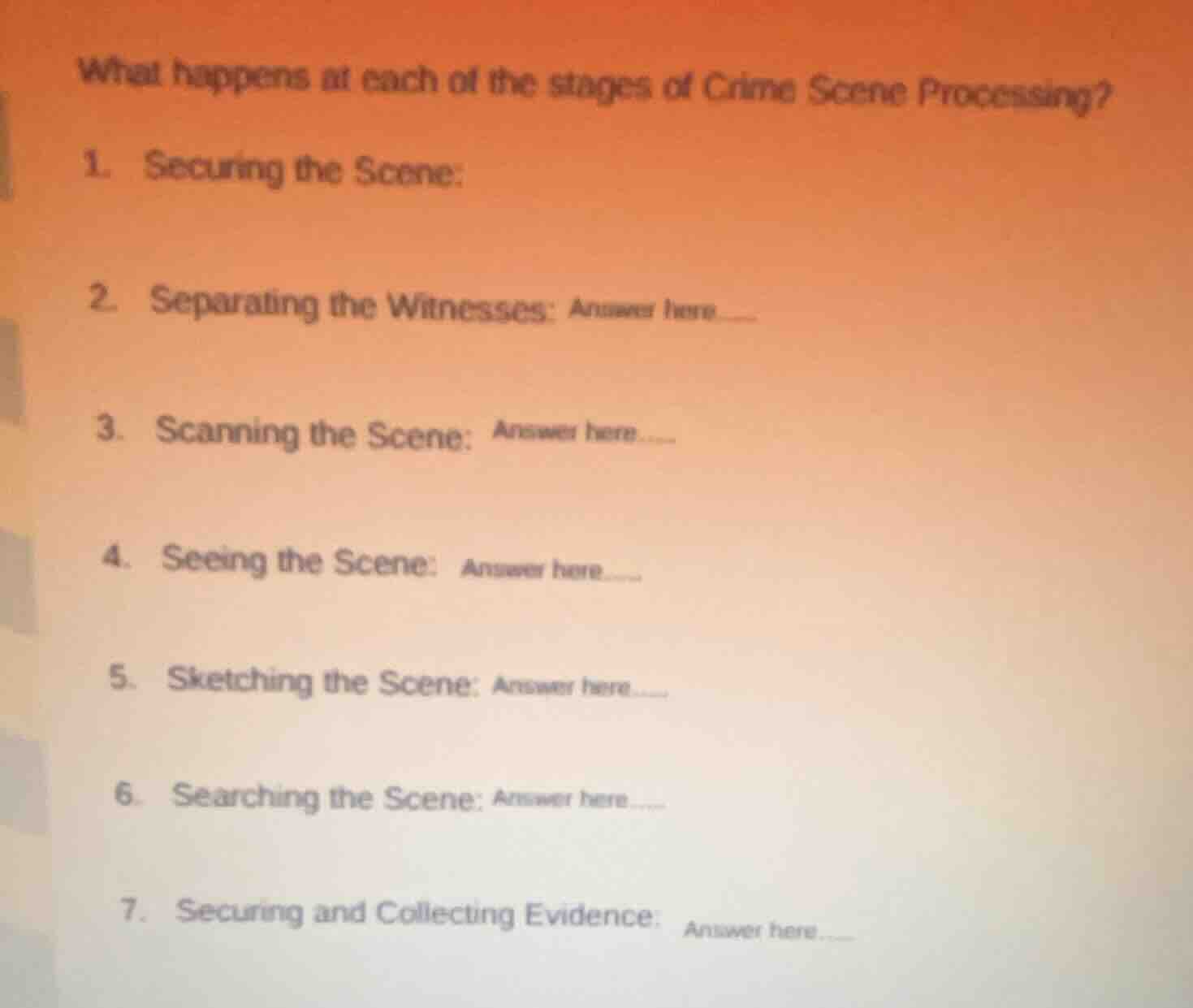
what happens at each of the stages of crime scene processing?
- securing the scene:
- separating the witnesses: answer here.....
- scanning the scene: answer here.....
- seeing the scene: answer here.....
- sketching the scene: answer here.....
- searching the scene: answer here.....
- securing and collecting evidence: answer here.....
Brief Explanations
- Securing the Scene: Law enforcement officers cordon off the crime scene using tape or barriers to prevent unauthorized access, preserve evidence, and ensure safety. They also document the arrival time and initial conditions.
- Separating the Witnesses: Witnesses are separated to prevent them from influencing each other's accounts. This helps in obtaining independent and accurate testimonies, as group discussions can lead to memory contamination or false details.
- Scanning the Scene: Investigators conduct a preliminary visual or systematic scan (e.g., using grids, spirals) to identify potential evidence, areas of interest, and the overall layout. This helps in planning the subsequent search and documentation.
- Seeing the Scene: This involves a detailed observation, often with the help of tools like magnifying glasses, to notice small or subtle details (e.g., blood spatter patterns, tool marks, fibers) that might be crucial for the investigation.
- Sketching the Scene: A scale or rough sketch is made to record the location of objects, bodies (if present), and evidence within the scene. It includes measurements, labels, and a legend to provide a permanent, accurate visual record for later analysis or court.
- Searching the Scene: A thorough search (e.g., zone, strip, or grid search) is conducted to find all physical evidence. This can involve manual search, using metal detectors, or forensic tools to collect items like weapons, documents, or biological samples.
- Securing and Collecting Evidence: Evidence is properly packaged, labeled (with date, time, location, collector's name), and sealed to maintain its integrity. It is then stored or sent to a lab for analysis, following chain-of-custody procedures to ensure admissibility in court.

Snap & solve any problem in the app
Get step-by-step solutions on Sovi AI
Photo-based solutions with guided steps
Explore more problems and detailed explanations
- Securing the Scene: Law enforcement cordons off the scene, prevents unauthorized access, and documents initial conditions.
- Separating the Witnesses: Witnesses are separated to get independent, accurate testimonies and avoid memory contamination.
- Scanning the Scene: Investigators preliminarily identify evidence, layout, and areas of interest for planning.
- Seeing the Scene: Detailed observation (with tools) to notice subtle, crucial details (e.g., blood patterns, fibers).
- Sketching the Scene: A scale/rough sketch records object/evidence locations, with measurements and labels.
- Searching the Scene: Thorough search (e.g., zone/grid) to find all physical evidence (weapons, samples, etc.).
- Securing and Collecting Evidence: Evidence is packaged, labeled, sealed, and stored/sent to a lab, following chain-of-custody.