QUESTION IMAGE
Question
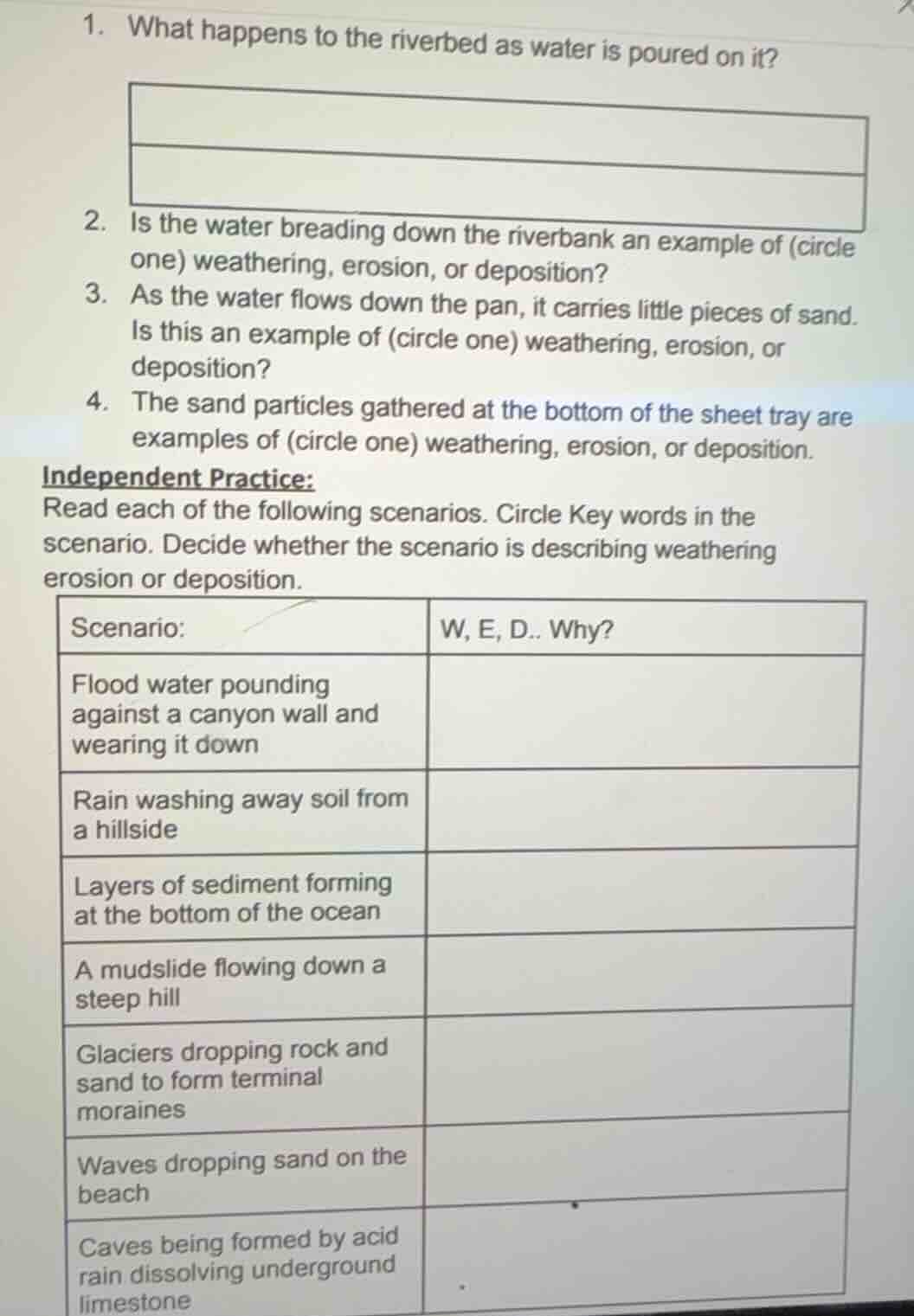
- what happens to the riverbed as water is poured on it?
- is the water breading down the riverbank an example of (circle one) weathering, erosion, or deposition?
- as the water flows down the pan, it carries little pieces of sand. is this an example of (circle one) weathering, erosion, or deposition?
- the sand particles gathered at the bottom of the sheet tray are examples of (circle one) weathering, erosion, or deposition.
independent practice:
read each of the following scenarios. circle key words in the scenario. decide whether the scenario is describing weathering erosion or deposition.
| scenario: | w, e, d.. why? |
|---|---|
| rain washing away soil from a hillside | |
| layers of sediment forming at the bottom of the ocean | |
| a mudslide flowing down a steep hill | |
| glaciers dropping rock and sand to form terminal moraines | |
| waves dropping sand on the beach | |
| caves being formed by acid rain dissolving underground limestone |
Brief Explanations
- When water flows over a riverbed, it picks up and moves small sediment particles, gradually wearing away the riverbed and shaping it over time.
- Weathering is the breakdown of rock/soil in place; erosion is moving broken material; deposition is dropping material. Breaking down a riverbank in place is weathering.
- Carrying sand particles via flowing water is the movement of sediment, which is erosion.
- Sand gathering at the bottom of a tray is sediment being dropped and left behind, which is deposition.
For the independent practice:
- Weathering (W) = breaking down material in place; Erosion (E) = moving broken material; Deposition (D) = dropping/leaving sediment in a new location.

Snap & solve any problem in the app
Get step-by-step solutions on Sovi AI
Photo-based solutions with guided steps
Explore more problems and detailed explanations
- The water will erode the riverbed, picking up and moving small sediment particles, gradually shaping and deepening it over time.
- weathering
- erosion
- deposition
Independent Practice:
| Scenario | W, E, D.. Why? |
|---|---|
| Rain washing away soil from a hillside | E; Moves soil to a new location |
| Layers of sediment forming at the bottom of the ocean | D; Sediment settles and accumulates |
| A mudslide flowing down a steep hill | E; Moves broken soil/rock downhill |
| Glaciers dropping rock and sand to form terminal moraines | D; Glaciers deposit sediment they carried |
| Waves dropping sand on the beach | D; Waves deposit sand they transported |
| Caves being formed by acid rain dissolving underground limestone | W; Dissolves rock in place |