QUESTION IMAGE
Question
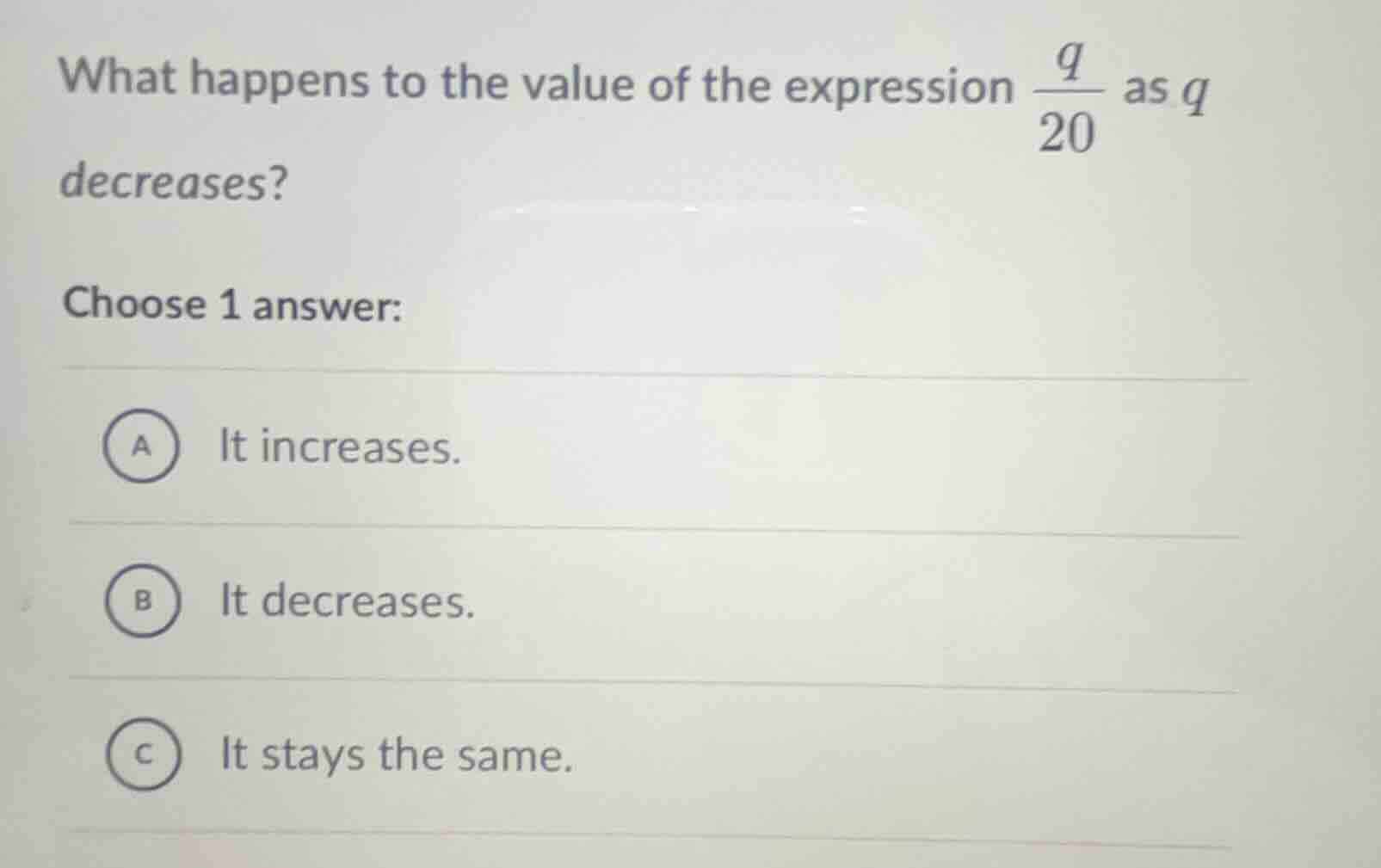
what happens to the value of the expression \\(\frac{q}{20}\\) as \\(q\\) decreases?
choose 1 answer:
a it increases.
b it decreases.
c it stays the same.
Step1: Analyze the expression structure
The expression is \(\frac{q}{20}\), which can be thought of as \(q\times\frac{1}{20}\) (since dividing by 20 is the same as multiplying by \(\frac{1}{20}\)). Here, \(\frac{1}{20}\) is a positive constant coefficient.
Step2: Relate variable change to expression change
In a linear relationship of the form \(y = kx\) (where \(k\) is a constant), if \(k>0\), as the independent variable \(x\) (in this case \(q\)) decreases, the dependent variable \(y\) (in this case \(\frac{q}{20}\)) will also decrease because the coefficient \(k=\frac{1}{20}\) is positive. For example, if \(q = 40\), then \(\frac{q}{20}=\frac{40}{20} = 2\). If \(q\) decreases to \(20\), then \(\frac{q}{20}=\frac{20}{20}=1\), which is a decrease. If \(q\) decreases further to \(10\), then \(\frac{q}{20}=\frac{10}{20}=0.5\), which is also a decrease from the previous value of 1.

Snap & solve any problem in the app
Get step-by-step solutions on Sovi AI
Photo-based solutions with guided steps
Explore more problems and detailed explanations
B. It decreases.