QUESTION IMAGE
Question
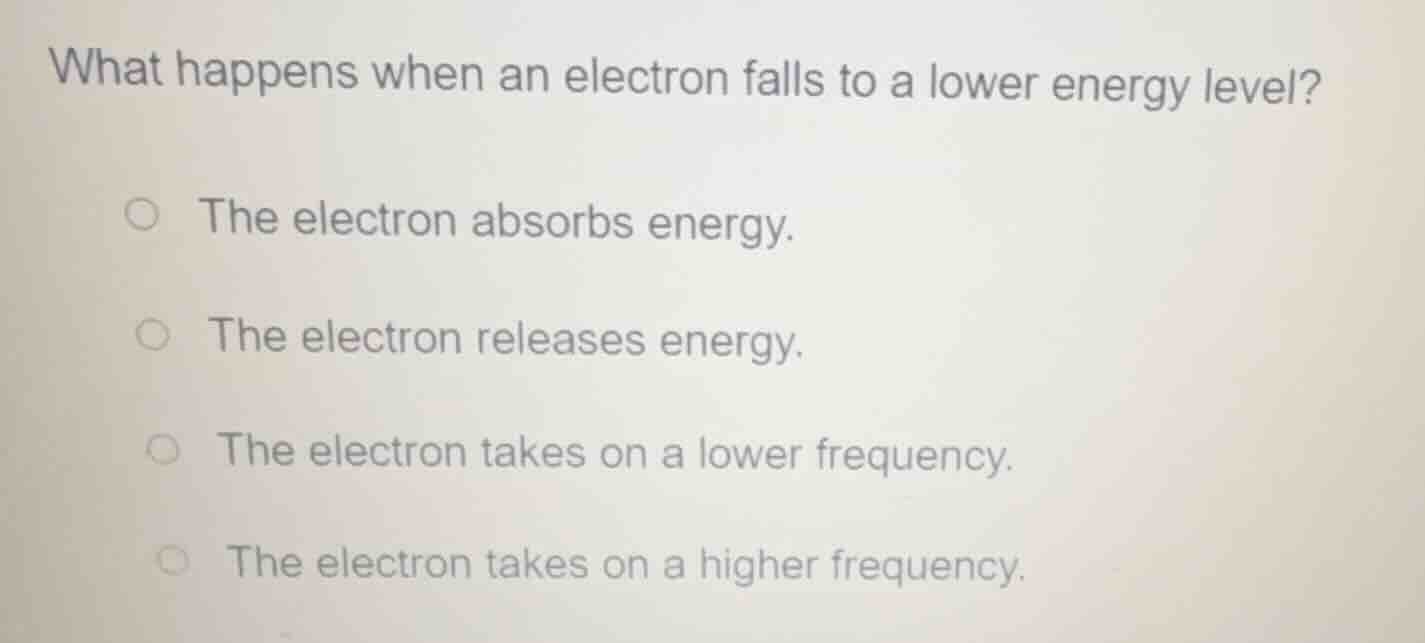
what happens when an electron falls to a lower energy level?
the electron absorbs energy.
the electron releases energy.
the electron takes on a lower frequency.
the electron takes on a higher frequency.
To determine the correct answer, we analyze the behavior of electrons in energy levels:
- When an electron moves to a lower energy level, it loses energy. This energy is released, often in the form of a photon.
- Absorbing energy (first option) occurs when an electron moves to a higher energy level.
- Frequency is related to the energy of the photon (via \( E = h
u \), where \( E \) is energy, \( h \) is Planck’s constant, and \(
u \) is frequency), but the electron itself doesn’t “take on” a frequency in this context. The third and fourth options are incorrect as they misdescribe the electron’s behavior.
Thus, the electron releases energy when falling to a lower energy level.

Snap & solve any problem in the app
Get step-by-step solutions on Sovi AI
Photo-based solutions with guided steps
Explore more problems and detailed explanations
B. The electron releases energy.