QUESTION IMAGE
Question
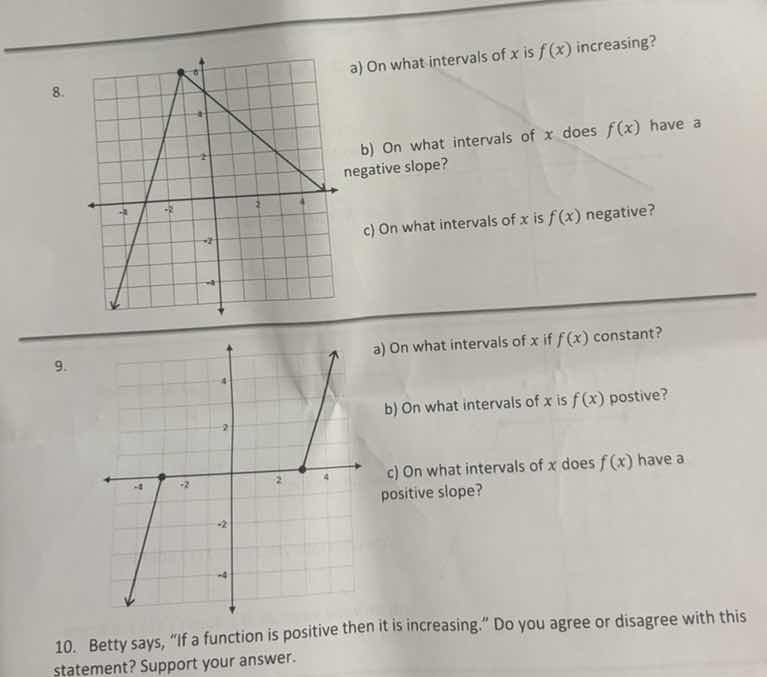
- a) on what intervals of x is $f(x)$ increasing?
b) on what intervals of x does $f(x)$ have a negative slope?
c) on what intervals of x is $f(x)$ negative?
- a) on what intervals of x if $f(x)$ constant?
b) on what intervals of x is $f(x)$ positive?
c) on what intervals of x does $f(x)$ have a positive slope?
- betty says, \if a function is positive then it is increasing.\ do you agree or disagree with this statement? support your answer.
Problem 8
Step1: Identify increasing interval
A function increases when it rises left to right.
From the graph, $f(x)$ rises for $x < -1$.
Step2: Identify negative slope interval
Negative slope means function falls left to right.
From the graph, $f(x)$ falls for $x > -1$.
Step3: Identify negative $f(x)$ interval
$f(x)$ is negative when below the x-axis.
From the graph, $f(x) < 0$ for $x < -3$.
Step1: Identify constant interval
Constant function is horizontal on graph.
From the graph, $f(x)$ is constant for $-3 < x < 3$.
Step2: Identify positive $f(x)$ interval
$f(x)$ is positive when above the x-axis.
From the graph, $f(x) > 0$ for $x > 3$.
Step3: Identify positive slope interval
Positive slope means function rises left to right.
From the graph, $f(x)$ rises for $x < -3$ and $x > 3$.
A function being positive (its output values are above the x-axis) does not guarantee it is increasing (rising from left to right). For example, a decreasing function like $f(x) = -x + 5$ is positive for $x < 5$, but it slopes downward (decreasing) across this entire interval. This contradicts Betty's statement.

Snap & solve any problem in the app
Get step-by-step solutions on Sovi AI
Photo-based solutions with guided steps
Explore more problems and detailed explanations
a) $(-\infty, -1)$
b) $(-1, \infty)$
c) $(-\infty, -3)$
---