QUESTION IMAGE
Question
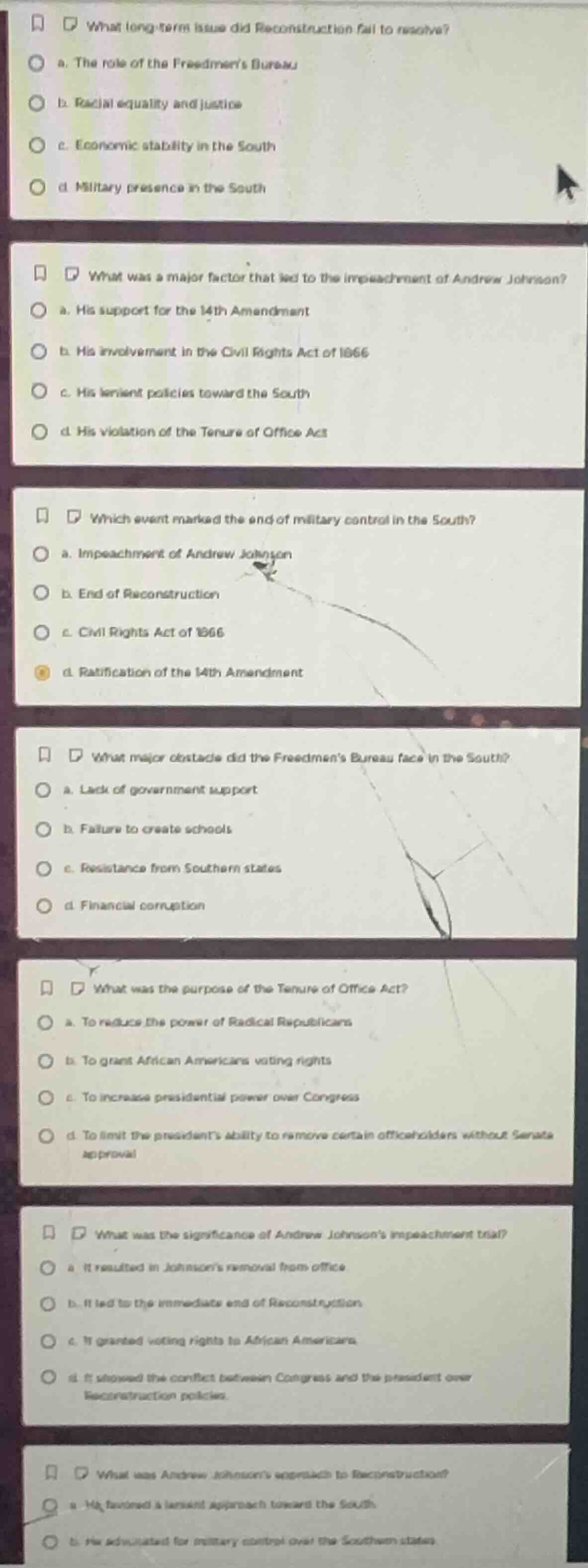
- what long - term issue did reconstruction fail to resolve?
a. the role of the freedmen’s bureau
b. racial equality and justice
c. economic stability in the south
d. military presence in the south
- what was a major factor that led to the impeachment of andrew johnson?
a. his support for the 14th amendment
b. his involvement in the civil rights act of 1866
c. his lenient policies toward the south
d. his violation of the tenure of office act
- which event marked the end of military control in the south?
a. impeachment of andrew johnson
b. end of reconstruction
c. civil rights act of 1866
d. ratification of the 14th amendment
- what major obstacle did the freedmen’s bureau face in the south?
a. lack of government support
b. failure to create schools
c. resistance from southern states
d. financial corruption
- what was the purpose of the tenure of office act?
a. to reduce the power of radical republicans
b. to grant african americans voting rights
c. to increase presidential power over congress
d. to limit the president’s ability to remove certain officeholders without senate approval
- what was the significance of andrew johnson’s impeachment trial?
a. it resulted in johnson’s removal from office
b. it led to the immediate end of reconstruction
c. it granted voting rights to african americans
d. it showed the conflict between congress and the president over reconstruction policies
- what was andrew johnson’s approach to reconstruction?
a. he favored a lenient approach toward the south.
b. he advocated for military control over the southern states
- Reconstruction ended without addressing systemic racial inequities, leaving racial equality unachieved long-term.
- Andrew Johnson was impeached primarily for violating the Tenure of Office Act by removing a cabinet member without Senate approval.
- The end of Reconstruction (1877) brought the withdrawal of federal military forces from the South, ending military control.
- Southern white leaders and state governments actively resisted the Freedmen's Bureau's efforts to aid formerly enslaved people.
- The Tenure of Office Act was passed to restrict presidential power by requiring Senate approval for removing certain federal officials.
- Johnson's impeachment trial highlighted the intense conflict between the executive branch and Radical Republicans in Congress over Reconstruction policies; he was not removed from office.
- Andrew Johnson favored lenient policies that allowed Southern states to rejoin the Union quickly with minimal protections for Black Americans.

Snap & solve any problem in the app
Get step-by-step solutions on Sovi AI
Photo-based solutions with guided steps
Explore more problems and detailed explanations
- b. Racial equality and justice
- d. His violation of the Tenure of Office Act
- b. End of Reconstruction
- c. Resistance from Southern states
- d. To limit the president's ability to remove certain officeholders without Senate approval
- d. It showed the conflict between Congress and the president over Reconstruction policies.
- a. He favored a lenient approach toward the South