QUESTION IMAGE
Question
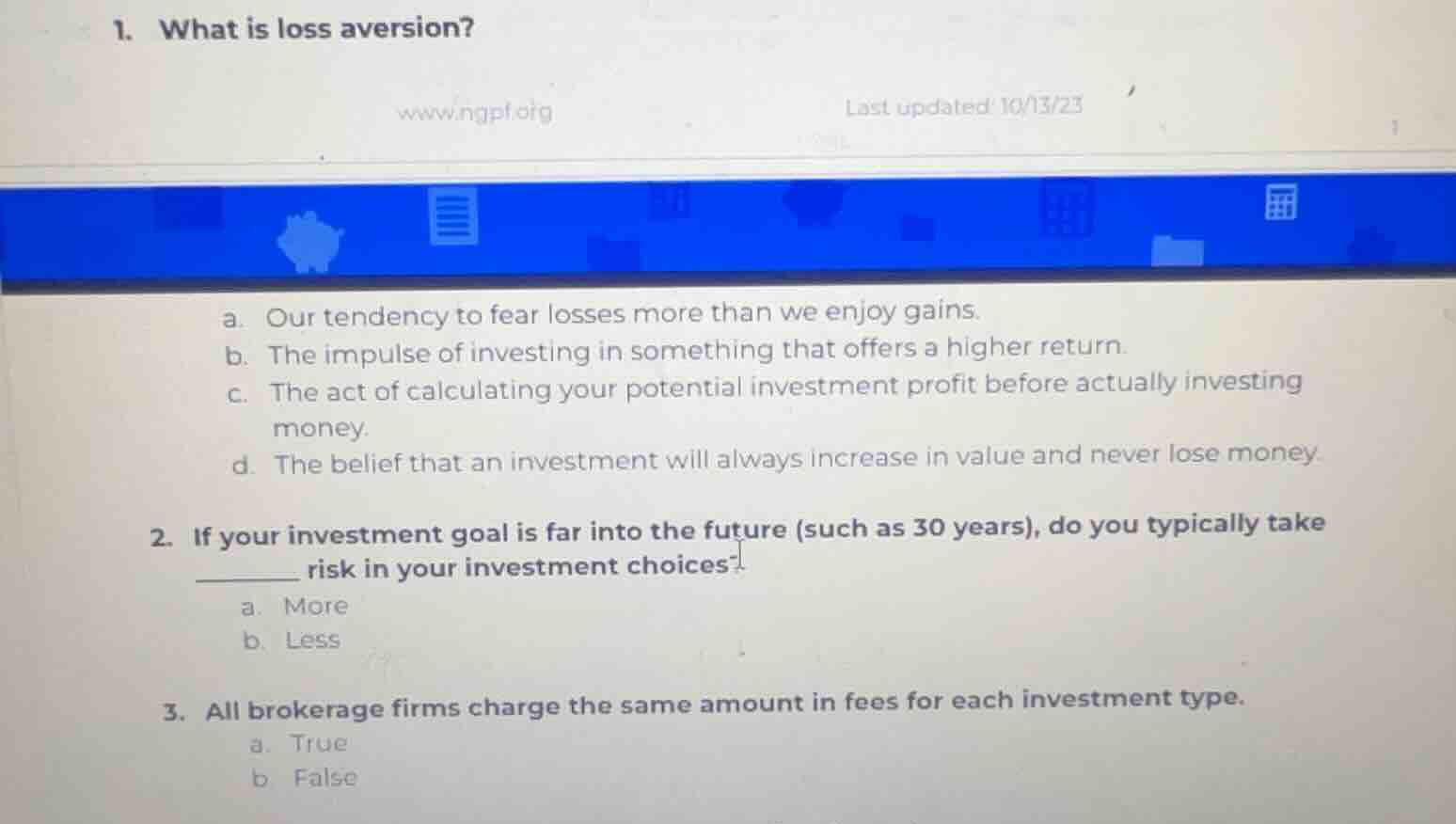
- what is loss aversion?
a. our tendency to fear losses more than we enjoy gains.
b. the impulse of investing in something that offers a higher return.
c. the act of calculating your potential investment profit before actually investing money.
d. the belief that an investment will always increase in value and never lose money.
- if your investment goal is far into the future (such as 30 years), do you typically take ______ risk in your investment choices?
a. more
b. less
- all brokerage firms charge the same amount in fees for each investment type.
a. true
b. false
Question 1
To determine the answer for "What is loss aversion?", we analyze each option:
- Option a: Loss aversion is a psychological and economic concept where people feel the pain of loss more intensely than the pleasure of gain. This matches the definition.
- Option b: Investing for higher return is about risk - return trade - off, not loss aversion.
- Option c: Calculating potential profit is related to investment analysis, not loss aversion.
- Option d: Believing an investment never loses value is overconfidence or a wrong perception, not loss aversion.
When the investment goal is far in the future (e.g., 30 years), there is more time to recover from potential losses. So, investors typically take more risk as they can afford to invest in assets with higher growth potential (and higher risk) because the long - term horizon allows them to ride out market fluctuations.
Brokerage firms have different fee structures. They may charge different amounts for the same investment type based on factors like their business model, services offered, and competition. So, not all brokerage firms charge the same fees for each investment type.

Snap & solve any problem in the app
Get step-by-step solutions on Sovi AI
Photo-based solutions with guided steps
Explore more problems and detailed explanations
a. Our tendency to fear losses more than we enjoy gains.