QUESTION IMAGE
Question
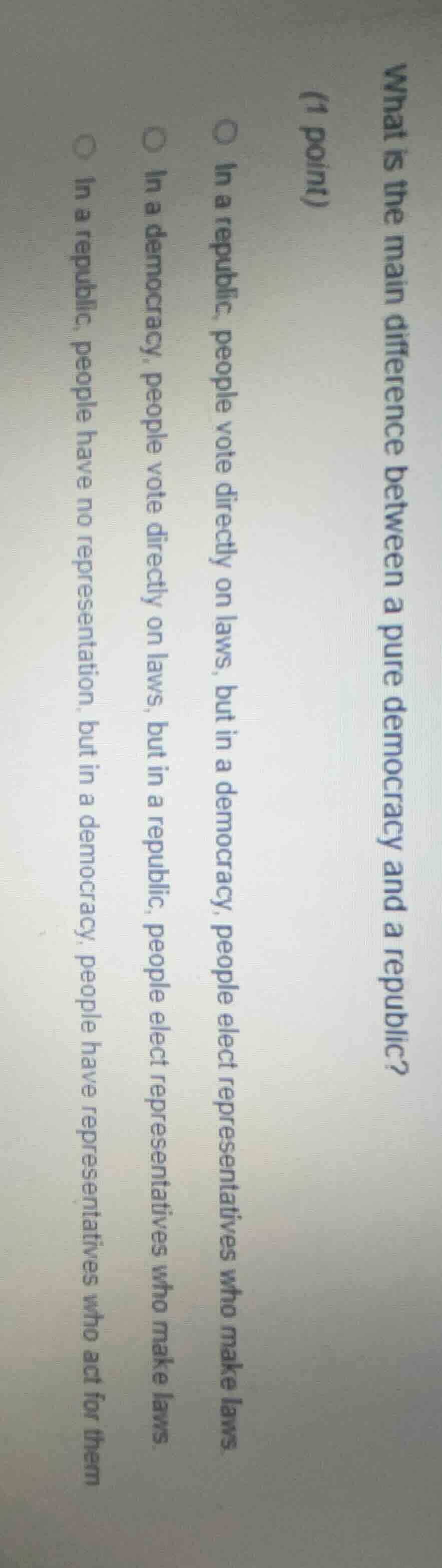
what is the main difference between a pure democracy and a republic? (1 point) in a republic, people vote directly on laws, but in a democracy, people elect representatives who make laws. in a democracy, people vote directly on laws, but in a republic, people elect representatives who make laws. in a republic, people have no representation, but in a democracy, people have representatives who act for them
To determine the correct answer, we analyze the definitions of pure democracy and republic:
- In a pure democracy, citizens vote directly on laws and policies.
- In a republic, citizens elect representatives who then make laws and decisions on their behalf.
Now we evaluate the options:
- Option 1: Incorrectly swaps the roles (says republic has direct voting and democracy has representatives).
- Option 2: Correctly states that in democracy, people vote directly on laws, and in a republic, people elect representatives to make laws.
- Option 3: Incorrect, as both democracies (depending on type) and republics can have representation, and the statement about republic having no representation is wrong.

Snap & solve any problem in the app
Get step-by-step solutions on Sovi AI
Photo-based solutions with guided steps
Explore more problems and detailed explanations
B. In a democracy, people vote directly on laws, but in a republic, people elect representatives who make laws. (Note: Assuming the middle option is labeled B as per typical multiple - choice formatting where the first is A, middle B, last C. If the original options had different labels, adjust accordingly based on the visual. From the text, the middle option is "In a democracy, people vote directly on laws, but in a republic, people elect representatives who make laws.")