QUESTION IMAGE
Question
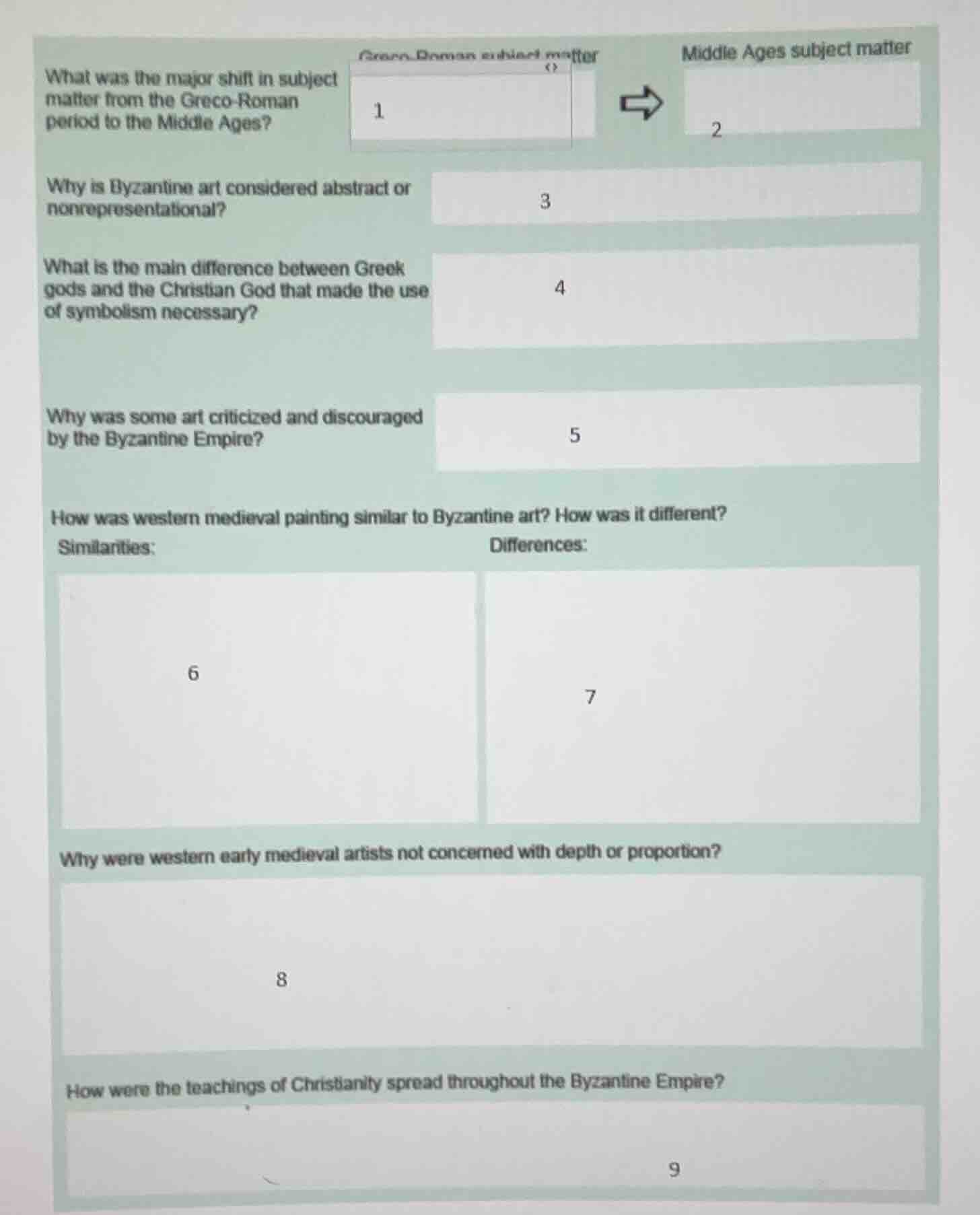
what was the major shift in subject matter from the greco-roman period to the middle ages?greco-roman subject matter1middle ages subject matter2why is byzantine art considered abstract or nonrepresentational?3what is the main difference between greek gods and the christian god that made the use of symbolism necessary?4why was some art criticized and discouraged by the byzantine empire?5how was western medieval painting similar to byzantine art? how was it different?similarities:6differences:7why were western early medieval artists not concerned with depth or proportion?8how were the teachings of christianity spread throughout the byzantine empire?9
- For the subject matter shift: Greco-Roman art focused on pagan myths, humanism, and secular themes; Medieval art centered almost entirely on Christian religious subjects (biblical scenes, saints, God).
- Byzantine art is abstract/nonrepresentational because it prioritizes spiritual meaning over realistic depiction—figures and scenes are stylized to convey divine truth, not natural appearance.
- Greek gods had human-like forms and behaviors, while the Christian God is an invisible, transcendent being that cannot be depicted realistically, so symbolism was needed to represent the divine.
- Some art was discouraged by the Byzantine Empire due to iconoclasm: periods where religious images (icons) were seen as idolatry, so their creation and display were banned.
- Similarities (Western medieval and Byzantine art): Both focused heavily on Christian religious subject matter, used symbolic imagery, and served to teach religious doctrine to illiterate populations.
- Differences (Western medieval and Byzantine art): Western medieval art was often more rustic, less technically refined, and varied more by region; Byzantine art had a more standardized, formal, stylized aesthetic with rich, gold-leaf backgrounds, and was centered on the imperial court's artistic traditions.
- Western early medieval artists ignored depth/proportion because their goal was not naturalism—they prioritized conveying religious symbolism and spiritual importance over realistic human or spatial representation.
- Christianity spread in the Byzantine Empire through state support (emperors made it the official religion), the work of missionaries, religious art and architecture that taught doctrine, and the integration of Christian teachings into daily life and legal systems.

Snap & solve any problem in the app
Get step-by-step solutions on Sovi AI
Photo-based solutions with guided steps
Explore more problems and detailed explanations
- Greco-Roman subject matter (1): Pagan myths, humanism, secular themes
Middle Ages subject matter (2): Christian religious themes (biblical scenes, saints)
- (3) Prioritizes spiritual meaning over realism
- (4) Christian God is transcendent/invisible; Greek gods had human forms
- (5) Iconoclasm: fear of idolatry from religious images
- (6) Similarities: Focus on Christian themes, use symbolism, teach doctrine
(7) Differences: Western art was rustic/regional; Byzantine art was formal/standardized with gold backgrounds
- (8) Prioritized symbolism over naturalism
- (9) State support, missionaries, religious art, integration into daily life