QUESTION IMAGE
Question
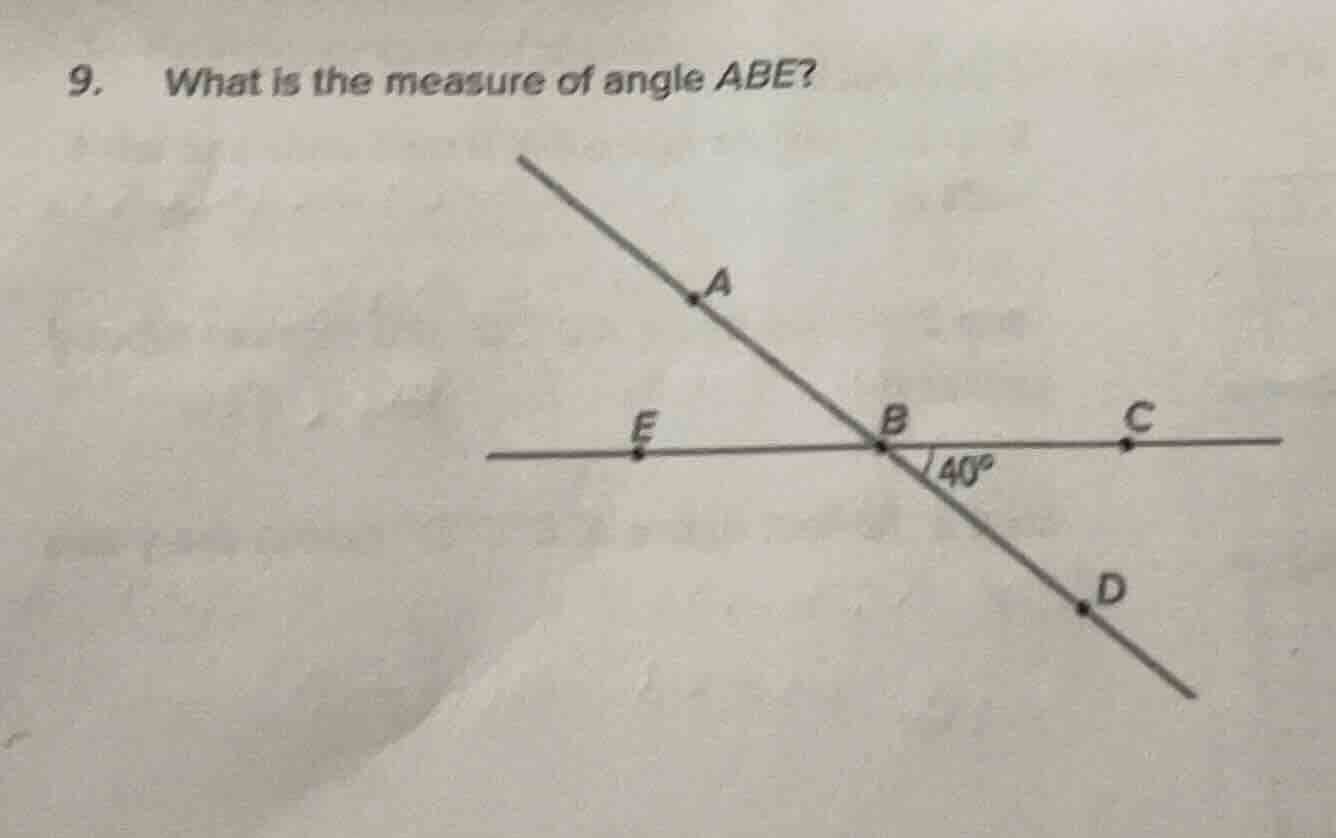
- what is the measure of angle abe?
Step1: Identify angle relationship
Angles on a straight line sum to \(180^\circ\), and vertical angles are equal. Also, angle \(ABE\) and the \(40^\circ\) angle? Wait, no, angle \(ABE\) and angle \(CBD\)? Wait, actually, angle \(ABE\) and the angle adjacent to \(40^\circ\) (vertical or supplementary? Wait, line \(EC\) is straight, and line \(AD\) intersects it at \(B\). The angle between \(BC\) and \(BD\) is \(40^\circ\), so angle \(ABC\) and angle \(ABD\)? Wait, no, let's see: line \(EC\) is a straight line, so angle \(EBC\) is \(180^\circ\). But angle \(ABE\) and angle \(CBD\) – wait, angle \(ABE\) and the \(40^\circ\) angle: are they vertical angles? Wait, no, angle \(ABE\) and angle \(CBD\) – wait, the angle between \(BC\) and \(BD\) is \(40^\circ\), so angle \(ABE\) is equal to angle \(CBD\)? Wait, no, angle \(ABE\) and angle \(DBC\) – wait, maybe I'm overcomplicating. Let's see: line \(AD\) and line \(EC\) intersect at \(B\). So angle \(ABE\) and angle \(CBD\) are vertical angles? Wait, no, angle \(ABE\) and angle \(DBC\) – wait, the angle given is \(40^\circ\) between \(BC\) and \(BD\), so angle \(DBC = 40^\circ\). Then angle \(ABE\) is equal to angle \(DBC\) because they are vertical angles? Wait, no, vertical angles are opposite each other. Wait, angle \(ABE\) and angle \(DBC\) – let's draw this mentally: point \(B\), with line \(EC\) horizontal (E---B---C), and line \(AD\) crossing it (A---B---D). The angle between \(BC\) and \(BD\) is \(40^\circ\), so angle \(CBD = 40^\circ\). Then angle \(ABE\) is equal to angle \(CBD\) because they are vertical angles? Wait, no, vertical angles are angle \(ABC\) and angle \(EBD\), or angle \(ABE\) and angle \(DBC\). Yes, angle \(ABE\) and angle \(DBC\) are vertical angles, so they should be equal. Wait, but that would be \(40^\circ\)? No, wait, maybe I got the lines wrong. Wait, line \(EC\) is horizontal, so E is left of B, C is right of B. Line \(AD\) is going from A (top left) to D (bottom right), passing through B. The angle between \(BC\) (right of B) and \(BD\) (bottom right) is \(40^\circ\), so angle \(DBC = 40^\circ\). Then angle \(ABE\) is at the top left: between A (top left) and B, and E (left of B). So angle \(ABE\) and angle \(DBC\) – are they vertical angles? Yes, because when two lines intersect, vertical angles are equal. So angle \(ABE = angle DBC = 40^\circ\)? Wait, no, that can't be. Wait, maybe angle \(ABE\) and angle \(ABC\) are supplementary? Wait, no, line \(EC\) is straight, so angle \(EBC = 180^\circ\). Angle \(ABC\) is \(180^\circ - 40^\circ = 140^\circ\)? No, wait, the angle between \(BC\) and \(BD\) is \(40^\circ\), so angle \(ABD\) is \(180^\circ - 40^\circ = 140^\circ\)? No, I'm confused. Wait, let's start over.
Two lines intersect: \(AD\) and \(EC\) intersect at \(B\). So the vertical angles are: angle \(ABE\) and angle \(DBC\), angle \(ABC\) and angle \(EBD\). The angle given is \(40^\circ\) for angle \(DBC\) (between \(BC\) and \(BD\)). Therefore, angle \(ABE\) is equal to angle \(DBC\) because they are vertical angles. So angle \(ABE = 40^\circ\)? Wait, but that seems too small. Wait, maybe the angle is \(140^\circ\). Wait, no, let's check the straight line. Line \(EC\) is straight, so angle \(EBC = 180^\circ\). Angle \(ABC\) is adjacent to the \(40^\circ\) angle, so angle \(ABC = 180^\circ - 40^\circ = 140^\circ\). Then angle \(ABE\) and angle \(ABC\) – wait, no, angle \(ABE\) is part of angle \(EBC\)? No, E---B---C is a straight line, so angle \(EBC = 180^\circ\). Angle \(ABE\) is at E---B---A, and angle \(ABC\) is at A---B---C. Wait, maybe I mixed…

Snap & solve any problem in the app
Get step-by-step solutions on Sovi AI
Photo-based solutions with guided steps
Explore more problems and detailed explanations
\(40^\circ\)