QUESTION IMAGE
Question
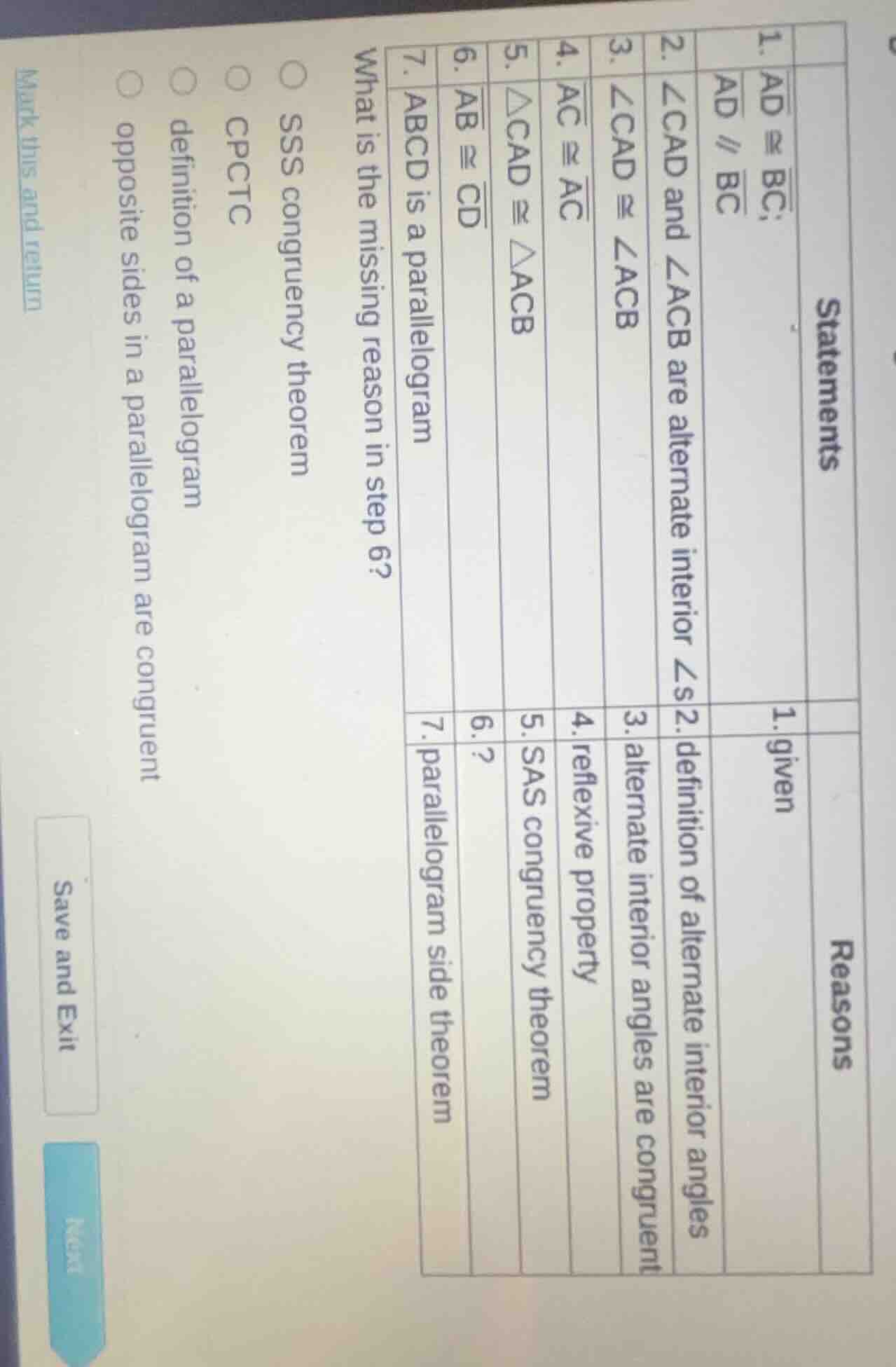
what is the missing reason in step 6?
statements
- $overline{ad} \cong \overline{bc}$; $\overline{ad} \parallel \overline{bc}$
- $\angle cad$ and $\angle acb$ are alternate interior $\angle$s
- $\angle cad \cong \angle acb$
- $\overline{ac} \cong \overline{ac}$
- $\triangle cad \cong \triangle acb$
- $overline{ab} \cong \overline{cd}$
- $abcd$ is a parallelogram
reasons
- given
- definition of alternate interior angles
- alternate interior angles are congruent
- reflexive property
- sas congruency theorem
6.?
- parallelogram side theorem
options:
sss congruency theorem
cpctc
definition of a parallelogram
opposite sides in a parallelogram are congruent
Brief Explanations
Step 5 proves that $\triangle CAD \cong \triangle ACB$ using SAS congruence. Step 6 states $\overline{AB} \cong \overline{CD}$, which is a corresponding part of these two congruent triangles. CPCTC (Corresponding Parts of Congruent Triangles are Congruent) is the rule that justifies this conclusion.

Snap & solve any problem in the app
Get step-by-step solutions on Sovi AI
Photo-based solutions with guided steps
Explore more problems and detailed explanations
CPCTC