QUESTION IMAGE
Question
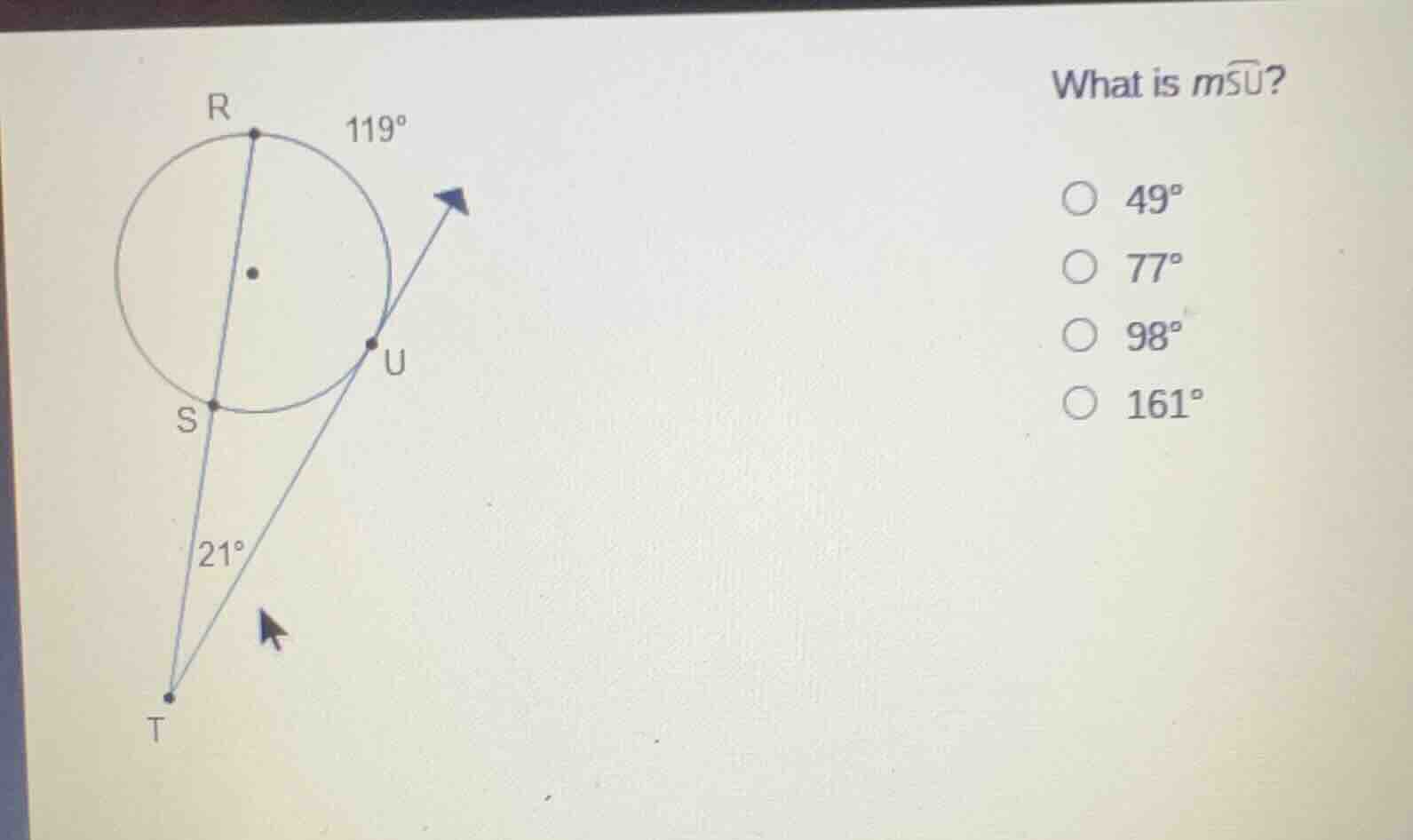
what is ( moverarc{su} )?
a circle with center (represented by a dot) and a diameter ( rs ) (with ( r ) and ( s ) on the circle). there is a point ( u ) on the circle, and a point ( t ) outside the circle. from ( t ), two lines are drawn: one to ( s ) and one to ( u ), forming an angle of ( 21^circ ) at ( t ). the arc ( ru ) is labeled ( 119^circ ).
options: ( 49^circ ), ( 77^circ ), ( 98^circ ), ( 161^circ )
Step1: Recall the formula for the measure of an angle formed by a tangent and a secant.
The formula is \( m\angle T=\frac{1}{2}(m\widehat{RU}-m\widehat{SU}) \), where \( \angle T \) is the angle formed outside the circle, \( \widehat{RU} \) is the major arc, and \( \widehat{SU} \) is the minor arc we want to find. We know \( m\angle T = 21^\circ \) and \( m\widehat{RU}=119^\circ \). Let \( x = m\widehat{SU} \).
Step2: Substitute the known values into the formula.
Substitute into \( 21^\circ=\frac{1}{2}(119^\circ - x) \). First, multiply both sides by 2: \( 2\times21^\circ=119^\circ - x \), so \( 42^\circ = 119^\circ - x \).
Step3: Solve for \( x \).
Rearrange the equation: \( x = 119^\circ - 42^\circ \), so \( x = 77^\circ \). Wait, no, wait. Wait, actually, the major arc and minor arc: Wait, maybe I mixed up. Wait, the angle outside is half the difference of the intercepted arcs. Wait, the tangent and secant: the measure of the angle is half the difference of the measures of the intercepted arcs (the larger arc minus the smaller arc). Wait, but \( \widehat{RU} \) is 119°, but maybe the straight line is a diameter? Wait, \( R \) and \( S \) are on a diameter? Wait, \( RS \) is a diameter, so \( m\widehat{RS}=180^\circ \). Wait, maybe I made a mistake. Let's re - examine.
Wait, \( RS \) is a diameter, so the arc \( RS \) is \( 180^\circ \). The arc \( RU \) is \( 119^\circ \), so the arc \( SU \): Wait, no, let's use the correct formula. The angle formed by a tangent and a secant outside the circle is equal to half the difference of the measures of the intercepted arcs. The formula is \( m\angle T=\frac{1}{2}(m\widehat{RU}-m\widehat{SU}) \). Wait, but if \( RS \) is a diameter, then \( m\widehat{RS} = 180^\circ \), and \( m\widehat{RU}=119^\circ \), so \( m\widehat{SU}=m\widehat{RS}+m\widehat{SU} \)? No, that's not right. Wait, maybe the arc \( RU \) is 119°, and the angle at \( T \) is 21°, so let's do it again.
Let me correct: The measure of an angle formed by a tangent and a secant drawn from a point outside the circle is equal to half the difference of the measures of the intercepted arcs. The two intercepted arcs are the major arc and the minor arc. Let the measure of arc \( SU \) be \( x \), and the measure of arc \( RU \) is 119°, but wait, actually, the other arc (the one opposite to \( SU \) with respect to the angle) would be the arc from \( S \) to \( R \) to \( U \)? No, wait, the secant goes through \( S \) and \( R \), and the tangent is at \( U \). So the intercepted arcs are \( \widehat{RU} \) (the arc between \( R \) and \( U \)) and \( \widehat{SU} \) (the arc between \( S \) and \( U \)). Wait, but if \( RS \) is a diameter, then \( m\widehat{RS}=180^\circ \), so \( m\widehat{RU}+m\widehat{SU}+m\widehat{SR} \)? No, \( R \), \( S \) are on a diameter, so \( \widehat{RS}=180^\circ \). Wait, maybe the arc \( RU \) is 119°, and the angle at \( T \) is 21°, so using the formula \( m\angle T=\frac{1}{2}(m\widehat{RU}-m\widehat{SU}) \). Wait, but if \( RS \) is a diameter, then \( m\widehat{RS}=180^\circ \), so \( m\widehat{RU}=119^\circ \), then \( m\widehat{SU}=m\widehat{RS}+m\widehat{SU} \)? No, I think I messed up. Wait, let's start over.
The angle outside the circle (at \( T \)) is 21°, formed by tangent \( TU \) and secant \( TS \) (which passes through \( S \) and \( R \)). The formula for the measure of an angle formed by a tangent and a secant is \( m\angle T=\frac{1}{2}(m\widehat{RU}-m\widehat{SU}) \), where \( \widehat{RU} \) is the major arc and \( \widehat{SU} \) is the minor arc. Wait, but we know…

Snap & solve any problem in the app
Get step-by-step solutions on Sovi AI
Photo-based solutions with guided steps
Explore more problems and detailed explanations
\( 77^\circ \) (corresponding to the option with \( 77^\circ \))