QUESTION IMAGE
Question
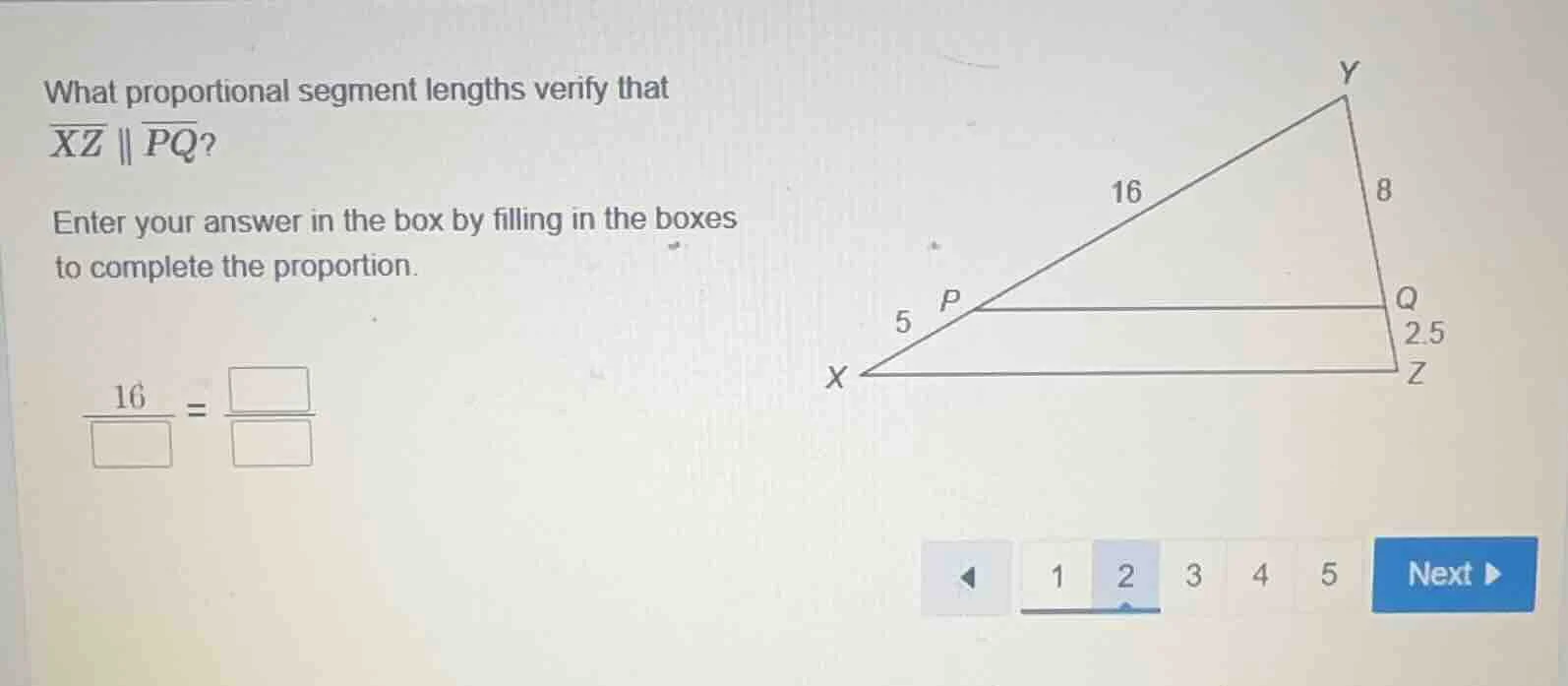
what proportional segment lengths verify that \\(\overline{xz} \parallel \overline{pq}\\)?
enter your answer in the box by filling in the boxes to complete the proportion.
\\(\frac{16}{\square} = \frac{\square}{\square}\\)
Step1: Identify the segments
We know that by the Basic Proportionality Theorem (Thales' theorem), if a line is drawn parallel to one side of a triangle, it divides the other two sides proportionally. Here, \( \overline{PQ} \parallel \overline{XZ} \), so the ratio of the segments on one side should be equal to the ratio on the other side.
The length of \( YP \) is 16? Wait, no. Wait, the length from \( X \) to \( P \) is 5, and from \( P \) to \( Y \) is 16? Wait, no, looking at the diagram: \( XP = 5 \), \( PY = 16 \)? Wait, no, the side \( XY \): \( XP = 5 \), \( PY = 16 \)? Wait, no, the length of \( XY \) is \( XP + PY = 5 + 16 = 21 \)? Wait, no, maybe I misread. Wait, the other side: \( YQ = 8 \), \( QZ = 2.5 \), so \( YZ = YQ + QZ = 8 + 2.5 = 10.5 \). Wait, no, the theorem is that \( \frac{YP}{XP}=\frac{YQ}{QZ} \)? Wait, no, let's check the segments.
Wait, the triangle is \( \triangle XYZ \), with \( P \) on \( XY \) and \( Q \) on \( YZ \), and \( PQ \parallel XZ \). So by Thales' theorem, \( \frac{YP}{XP}=\frac{YQ}{QZ} \). Wait, \( YP \) is 16? Wait, \( XP = 5 \), \( PY = 16 \)? Wait, no, the length of \( XY \): \( X \) to \( P \) is 5, \( P \) to \( Y \) is 16? Wait, that would make \( XY = 5 + 16 = 21 \). On the other side, \( YZ \): \( Y \) to \( Q \) is 8, \( Q \) to \( Z \) is 2.5, so \( YZ = 8 + 2.5 = 10.5 \). Wait, but \( \frac{YP}{XP}=\frac{16}{5} \), and \( \frac{YQ}{QZ}=\frac{8}{2.5} \). Wait, let's calculate \( \frac{8}{2.5} = 3.2 \), and \( \frac{16}{5} = 3.2 \). Wait, but the given proportion is \( \frac{16}{\square}=\frac{\square}{\square} \). Wait, maybe \( YP = 16 \), \( XP = 5 \), \( YQ = 8 \), \( QZ = 2.5 \). Wait, no, the first fraction is \( \frac{16}{\square} \), so the numerator is 16, which is \( PY \), so the denominator should be \( XP = 5 \)? Wait, no, wait: \( \frac{PY}{XP}=\frac{YQ}{QZ} \). So \( PY = 16 \), \( XP = 5 \), \( YQ = 8 \), \( QZ = 2.5 \). Wait, but \( \frac{16}{5}=\frac{8}{2.5} \)? Let's check: \( 16 \times 2.5 = 40 \), \( 5 \times 8 = 40 \). Yes, that works. So the proportion is \( \frac{16}{5}=\frac{8}{2.5} \).
Step2: Fill in the boxes
So the first fraction is \( \frac{16}{5} \), and the second fraction is \( \frac{8}{2.5} \).

Snap & solve any problem in the app
Get step-by-step solutions on Sovi AI
Photo-based solutions with guided steps
Explore more problems and detailed explanations
\( \frac{16}{5} = \frac{8}{2.5} \)