QUESTION IMAGE
Question
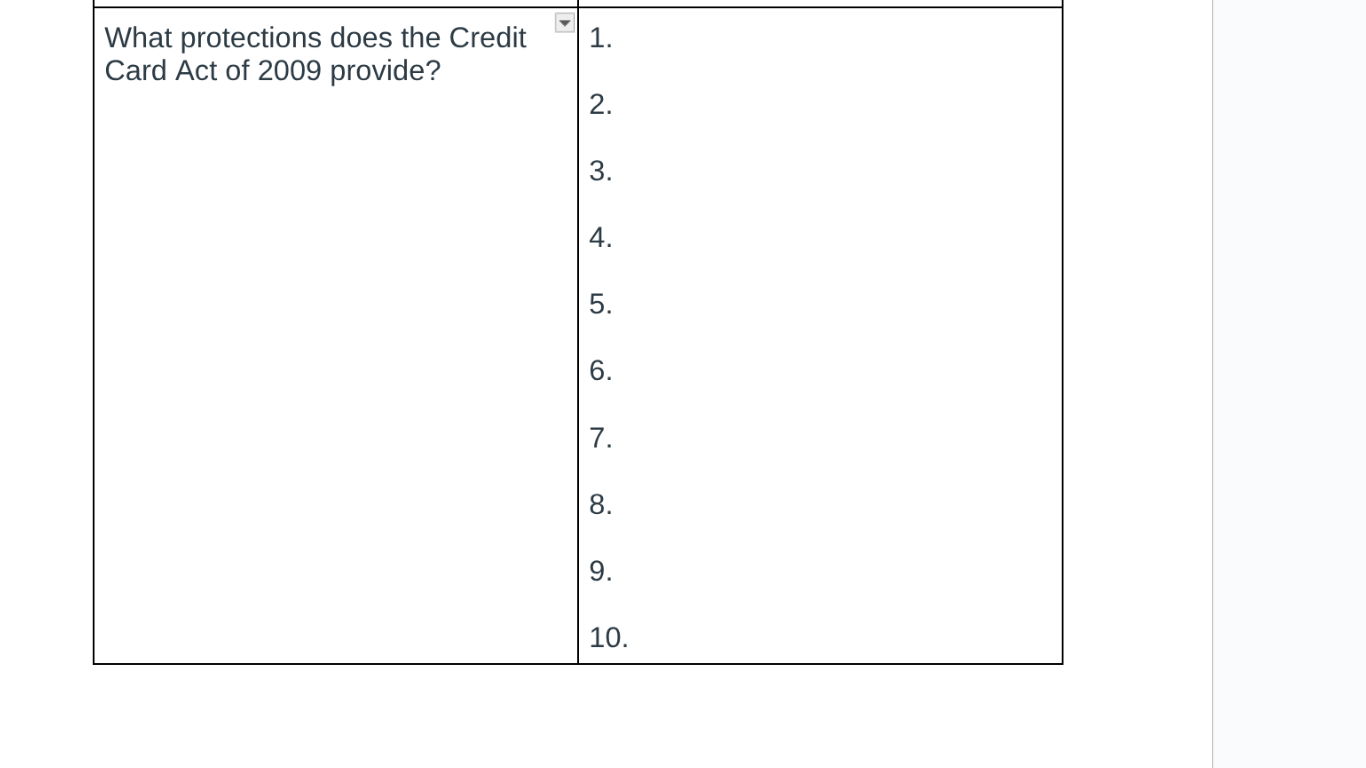
what protections does the credit card act of 2009 provide?
Brief Explanations
The Credit Card Act of 2009 (also known as the Credit CARD Act) provides several consumer protections:
- Young Consumers: Prohibits issuing credit cards to those under 21 unless they have a co - signer (with income) or can prove independent ability to pay.
- Interest Rate Increases: Limits rate hikes on existing balances (except for specific reasons like missed payments for over 60 days, expiration of promotional rates, or significant changes in credit risk).
- Fees and Charges: Caps over - the - limit fees (unless cardholder opts - in), restricts late fees (must be reasonable and proportional), and limits other fees.
- Billing Statements: Requires statements to be sent at least 21 days before payment due date, and provides clear information on payment allocation (e.g., how much goes to principal/interest).
- Payment Timing: Sets rules for due dates (e.g., same day of week, no penalty for weekends/holidays), and allows payments at any branch or online without extra fees.
- Over - Limit Transactions: Cardholders must opt - in to allow transactions that exceed credit limits (otherwise, transactions are declined, and no over - limit fees are charged).
- Grace Periods: Requires a 25 - day grace period for purchases (no interest if balance is paid in full by due date), and standardizes grace period rules.
- Promotional Rates: Requires clear disclosure of promotional rate terms (e.g., duration, how rate changes after promotion), and limits retroactive rate increases on promotional balances.
- Credit Card Marketing to Students: Restricts credit card marketing on college campuses (e.g., no freebies to entice students), and limits marketing near schools.
- Account Closure and Reductions: Requires notice before closing an account or reducing credit limits (except for specific risk - related reasons), and provides reasons for such actions.

Snap & solve any problem in the app
Get step-by-step solutions on Sovi AI
Photo-based solutions with guided steps
Explore more problems and detailed explanations
- Prohibits issuing credit cards to those under 21 without a co - signer (with income) or proof of independent ability to pay.
- Limits rate hikes on existing balances (except for specific valid reasons).
- Caps over - the - limit fees (unless cardholder opts - in), restricts late fees.
- Requires statements to be sent at least 21 days before payment due date.
- Sets rules for payment due dates (e.g., same day of week, no weekend/holiday penalties).
- Cardholders must opt - in to allow over - limit transactions (else declined, no over - limit fees).
- Requires a 25 - day grace period for purchases (no interest if balance paid in full).
- Requires clear disclosure of promotional rate terms, limits retroactive rate increases on promotional balances.
- Restricts credit card marketing on college campuses (e.g., no freebies to entice students).
- Requires notice before closing an account or reducing credit limits (except for specific risk - related reasons).