QUESTION IMAGE
Question
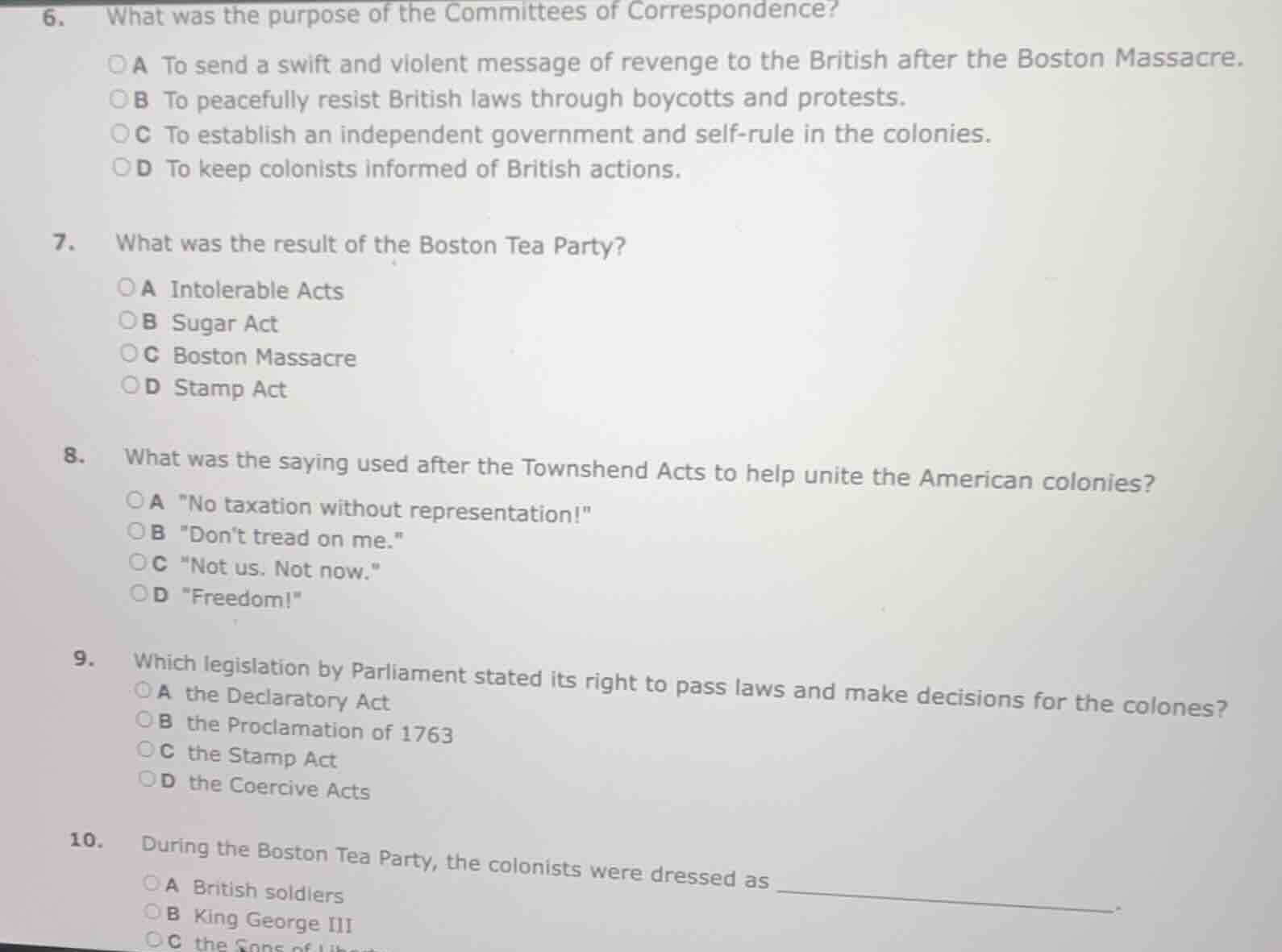
- what was the purpose of the committees of correspondence?
a to send a swift and violent message of revenge to the british after the boston massacre.
b to peacefully resist british laws through boycotts and protests.
c to establish an independent government and self - rule in the colonies.
d to keep colonists informed of british actions.
- what was the result of the boston tea party?
a intolerable acts
b sugar act
c boston massacre
d stamp act
- what was the saying used after the townshend acts to help unite the american colonies?
a
o taxation without representation!\
b \dont tread on me.\
c
ot us. not now.\
d \freedom!\
- which legislation by parliament stated its right to pass laws and make decisions for the colones?
a the declaratory act
b the proclamation of 1763
c the stamp act
d the coercive acts
- during the boston tea party, the colonists were dressed as
a british soldiers
b king george iii
c the sons of liberty
Brief Explanations
- The Committees of Correspondence were created to share information between colonies about British policies and actions to coordinate responses.
- The Boston Tea Party led Parliament to pass harsh punitive laws called the Intolerable (Coercive) Acts to punish Massachusetts.
- The Townshend Acts imposed new taxes on the colonies without colonial representation in Parliament, so the unifying slogan was "No taxation without representation!".
- The Declaratory Act explicitly stated that British Parliament had full authority to make laws binding on the colonies "in all cases whatsoever".
- (Note: Option C is cut off, but the historical fact is that colonists disguised themselves as Mohawk Indigenous people during the Boston Tea Party. Assuming the full option C is "the Mohawk Indians" or similar, it is the correct answer.)

Snap & solve any problem in the app
Get step-by-step solutions on Sovi AI
Photo-based solutions with guided steps
Explore more problems and detailed explanations
- D. To keep colonists informed of British actions.
- A. Intolerable Acts
- A. "No taxation without representation!"
- A. the Declaratory Act
- [Assuming full correct option: C. the Mohawk Indians (or equivalent Indigenous group)]